Back-to-School Nights are coming up soon in Prince George’s County Public Schools. Here are the TOP TEN REASONS we think you should attend:
This is your night to MEET TEACHERS! Most of our middle school students have at least 7 teachers per semester. This is the best night to meet them all and find out their expectations for the year. Just keep in mind that this is not a time for conferences; your time with each class will be brief.
This is also a good time to MEET ADMINISTRATORS and Support Staff throughout the night. It is always nice to put faces to the names of the people who can help you when you have questions and concerns at school.
You get to VISIT CLASSROOMS (without having to embarrass your middle schooler!). Seeing the environment can help you appreciate how the school functions every day.
Take advantage of this opportunity to MEET OTHER PARENTS. Middle School can be a challenge for all of us. It’s a great time to exchange contact information and increase your parent support network.
Attending shows your CHILD that SCHOOL MATTERS TO YOU and that you want to be involved.
Attending shows school STAFF that you want to PLAY AN ACTIVE ROLE in your child’s education.
Find out about EVENTS AND ACTIVITIES that are coming up at school, including opportunities to volunteer.
Drop off those BOX TOPS that you have been collecting all summer. Every dime counts!
Show your teachers some love by bringing in extra lined paper, pencils, whiteboard markers, or Kleenex as a CLASSROOM DONATION.
And above all, JOIN YOUR PTA, PTO, OR PTSO! Stay informed, add your support to our team of advocates, and know that your dues will support activities for our students and staff for the entire year.
When it comes to school spending, many people would agree that there is a need to increase funding for teachers, programs, and activities that have a direct influence on students. But how to achieve that is the difficult part.
To get an idea of exactly what Prince George’s County Public Schools spends and where, it is worth comparing how our school system allocates its funding versus other area school systems. Not that other systems are inherently better at how they spend money, but it is a way to benchmark and to look for ideas and opportunities.
PGCPS is the 21st largest school system in the nation (2014 data from the National Center for Education Statistics). It’s the second largest school system in Maryland and the third largest in the D.C.–Maryland–Virginia region. Montgomery County Public Schools is the largest school system Maryland and the 17th largest in the nation. Fairfax County Public Schools is the largest in the region and the 11th largest in the nation.
Because the Maryland State Department of Education requires county school systems to organize their operating budgets into standardized categories, it is relatively simple to compare how MCPS and PGCPS allocate their funds. (Adding FCPS to the comparison is more difficult because its budget does not detail spending in the same manner.) This comparison does not include the separate capital improvement budget each school system compiles annually.
–All 17 cases of employees involved in the Internal Audit compensation findings have been returned to previous pay levels and steps are being taken to review future pay increases related to change in responsibilities.
–Dr. Goldson also discussed the restructuring of the Area Office Structure for better leveling and monitoring. In addition, positions formerly working in the Ombudsman office will be placed in Area Offices as “Area Office Resolution Specialists” to allow more timely resolution of parent concerns.
–Principal meeting was held on Aug 8 to present updates for Administrative Procedures related to Attendance (5113) and Grading & Reporting (5121), grade change authorization and grad standards module. Additional principal meeting was held on Aug 21 to answer questions and concerns about policies. There was also a meeting specifically for Elementary/K-8 Principals to review Health & Wellness 0116 and recess procedures. Principals were directed to include the information in handbooks and review the information with staff.
–Discussed updates about curriculum documents and resources that will be available to teachers. Materials have been disseminated so that teachers will be able to begin instruction on day one.
–Discussed $3M technology upgrades; increase of the one-to-one intitiative (up to 18 schools); and automated graduation standards/grade change modules.
–Teachers: Hired 976 teachers this summer and have 55 vacancies. We have a pool of 3000 substitute teachers. Substitutes who will be filling vacant positions have been able to attend training/planning days with teachers so that they will be able to teach on the first day.
–Bus drivers: 69 vacancies with over 1000 bus drivers. Substitute drivers and doubled routes will be used to cover the vacancies. 36 drivers are currently in training with another 15 who have been recently hired.
–Nurses: Hired 19 nurses since July 1 but still have 32 vacancies. Will use contract nurses from 8 agencies to fill vacancies and schools all have emergency care plans in place.
–Administrative Leave: Human Resources and Labor Relations looked at cases of individuals who are currently on leave. Staff with minor infractions who were found not to pose threat to staff, students or the organization will be able to remain in the work location. Individuals with cases pending with Child Protective Services are not able to remain in their work locations.
Interim CEO Dr. Monica Goldson:
–Capital Improvement: https://youtu.be/lkl1Z-417J8?t=3200 Discussed projects at Tulip Grove ES (Renovation completed), Francis T. Evans ES (Pod conversion, 1 out of 3 completed. Expect completion at end of November), and Hollywood ES (Pod conversion with delays).
–District Heights ES Update: https://youtu.be/lkl1Z-417J8?t=3328 Mold reappeared in the elementary school this summer. Dr. Goldson requested external evaluation and ultimately made the decision that students will be bussed to Forestville HS for this school year so that systemic repairs can be made. $2.5M was already in the FY2019 budget to replace the air conditioning system.
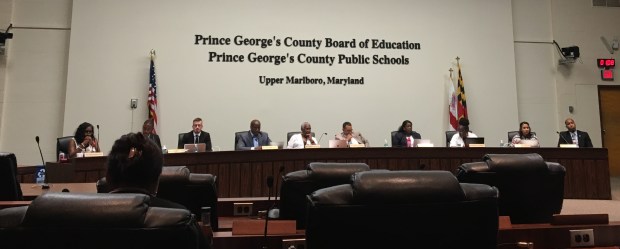
Lori Morrow presented this testimony during the public comment portion of the July 12 Prince George’s County Board of Education work meeting.
Good evening Dr. Eubanks, Board Members, Dr. Maxwell, staff and community members,
My name is Lori Morrow. I have been a PGCPS parent for 10 years and am active with the Prince George’s County Advocates for Better Schools. I chose to speak about recess tonight because it is a concern I continue to hear from parents, and it is also something principals have the ability to change for the upcoming school year if they wish.
Last summer, PGCPS updated its Health and Wellness Procedure 0116, and one of the changes was a recommendation to provide 30 minutes for elementary recess, with the minimum required time increasing from 15 to 20 minutes. This spring I submitted a Public Information Act request to find out how many schools actually met that 30-minute recommendation. The answer I received, and I quote: “Upon review, there are no records available to show school responses for compliance with the updated AP 0116 for this request.” I take that to mean the administration does not actually know.
Included in my reply was the spreadsheet of recess times by school prior to the update. It was enlightening to learn that before 2017, approximately HALF of PGCPS elementary schools had 15-minute recess. At the same time, a quarter of schools managed to provide 30 minutes. With studies that show increased recess can improve student focus and academics, why were so many principals content to do the minimum, and are they still just meeting the minimum?
We appreciate that the wellness policy was updated last year, but I would love to see the administration and the Board of Education do more to encourage all principals to provide 30-minute recess. For the parents and community members out there, don’t settle for the minimum. If you believe kids should have 30 minutes for recess, advocate for it at your school. The framework is there and the principal has the authority to make it happen. I also learned there are no MSDE or PGCPS policies prohibiting middle school principals from implementing a break or recess period. I would love to see some of them experiment with schedules that give middle school students a mental break from their hour-long classes.
Ultimately I’m disappointed because this reinforced complaints that even when the policies and procedures are in place, schools may not be following them. For example 0116 also states that “Withholding of recess as a punishment is prohibited,” but many people, including my rising 5th grader, have examples where it is used that way either for individual students or the entire class.
I recently attended the Maryland Parent Teacher Association (PTA) convention on July 14-15. It was good to connect with other Prince George’s County Public Schools and Maryland PTA leaders. And since my last convention was seven years ago, it was great to refresh myself on PTA operations. After reflecting on the weekend, here are recommendations based on my experiences as a PTA/PTO president and board member:
State your mission. This was emphasized in every convention workshop. Why are we here? What is the purpose of our organization? Whether you are a PTA or PTO (Parent Teacher Organization), your mission should be clearly stated in your bylaws or guiding document. Read it out loud at Board or Membership meetings. Type it as a header or footer on your flyers. It serves as a reminder that all actions should support that mission as well.
Read your bylaws. Reading bylaws and guiding documents should be one of the first things new board members do. Make your bylaws available for all members (and potential members) as well so that there is transparency in how the organization operates. For PTAs, bylaws must be updated and submitted to the state PTA every three years. If your bylaws state that you follow Robert’s Rules of Order, become familiar with them and use them to help conduct meetings in an efficient and orderly manner.
Publish standing rules. These are the day-to-day policies and procedures that your PTA/PTO follows that are not covered in your bylaws. Standing rules are established by the local organization or committee and do not need to be submitted to the state. Examples of standing rules could include policies for reimbursement; procedures to follow in planning events; procedures about maintaining binders for board members; or job/committee descriptions that are not outlined in the bylaws.
Be transparent. I cannot emphasize this one enough! Let members know when and how decisions are made. Provide explanations for budget and committee decisions. The board should never operate in secret.
Don’t take it personally. This can be a challenge because we are all human and it is easy to become emotional with decisions that impact our children. There will always be someone who questions a decision or is not happy with an outcome. As much as possible, take a step back and lead the PTA/PTO as you would a business. Follow the bylaws and rules that will help you make decisions in the best interest of all children.
Collaborate. Talk to staff, parents, and the community members and be open to other opinions and ideas. Work as a team to make things happen, and respect that sometimes your board or membership may vote in a way that is different from what you would do on your own. Network with parent groups outside your school as well. No matter what the issue is, chances are good that someone else has faced it before.
Be inclusive. Invite everyone to join. The best recruiting tool is face-to-face communication, but hardcopy forms, emails, social media, and phone calls can work too. Never assume that someone won’t be interested before they are even asked. PTA/PTO membership is open to anyone that shares your mission, so reach out to extended family, neighbors, community members, and local businesses. In the same vein, never turn away a volunteer. There is always something else that can be done. Ask what they are interested in doing, or how much time they can commit.
Keep good records. All officers of the organization have a fiduciary responsibility to make sure the organization stays in good financial standing. Know what the obligations are legally and financially, and ensure that the PTA/PTO is meeting them. You will not be in this position forever. Keep in mind what information would have been useful when you were starting and write it down.
Know your limits. Being a PTA/PTO leader does not mean that you are single-handedly responsible to plan and execute every event, fundraiser, and activity of the organization. Delegate, work as a team, and sometimes you just have to say “no” when you don’t have enough volunteers to make things happen. It is okay.
Think advocacy. There are PTAs and PTOs that are great at planning events and fundraisers and family nights, but don’t forget to return to your mission of advocacy. It is the difference between doing a fundraiser to support something once, and advocating for permanent funding at the county or state level to make sure that thing will continue on. As a group of parents, teachers, staff, and community members, we have a powerful voice and influence when we use it.
For anyone who needs a break from thinking about the systemwide controversies in Prince George’s County Public Schools, here are some other things to do this summer:
1. Find out which PTA/PTO committees need members for next year and volunteer.
2. Ask school staff if there are areas that need to be spruced up before the school year and gather some friends to help.
3. Read the new PGCPS Grading & Reporting Administrative Procedures 5121.1-.3, so you are familiar with them before school starts.
4. Volunteer to ask nurseries/home improvement stores for flowers, mulch, garden items to beautify the school.
5. Volunteer in the community with your middle schooler or high schooler to work on their service-learning hours.
6. If your elementary school has 20-25 minutes for recess, talk to your principal and ask them to increase it to 30 minutes per the recommendation in AP 0116.
7. Check out the Family & Community Engagement Pop-up events this summer (see the calendar at pgcps.org).
8. Get fingerprinted and do your volunteer training before the school year starts.
The opinions expressed in this piece are the author’s own and do not necessarily reflect the views of Prince George’s County Advocates for Better Schools.
by Robyn Kravitz
What an interesting, frustrating, challenging, yet energetic time to be a Prince George’s County resident!
I’m new-ish to the county. My family moved here two years ago thanks to the Air Force. However, in that time I have seen many hurdles within our school system. The most recent hurdle involves the employment, performance, and resignation of Dr. Maxwell from PGCPS. Here are some basic facts that feel important:
Now as parents, where do we go from here? I see two very distinct actions we need to take head on — be an educated voter and volunteer in your local parent-teacher organization.
If you love the decision by the Board of the Education, get out and vote this fall for the candidates that supported this package through the system. If you disagree with the package from the Board of Education, get out and vote this fall for the candidates that offer a view you align with. The way we hold our elected officials accountable for the decisions they make is to show up at the polls in November and vote.
Updated: Results for the 2018 general election are here.
Residents of Prince George’s County Board of Education Districts 2, 3, 6, and 9 had the opportunity to vote for a school board candidate in the Maryland primary election on Tuesday. The two candidates with the most votes will go on to the general election in November.
Incumbents did very well at the polls: In the three districts where incumbents ran for re-election (Districts 2, 6, and 9), incumbents won the most votes.
In the June 26 election, Prince George’s County will be selecting the person most likely to become our next County Executive. The Democratic primary has nine candidates, which will be winnowed down to one, to face the one Republican candidate and any third-party candidates who may be added to the November ballot.
As a grassroots organization focused on building parental and community engagement with Prince George’s County Public Schools, PGCABS does not endorse candidates, but we feel it is important to help the public learn how these candidates will approach their responsibility to shape the path forward for PGCPS and public education in our county through their appointments of PGCPS’s next CEO/superintendent and appointments to the Board of Education.
To this end, all ten current candidates were sent the following question:
What criteria will you use in filling the position of PGCPS CEO and the appointed positions on the Board of Education? Please be specific about what sort of people you will seek for these positions and whether or not you will replace the current board members.
The responses from Angela Alsobrooks, Billy Bridges, Donna Edwards, and Paul Monteiro are linked below, unedited except for light formatting adjustments. Sam Bogley replied with a biographical statement that did not address the question. Lewis Johnson, Michael Kennedy, C. Anthony Muse, and Tommie Thompson, as well as Republican candidate Jerry Mathis, did not reply to our request.
In advance of the June 26 election primary election, Prince George’s County Advocates for Better Schools (PGCABS) sent the following question to all ten County Executive candidates:
What criteria will you use in filling the position of PGCPS CEO and the appointed positions on the Board of Education? Please be specific about what sort of people you will seek for these positions and whether or not you will replace the current board members.
Some say that it doesn’t matter whether the board is elected, appointed or a hybrid. I disagree. It matters to those who work in the system and those who are affected by the system. We need to restore the voice of the voter when it comes to our School Board. We should establish criteria for board service. I have served on numerous national boards and on boards in higher education. I have never served on a board that does not have criteria for service and a description of the time and responsibility expected in service.
I would set up a process that includes current elected school board members, educators and parents to solicit and interview candidates for appointed positions. I would make my appointments with recommendations made through this process for all vacancies. I support enabling the board to select its own chair among the members. If we continue with the current CEO-CE structure, I will ensure that we have a CEO who has the confidence of parents, educators and taxpayers. As the County Executive, I would devote my attention to requiring the budget restructuring that I described above and have regular reporting requirements from the CEO to me and to the School Board, which would include policy and budget review. I would be a strong advocate within our delegation to restore an elected school board.
Search criteria for a CEO would include candidates with experience in:
K–12 teaching
Managing large scale organizations
Education public policy
Fiscal oversight of a multimillion dollar budgets
The one I select from among the three Superintendent nominees will then be part of a Town Hall Tour (in North, Central and South County) to hear public concerns and demonstrate the leadership and vision necessary to unite all stakeholders in common purpose.

 Lori Morrow presented this testimony during the public comment portion of the July 12 Prince George’s County Board of Education work meeting.
 by Lori Morrow




 Prince George's County Advocates for Better Schools