Notes on the Sept. 8th Board of Education Meeting, Part 2

Read Part 1 here.

by Laura Rammelsberg

To view the agenda for the September 8th Board of Education meeting in BoardDocs, go here. Video of the entire meeting is below.

See notes on the first portion of the meeting here.

AGENDA ITEMS, at 1:22:01.

4.1 Head Start Update / 11.2 Head Start Policy Council Minutes and Follow UP

CEO: On August 29, Head Start opened up for 2017 school year. Very few problems. Members of executive team visited every Head Start classroom in district and will continue to do so. In the summer, all Head Start staff received training on suspected child abuse and neglect and additional training for positive behavior techniques, which is requirement for Head Start. Trainings will continue throughout the year. Issues are being sent to Deputy Superintendents. Conducted several unannounced observations and will continue them throughout the school year. Discussions are underway with Administration for Children and Families, PGCPS administration, four school board members and members of the County Council. Special Section on PGCPS website with updates. Their priority is that Head Start children remain in school with no disruptions.

Questions, beginning at 1:24:34.

Mr. Blocker: What are next steps for Head Start Program? Clarity into the investigation. Internal investigation? How are you will inform the public? He is disappointed how the situation is being handled by administration.

CEO Response: We have been doing fact-finding and investigation, identified people who were a part of the original concerns. Also doing additional trainings and continuing conversation. There is an internal investigation. They will continue to update as additional information becomes available to them. Pieces of personnel investigations that can be public and others not. Taking action, but there are things that they cannot legally discuss in public about individual employees. There can be appeals to BOE (and some already have been appealed). “So I’m glad that you’re disappointed, Mr. Blocker, but you should wait until you have all the facts to be disappointed.”

Mr. Burroughs, at 1:28:50: What is being done to keep our students are safe? Original report from Federal Government mentioned there are cases that weren’t reported so what about the non-Head Start classes? Telling parents that policies have changed is not sufficient. Initial notice was sent to Administration in February. What actions were taken then? What corrective measures taken then?

CEO Response: We have been very clear publicly that we went through the entire process of retraining the staff over the past couple of months. Also, the Student Safety Task Force results are known, Board acted and changed policy. They have been evaluating the training since.
Continue reading

Notes on the Sept. 8th Board of Education Meeting, Part 1

These notes cover the first hour and twenty minutes of the September 8th Prince George’s County Board of Education meeting, including the public comment portion of the meeting. Notes on the remainder of the meeting are here.

by Laura Rammelsberg

To view the agenda for the Board of Education meeting in BoardDocs, go here. Video of the entire meeting is below.

REPORT OF THE CHAIR, at 17:01 in the video

Attendance Awareness Month is September. Showing up is half the battle.

Buck Lodge Middle School Science Teacher Lazaro was selected for President Obama’s Award for Excellence in Mathematics and Science Teaching. She is among 212 educators from across the nation to win this award. She received a $10,000 award from the National Science Foundation and a letter from President Obama.

Statement about Head Start Program, at 18:38: Board wants the Head Start students to continue to receive a high quality education and services this year and beyond. They recognize a close review and examination of what led to the situation must take place. Disciplinary actions were announced last week. This is a first step to keep students safe. They must provide full transparency into this situation. They must examine policies, procedures and actions, but also take stock at the underlying culture in the system and how it must be transformed. Dr. Maxwell and Administration have been asked to provide a full review and public written debriefing. He’s inviting the Federal Government’s Administration for Children and Families to address the Board of Education at an upcoming public meeting. Their external investigation shined light on an area in which we must clearly improve. The Board and Public should hear how they arrived at their conclusions and what solutions they offer.

Continue reading

Join Us For an Advocacy Meeting on September 21st

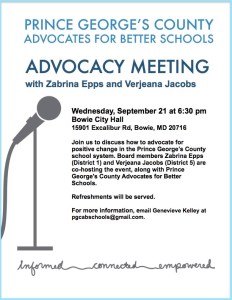
pgcabsfliervertv49-21-16Board members Verjeana Jacobs (District 5) and Zabrina Epps (District 1) will co-host a meeting with Prince George’s County Advocates for Better Schools on Wednesday, September 21st, at the Bowie City Hall.
Parents, teachers, and other members of the community are welcome to join us for a discussion of how to advocate for positive change in the school system. Bring your concerns about school system policies and procedures, budget priorities, and state legislation, and connect with community advocates to learn how you can help move Prince George’s County Public Schools forward.

  • Wednesday, September 21st, at 6:30 pm
  • Bowie City Hall, 15901 Excalibur Road, Bowie, MD, 20716
  • Light refreshments will be served.

For more information, contact Genevieve Kelley at pgcabschools@gmail.com. Visit the Facebook event page here. Download the flier here.

Charter Schools vs. Traditional Public Schools: One Parent’s Experience

Prince George’s County has several publicly funded charter schools. Though charter schools administer the same statewide tests and are accountable to the Board of Education for student achievement, the curricula, instructional programs, and policies may be different than in traditional public schools. Each charter school has its own Board of Directors. Policies, procedures, philosophies, and approaches to education vary from school to school.

Here, one parent relates her experiences with a charter school and a traditional public school in Prince George’s County Public Schools (PGCPS). The views expressed are the author’s own and do not necessarily reflect the views of Prince George’s County Advocates for Better Schools.

by Khadija B.

IMG_6342Picture this: My husband and I wake up at 5 am to get our kids ready for their first day of school. One child attends a charter school more than 25 minutes away from home (in good traffic), and transportation is not provided. Our other child attends school a little closer, but she is in the Talented and Gifted (TAG) program. She is attending her dedicated TAG center, and transportation is provided.
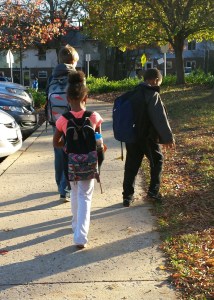
I put my third grader on the private bus — that I pay out-of-pocket for — and I follow the bus to his school. Last year, he was left at this school by a different private bus company, so I hope that this will minimize the chances of a repeat of last year.

I follow the bus all the way to the charter school, only to get to the door and have the teacher say, “Students only, no parents allowed.”
“What?! I just drove twenty-five minutes, fought through traffic, took time off from work, just so that I could see and meet my child’s teacher and find out where his class will be, and you are telling me I can’t even come in the building?”

The teacher replies unapologetically, “Aww, so sorry, but you have to leave now. You can meet the teacher at Back to School Night in two weeks.”

I don’t even know how the classes are arranged. Will he be changing classes this year? Is there a PE uniform? And what about the fact that I was able to walk my son to class last year, on his first day? All of these concerns are running through my head.

Fortunately, I am not the only parent with this concern. Unfortunately, some parents are more outspoken than I am. I hear cursing. Some parents refuse to go.

I really do not want to leave without meeting his teacher and making sure she knows he wears glasses and needs to be in the front of the class, but I do not want to make a scene and embarrass him. After all, he has to see these teachers every day, not I. I decide to leave the school, but I can’t help but ask, “Excuse me, where was the email notification?” What I want to say is, “Where is your empathy for all of these parents who care and want to show their support and cheer their children on to class for their first day of school?”

Silence is what I receive, and also a shrug of the shoulder.

Continue reading

Notes on the August 25th Board of Education Meeting

by Laura Rammelsberg

To view the agenda for the August 25th Board Meeting in BoardDocs, go here.


At 3:33 in the video. Student Board Member Juwan Blocker called for a Motion (Emergency Item) to discuss Head Start; Jacobs seconded the motion to discuss Head Start. Chairman Eubanks said it should be an Agenda Item so that the CEO and Board have time to prepare. Request was denied.

MOTION: At 9:15. Board Member Burroughs requested a Federal & State External Investigation into Head Start Case. Motion required 2/3 majority vote.
Yes – Anderson, Blocker, Burroughs, Epps, Jacobs
No –Boston ?, Eubanks, Hernandez, Quinteros-Grady, Valentine, Chairman Eubanks
Abstain – Roche, Wallace, Williams
Motion failed.

Continue reading

What Went Right on the First Day of School

Several Prince George’s County parents have shared with us what made their child’s first day of school successful.

20151113_152926

  • I appreciate how organized things were the first day — from the kindergarten teacher explaining exactly how things should go, via her letter to parents, to the school sending home everything we needed to know for those first couple of weeks. I was really impressed at how clearly things were laid out for us as a new family at the school.
  • My kids were so nervous returning to school. What made their day was seeing their teachers from last year, who made a point of smiling, waving, and asking about their summers. It was a simple thing, but it really made them feel at home and welcome!
  • Our son started high school this year. The summer “bridge program” offered by his high school provided an excellent orientation to the new school and made the transition from middle school much easier.
  • My son enjoyed the get-to-know-you activity that his third grade teacher organized for the class on the first day.
  • It was lovely to see so many teachers outside the school helping to direct traffic and welcome the children as we arrived on the first morning. And as soon as I walked into my second-grader’s new classroom I could see how well-prepared and well-organized her teacher was because of all the lovely personalized touches for each student. They really made the kids feel as if they belonged, and filled me with confidence for a great year ahead.
  • We have been working to get a more appropriate schedule for our middle school daughter. Even though the situation has been stressful, I’ve been really grateful for the caring response and advocacy from the TAG coordinator at the school. Way to not be dismissive!

Continue reading

A Parent’s Letter to County Executive Baker

by Caroline Small

Dear Executive Baker:

I am writing as a parent of a young child who should be starting in Prince George’s County Public Schools next year. I am considering moving out of this County because of the situation with school leadership that I have witnessed over the last year, particularly but not exclusively with regards to the current Head Start situation. I love Prince George’s County, so I am hoping that there will be a change in the way leadership is responding to these recurring situations, so that my confidence can be restored.

CEO Kevin Maxwell’s public responses to the loss of federal Head Start funds, as well as to the recent situation at Dora Kennedy and the instances of sexual abuse, are wholly inadequate. Once a problem is reported, it is not “poor judgment” on the part of “a few people.” It is a problem with the administration. Likewise the school board’s failure to be aware and monitoring is a failure of leadership. The emphasis from the County has been on “ensuring the program continues” — showing much less concern about understanding and correcting root causes of the failure. That, combined with the fact that the problems were not corrected initially, makes it appear that the County does not recognize the severity of this problem.

Even more importantly, though, the response suggests that none of our leaders are willing to step up and take responsibility for the shoddiness of the leadership that has been demonstrated up to this point. You have stated that nobody will be asked to resign or held publicly accountable for this failure. As far as I can tell as a parent, there is no accountability at any level, and therefore I believe the commitment to reform is insincere.

Our teachers are, for the most part, valiant. But the leaders of our school system — and you— are saying exactly the wrong things. School leadership in this county is closed off, disengaged, and suffering from a trust deficit with the community.

Continue reading

Prince George’s Schools Team up with the Clean Water Partnership on Green Stormwater Retrofit Projects

by Carmel Jones

CWP Partners Nardi Construction and Soltesz reviewing design plans for L...

Eighteen schools in Prince George’s County were evaluated this year to receive green stormwater retrofits as part of the county’s Clean Water Partnership (CWP), a $100M public-private partnership with private company Corvias Solutions, to retrofit 2,000 impervious acres with green infrastructure in order to achieve regulatory compliance.

The CWP Schools program, designed to assist Prince George’s County Public Schools (PGCPS) with treating and managing stormwater runoff through the application of Best Management Practices (BMPs), will guarantee that PGC’s federal stormwater standards are met, while also providing an educational legacy for future generations committed to improving the water quality in our communities.

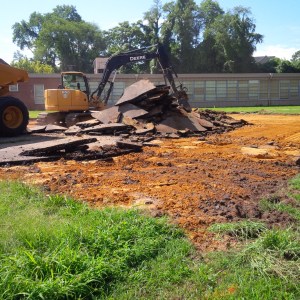
Courtyard Demolition at Capital Heights Elem. School

The program includes an educational component, and select schools will receive instructive signage, educating students about the benefits of managing stormwater runoff and displaying how installed BMPs will perform at each site. At the end of the summer, students and faculty from the schools will also have an opportunity to participate in a volunteer tree planting session that will support the installed BMP devices. These educational learning sessions will take place during school hours and will give students a hands-on experience in preserving our environment.

The initial eighteen schools identified to participate in the program include elementary, middle, and high schools in Prince George’s County. These schools include:

  • Bond Mill Elementary School
  • Calverton Elementary School
  • Capital Heights Elementary School
  • District Heights Elementary School
  • Frances Scott Key Elementary School
  • Friendly High School
  • Gwynn Park High School
  • High Point High School
  • John Hanson Montessori
  • Laurel Elementary School
  • Magnolia Elementary School
  • Oxon Hill Middle School
  • Parkdale High School
  •  Potomac High School
  • Rosa L. Parks Elementary School
  • Scotchtown Hills Elementary School
  • Templeton Elementary School
  • Walker Mill Middle School

Completed Retrofit at Rosa Parks Elem. SchoolIn the initial phase of the program, each school was given an individual plan, which included a customized package with pictures and concept designs, as well as a dialogue to help each school understand the purpose of the BMP devices. The retrofit needs for each school were pre-identified by the school’s students, faculty and maintenance staff, and customized to fit the unique needs of each facility. Since then, various types of BMPs, including bio-retention cells, sand filters and swales, to name a few, are now being installed by local workforce on the outdoor grounds of each location to capture and treat previously untreated stormwater runoff from the sites impervious surfaces.

Continue reading

A Closer Look at Findings from the Federal Investigation Into PGCPS’s Head Start Program

by Genevieve Demos Kelley and Amy Alford

Federal funding has been withdrawn from the Prince George’s County Public Schools Head Start program, after PGCPS failed to correct problems identified in a federal investigation conducted in February. The school system has been cited for failing to “report instances of child abuse and neglect to Federal, State, and local authorities as required by applicable laws; therefore, putting children at significant risk for mistreatment and abuse’ (see “Overview of Findings,” p. 4).

The federal Office of Head Start sent a letter to Board of Education Chair Segun Eubanks, outlining findings that point to failure failure at several levels of organization within the school system.

Failure to Report Use of Humiliation as Punishment

  • On December 17, 2015, a teacher at H. Winship Wheatley Early Childhood Center forced a 3-year-old child to mop up his own urine, while still wearing his wet clothing. The teacher used her personal cell phone to take photos of the child, and sent them to the child’s mother, including the text abbreviation “LOL,” along with a description of the incident.
  • The child’s parent was upset about the matter and on December 22, she spoke to the Family Services Worker (FSW), a PGCPS employee assigned to family-based case management. The FSW “likely discouraged the parent from making a report at the time, as she told the parent she would have to report it as a mandatory reporter” (see “Overview of Findings,” p. 3).
  • Several weeks later, on January 12, the parent did make a report to the FSW. However, there is no record that the FSW immediately reported the incident to the Maryland Department of Human Resources Child Protective Services (CPS). Maryland law requires that educators make an immediate report of suspected abuse by telephone, and a written report within 48 hours of the telephone contact.
  • The Regional Office of Head Start learned of the incident when the child’s parent notified the office, via telephone, on February 5.
  • The Program Supervisor of PGCPS’s Head Start program did provide some documentation, including a timeline, to the Regional Office of Head Start on February 10. However, PGCPS refused to provide additional documentation after multiple requests were made. This “limit[ed] the Administration for Children and Family’s ability to perform its oversight responsibilities to ensure Federal requirements were met and children were provided safe and secure environments” (see “Overview of Findings,” p. 4)
  • Though the child was forced to mop his urine in an open area of the classroom, two assistant teachers claimed that they did not witness the incident.

Failure to Ensure Teachers Maintained Confidentiality

  • It was reported that teachers in the Head Start Program and regular volunteers in the school system took inappropriate photographs of children (see “Overview of Findings,” p. 5).
  • The Regional Office requested that PGCPS provide its policies and procedures regarding taking photographs of children in the Head Start program. PGCPS refused.

Failure to Ensure that Teachers Use Positive Methods of Discipline

  • On June 9, 2016, two children in the Head Start Program at James Ryder Randall Elementary School were forced by a teacher and an assistant teacher to stand in the classroom holding objects above their heads. According to the report, “The first child was crying and calling the teacher’s name, and the teacher yelled at the child and instructed her to continue holding the object. The second child accidentally dropped the object and was also yelled at and instructed to continue to hold the object (see”Overview of Findings,” p. 7).

Failure to Ensure that No Child is Left Unsupervised

  • On June 9, 2016, a five-year-old child walked home after being left unsupervised during school hours. The child had been released from the nurse’s office and told to return to her classroom, but the class was at the playground. Not being able to find her class, the child returned to the nurse’s office and was unable to open the door. She left the building and walked home (see “Overview of Findings,” p. 8).
  • This incident was reported to the Regional Office on the same day by the PGCPS Head Start Director.

Read more:

Read the entire letter from the Office of Head Start to Board Chair Segun Eubanks, as well as the enclosed report, below.

Continue reading

A Teacher’s Perspective on the Junior Achievement Finance Park

by Natalie Barnes

IMG_7453When I first heard that all eighth graders would be participating in the Junior Achievement Finance Park curriculum, I was not looking forward to the experience. I assumed that it would be just one more thing to try to fit into the already jam-packed school year. However, in the end, I was delighted by the experience and look forward to participating in the future.

I attended a training at the beginning of the 2015-2016 school year that shared highlights of the curriculum and took us on a tour of the location. I was still a bit confused, but the coordinators promised that once we looked at our curriculum guides, it would make much more sense. And they were right. The curriculum guide was well put-together, with color-coded organization, clear instructions, and detailed explanations. It also provided teaching suggestions, extension activities, and probing questions. The county required that we only cover a few lessons (shared between social studies and math class), which were mandatory material for the experience. However, there was a plethora of additional material for students who needed differentiation or teachers who had more time to further explore the content. Overall, the curriculum took approximately a week in math class and a week in social studies, although teachers were free to customize this for their classes as long as they met the minimum lesson requirements.

Each student had his or her own workbook.  These were consumable workbooks that were designed to be engaging to students with various graphics as well as plenty of activities and space to work—all in full color.

The fourteen required lessons covered four main topics:

  • Income
  • Saving, Investing, and Risk Management
  • Debit and Credit
  • Budget

Income and Budget were covered in math classes while the remaining topics were taught in social studies classes. While many situations were geared to future careers and salaries, students also spent a great deal of time analyzing situations and jobs that are common for middle and high school students. Many of my students were engaged as they examined current and future potential situations, applying the principles of financial literacy to their own lives. This became even more true as we prepared to attend the Financial Park.

The entire field trip was free of charge to students, ensuring that every student could come. The buses were prompt and because they were not school buses, students were excited to attend, and they felt like this was a special experience. When we arrived, they were ushered into the Financial Park auditorium to receive a brief overview of the day’s activities. But after only a few moments, they were split into groups and assigned a volunteer who would serve as their group leader for the day. Many of the volunteers were teachers, parents, student teachers, or community members. The students were often pleased to be working with an adult they knew. It was particularly advantageous to some of our students with learning disabilities or other special needs as they were able to be placed with supportive chaperones who allowed them to participate fully. We had a group who spoke very little English, which was assigned to a chaperone who also spoke Spanish, allowing the day to be conducted bilingually, truly allowing all the students to engage with the activities.

As they were assigned groups, each student received an iPad and a fictional scenario about their job, salary, marital status, and family situation. From there, they determined their monthly gross income and monthly net income, using the iPad. On the iPad, they then set a budget, allotting money for housing, transportation, utilities, food, clothing, entertainment, etc. During the budgeting time, they explored the Finance Park, which has various stations devoted to each of these categories, allowing students to research costs before making a final decision. After lunch, students then revisited each of these stations and actually “purchased” items. They had to first decide on renting an apartment or buying a house and then owning a car or using public transportation. Many times they had frustrating realizations that they simply could not afford the home or car of their dreams and had to settle for less expensive options. Once they had determined their housing and transportation options, students were then given a “debit card” linked to their iPad and account. They went shopping to the various stations around the Finance Park, buying different products and quickly realizing that their money supply was not endless. After their purchasing time was up, they worked through reflection activities with their chaperone and made any final changes to their monthly spending. One aspect of the reflection included a random event that caused them to spend money (e.g. the car needed repairs, the refrigerator stopped working, a child broke her arm).

Continue reading