Ten Things PGCPS Can Do to Rebuild Community Confidence

IMG_6358

by Lori Morrow

This past weekend I read the graduation rate audit report from Alvarez & Marsal. Unfortunately I was not surprised by the findings. Over the past 9+ years, I’ve noticed a disconnect between Prince George’s County Public Schools (PGCPS) leadership/central offices and the way individual schools operate on a daily basis.

I suspect that any PGCPS parent could provide anecdotes about inconsistent policy and procedure compliance at the school level — from issues like withholding elementary school recess as punishment and discrepancies in meeting volunteer/visitor requirements, to inconsistencies in grading procedures or the abuse incidents in recent years. While the report did not find system-wide fraud, I believe we need a system-wide solution to balancing effective policies and procedures without drowning staff in processes and paperwork.

Earlier this week I wrote a list of things that I believe parents/guardians should do. Parents own a piece of the issues identified in the audit if they aren’t paying attention to grades and attendance, if they ask to have their child promoted when they shouldn’t be, or if they are focused just on the diploma instead of the education. Sadly what I often hear from parents and teachers is that it doesn’t matter what we do because we are powerless to change PGCPS. I spend too much time attending PGCPS events and meetings to accept that there is nothing we can do.

Here are my suggestions for ways PGCPS can partner with parents and staff to help rebuild trust and confidence in our school system:

  1. Host forums like last year’s “Community Summit on Safety & Accountability” to involve the community in identifying problems and searching for solutions.
  2. Involve PTA/PTO leaders in reviewing climate survey results at the school level so that they can assist in resolving ongoing concerns.
  3. Add an item to parent and teacher climate surveys that asks about staff adherence to policies and procedures.
  4. Implement new Administrative Procedures in the spring or beginning of the summer (instead of right before school starts) so that principals and central offices are thoroughly prepared to communicate them to parents and teachers by Back-to-School Night.
  5. Create an interactive video/training module on the Students Rights & Responsibilities Handbook for parents and students that can be posted online and shared at Back-to-School Nights or PTA meetings.
  6. Reach out to the Board of Education Parent and Community Advisory Council to provide feedback on policy and procedure changes.
  7. Host forums with PTA/PTO leaders at least twice during the school year to identify system-wide issues.
  8. Clarify the role of instructional directors as it relates to policy and administrative procedure compliance, and share that information with the community.
  9. Educate the community on the formal process for teachers, students, and parents/guardians who wish to report instances of non-compliance, and ensure that they will not face retaliation.
  10. Above all else, please put aside the politics and make our children’s EDUCATION the priority.

Ten Things Parents Can Do in Response to the PGCPS Graduation Rate Audit

IMG_6342

by Lori Morrow

Here are ten things parents and guardians can do in response to the Prince George’s County Public Schools (PGCPS) graduation rate audit:

  1. Read the Executive Summary of the report if you haven’t already, regardless of what grade your child is in.
  2. Read the sections of the Students Rights and Responsibilities Handbook that relate to attendance and graduation requirements (and the rest of it too if you can find the time).
  3. Make sure you are meeting your parent responsibilities by getting your child to school every day.
  4. Set high expectations for your children and provide them the support they need to meet them.
  5. Check grades and attendance regularly in the Schoolmax Family Portal and contact teachers if you see any errors/discrepancies.
  6. Attend parent teacher conferences to understand how your child is doing in school.
  7. Ask teachers and guidance counselors about graduation requirements that you don’t understand.
  8. Keep your own file (hardcopy or digital) of documentation for credit make-up work and Service Learning Hours.
  9. If you find that procedures are not being followed, bring that to the attention of someone at a higher level (whether that is the principal, the Instructional Director, the Ombudsman, the CEO or the Board of Education).
  10. If you see a better way to do things, bring that to the attention of someone as well. We can ALL find solutions.

Continue reading

Notes on the October 24 Board of Education Meeting

by Laura Rammelsberg

To view the agenda in BoardDocs, go here.

Attendees: Board Members Ahmed, Boston, Burroughs, Hernandez, Murray, Paige, Quinteros- Grady, Roche, Valentine, Wallace, Williams, Dr. Wiseman, Dr. Eubanks
CEO Dr. Maxwell

Ms. Eubanks had a friend who passed today and could not attend the meeting.

NEWSBREAK

At 5:39 in the video. Our New 3D Scholars Program – highlights partnership between PGCPS, Prince George’s Community College and UMUC that allows students to get a Bachelor’s Degree for $10,000.

For more information about the 3D Scholars Program visit: http://www.pgcps.org/3dscholars/

REPORT OF THE CHAIR

At 9:49. Honored lives of four individuals – Kayla Holman (G. James Gholson Middle School student), Ms. Owens (educator at Gwynn Park MS), Shelly Miley (father of Dr. Kara Libby, Executive Director of Teaching and Learning, PGCPS) and Ms. Murphy (daughter of Kim Murphy, Sasscer building services staff.)

Fairmont Heights HS – new high school was dedicated attended by alumni from 1940s and 1950s were there. Video of the Fairmont Heights HS Ribbon Cutting can be found here: https://www.youtube.com/watch?v=YuImqO3DUTQ

Oct. 16 – U.S. Senators Ben Cardin and Chris Van Hollen at Greenbelt Middle School announcement of the award of $25 million US Department of Education grant titled “Great Teachers, Great Leaders, Great Schools.” Funds will go to highest need schools and develop leaders to help our children thrive and succeed.  

Video about $25 million grant announcement can be found here: https://www.youtube.com/watch?v=X851MuCwtaA

At 14:29. Board Member Burroughs – recognized former School Board Chair Owen Johnson, who is in the audience.  

Board Member Wallace – recognized 12-year old student from North Forestville Elementary, Ms. Dashai Morton. For her birthday, she raised 3000 cases of water for victims of Hurricane Maria and Irma in Puerto Rico. Proclamation made in honor of her.  To see more information about Ms. Morton’s story visit: http://wjla.com/news/local/prince-georges-county-sixth-grader-collects-water-for-hurricane-victims-in-puerto-rico

Board Member Williams – Greatness is happening all over PGCPS.  Law passed to implement green cleaning in schools throughout the State.  PGCPS is the first organization in the State to complete the green cleaning certification. Ten custodians completed a green certification course, which help achieve this goal, she recognized them.

Continue reading

Notes on 2017 PARCC Results

by Lori Morrow

Results for the PARCC Assessments taken in Spring 2017 were the main discussion item at the PGCPS Board of Education meeting on September 19, 2017.  PARCC stands for the Partnership for Assessment of Readiness for College and Careers. It is a set of annual tests in English/Language Arts and Mathematics that students take in grades 3-12 during April and May.  More information about PARCC can be found online at https://parcc.pearson.com or www.pgcps.org/parcc.

  • The Maryland State Department of Education released this year’s PARCC scores near the end of August 2017.  Results for all state, county and individual school results are available online at http://reportcard.msde.maryland.gov.
  • All students who took PARCC tests should receive individual score sheets from their schools.  If you have not received your results, contact your school’s Testing Coordinator.  Information about understanding the score sheets is online at www.pgcps.org/parcc. Dr. Goldson mentioned that PGCPS will not be presenting “PARCC Nights” like previous years due to low attendance during the 2016-17 School Year.

PARCC RESULTS PRESENTATION:

Dr. Goldson’s presentation begins with the overview and Elementary School Scores: https://youtu.be/o9T65Q9I83U?list=PL4585E4C6234DE895&t=1620

  • Grades 3-5: Increases in all ELA/Math scores by grade except for a decrease for Math 5. Despite increases, PGCPS is still well below the state average for both assessments. For all demographics, students did better on ELA than they did for Math. Most demographic subgroups showed improvement from SY2016 to SY2017.

Middle School Scores: https://youtu.be/o9T65Q9I83U?list=PL4585E4C6234DE895&t=1944

  • Grades 6-8: Slight decrease for student performance in grades 6-8 on both ELA and Mathematics assessments.  The only increase in results was at Grade 7, which was due to clarification from MSDE that students should take the assessment for their grade level.  All demographic subgroups did better on ELA assessments than they did in Math.  Asian and white students outperformed African American students, but it also must be noted that the number of African American students in PGCPS significantly exceeds the number of Asian and white students.  Most groups at the middle school level showed minimal growth or a slight decrease.

Continue reading

Eubanks Reappointed to Board of Education, Anderson Resigns

by Genevieve Demos Kelley

Prince George’s County Board of Education Chair Segun Eubanks has been appointed to a second four-year term on the board. In a June 8 phone conversation, a staff member in County Executive Rushern Baker’s office confirmed that Baker reappointed Eubanks on June 1 of this year.

Eubanks was first appointed on June 1, 2013, the same day that the controversial House Bill 1107 took effect. The legislation changed the structure of the board, adding four at-large appointed members to the previously all-elected board and giving the superintendent (renamed under the bill as “Chief Executive Officer”) and county executive more control over the school system. Under HB 1107, the county executive also selects the chair of the board of education, who serves a two-year term as chair. Eubanks was selected by Baker to serve as chair of the board in June of 2013.

Beverly Anderson, whose recent resignation from the board has made the news, was also appointed by Baker to a four-year term in June of 2013. Anderson’s appointment was announced on June 17, along with the appointments of Daniel Kaufman and Curtis Valentine. Under the provisions of HB 1107, Valentine was appointed by the county council, and Kaufman was appointed by the county executive. Both were appointed to two-year terms initially, with the stipulation that future appointments to those seats would be four-year terms. Valentine was appointed in June 2015 to a second term, which will last four years. Kaufman’s seat is now held by Mary Roche.

The board of education also has nine elected members, each elected from their own board of education district, and one student member.

On June 13, four days before her term ended, Anderson sent a resignation letter to County Executive Baker, criticizing the school system for its “lack of a coherent educational plant” and calling the board “dysfunctional.” The letter was obtained by NBC 4 through a public information request, and the full text is below. It is not clear whether Baker had planned to appoint Anderson to a second term. Baker is responsible for appointing someone to fill the vacancy left by Anderson.


Continue reading

A Lonely Journey: Life on Administrative Leave

IMG_6404

The author is an employee of Prince George’s County Public Schools (PGCPS) who wishes to remain anonymous.

There is your badge sitting on the desk. Your smiling face and the PGCPS logo are looking straight up at the ceiling. That piece of plastic that stayed so close to you every day at work was being taken away from you. Maybe for a few days. Maybe forever. The words still ring in your ears: “I’m placing you on administrative leave.”

You’ve had a stellar record through all of your career. You’re respected by your colleagues. You’ve never had a whiff of trouble. And now, you can’t do the thing that’s been at the core of your being for almost your entire adult life.

Your mind turns to the alleged victim. You are a teacher because you have a sincere desire to make the world a better place. You want the best for your students, your colleagues, and your community. Yet somehow, somebody believes you have been harmful to them or that you have done something to put others at risk. Whoever is putting forth the allegations is not your enemy, but you are suddenly placed in an antagonistic position with someone you have tried to support.

As the principal walks you to the parking lot and you drive away, you contemplate how you will explain this to your family. You know they will be hurt and confused, but you still have to be the one to deliver the news. Before it even happens, you can hear what will come: the bewildered silence and the anger in their voices.

You turn your attention to what it will take to defend yourself. So many things happen in a teacher’s day. This is a profession that is exhausting based on the sheer number of decisions you have to make as you plan and manage a classroom full of young personalities and try to impart the curriculum. You don’t have time to take detailed notes of everything that happens, yet right now you wish that you had a record of every interaction you’ve had. You do the best with what you’ve got.

It soon becomes clear what is one of the most insidious aspects of being on administrative leave. The feeling of isolation is horrible. You have been instructed not to be in contact with any colleagues, students, or parents. You know they are wondering about you. Where is my teacher? Will they ever come back? What happened to our colleague? I hope everything is OK. You receive phone calls, text messages, and emails, but you know you can’t respond and tell the truth of what you’re going through.

When the school year ends, you will learn from news reports that there were 848 PGCPS staff members placed on administrative leave this year. In that sense, you are not alone. Sure, you had heard through the grapevine what had happened to a friend of a friend. It was unfortunate, but it was distant. Now it is all too close. You wish you could reach out to the others. You need a support group, but you don’t know who they are or where they are.

Continue reading

More Than a Statistic: Observations from a PGCPS Employee on Administrative Leave

IMG_6404The author is an employee of Prince George’s County Public Schools (PGCPS) who wishes to remain anonymous. The opinions expressed in this piece are the author’s own and do not necessarily reflect the views of Prince George’s County Advocates for Better Schools.

Over recent months, media attention has focused on what employees of Prince George’s County have known for a long time: the problem of having too many school staff on administrative leave. According to the Washington Post, as of June 6, there were 142 teachers and 91 other employees off the job.

I am part of that statistic.

I will share part of my story. Of course, there are very strict limits to what I can share. However, with the massive number of employees who have gone through what I am experiencing, it is important for policy makers and the public to know the issue from the perspective of someone in my position.

First, some perspective on the known statistics:

There were 848 PGCPS employees placed on administrative leave this year. That means 4.24%, or about one out of every twenty-four PGCPS employees were paid for days, weeks, or even months to not be at work serving the children of Prince George’s County. To put this in perspective, if students were absent at that rate, many of our schools would not meet their own student attendance targets.

There were some cases where the wrongdoing was real. Of the 615 cases that have been resolved, 196 resulted in a reprimand, suspension, retirement, resignation, or termination. Another 170 or so resulted in a letter of professional counsel. In all, violations of PGCPS policy were found in about 60% of the cases, but only about 10% of the cases rose to the level of requiring the employee leave the school system permanently. 

From my perspective, based on past results and not on the merits of my case, I have a 10% chance of needing to search for a new job. I have about a 50% chance of having done something wrong while still keeping my job, but was it really worth having me out of the classroom to determine this? I have about a 40% chance of being completely cleared, in which case my time removed from the classroom has been completely worthless to me and detrimental to the education of the students I serve.

The logic of having the staff member removed from the schools during the investigation is that the employee may interfere with the investigation. This makes sense when an investigation is done in an expeditious manner. The interruption will only last for a few days, and if there is no fault found or only enough fault to warrant a reprimand or letter of counsel, the employee can return to duty in a timely manner.

However, when there is a known backlog of cases and it is widely understood by all parties that the process can take weeks or months, this brings into question whether the use of administrative leave has been misapplied. Certainly, it was necessary in at least 10% of the cases. But what about the other 90%? Was it truly helpful to have the employee off the job for that length of time? What could have been done differently so instruction or other important services were not interrupted or diminished?

Good teachers know that if you are going to crack down on a problem behavior, you have to plan for a timely and efficient enforcement of your class rules. Otherwise, you are not going to be respected by the students, especially those who are trying to do their best and feel like they have all been collectively thrown into a toxic pool of suspicion because of the bad behavior of a few. Why, then, did PGCPS not use that same logic and realize that if they were going to have more reporting of suspected misconduct, they needed to be prepared to handle the increased caseload?

Again, I can’t give details about the nature of my case, but the nature of how the process has been handled is very instructive. When I was put on administrative leave, I was given a vague verbal explanation of the allegations. To this date, I have nothing in writing stating the nature of the allegations. I was told not to have any contact with colleagues, students, or parents and to remain off PGCPS property until advised otherwise.

Continue reading

Notes on the June 22 Board of Education Meeting

by Laura Rammelsberg

To view the agenda for the meeting in BoardDocs, go here.

All Board Members Present

2.0 Adoption of Agenda

At 3:19 in the video. Motion by Board Member David Murray to add to the agenda (as an an emergency item) a discussion of the proposal to update administrative leave policies , given the “record-breaking numbers of teachers, bus drivers, principals, assistant principals, guidance counselors, employees at all levels of the system that have been caught up in our administrative leave policies and are out unjustly, some without pay, some with pay, for extended periods of time . . .”

8 ayes/6 nays — to add Board Member Murray’s motion to the agenda. Required a two thirds majority vote; motion did not carry.

At 5:35. Motion by Edward Burroughs to allow all members of the public who signed up prior to the deadline to speak during the public comments. Motion ruled out of order by Dr. Eubanks.

4 ayes/8 nays/2 abstains — vote to overrule the chair’s decision to enforce public comment policy. Motion did not carry; policy limiting public comments to 15 remained in force.

Minutes from June 7, 2017 board work session and June 13, 2017 operating budget public hearing were approved.

Report of the Chair

At 13:19. Gave honor to two members at their last board meeting. Student Board Member Blocker was thanked for his service with a $5,000 scholarship for college and a certificate.

At 14:18. Student Board Member Blocker (remarks) — Showed photograph of himself with the late Principal Tanya Washington and honored her for supporting him. Thanked his family and community. It takes a village to get a person where they are. He held true to his promise that he would advocate and vote his conscious and get more students involved politically and civically. Words of advice to colleagues: it is an honor to serve the students. He is concerned with the amount of politics that gets in the way of helping the students.”We will continue to be second to the bottom if we continue to let politics get in the way of our decision making.” Thanked Board Members Murray, Ahmed, Burroughs and Dr. Anderson. There is a lot of work to do. Encourages the community to be as active as possible. 2018 is a big year; vote out certain individuals.

At 18:46. Dr. Eubanks gave honor to Dr. Beverly Anderson, who has served with great skill and integrity. Pushed to advance student achievement and make program offerings stronger than ever. Thanked her for her hard work and dedication. A plaque presented to her.

Continue reading

What We Know About the Prior Investigation into Alleged Fraudulent Graduation Rates

by Genevieve Demos Kelley

Earlier this month, four Prince George’s County board of education members raised hackles when they alleged that graduation rates in the county schools had been inflated through grade fixing and other tactics. The board members — Edward Burroughs, David Murray, Raaheela Ahmed, and Juwan Blocker — asked Governor Larry Hogan to order an investigation into the claims of fraud. Schools CEO Kevin Maxwell and other school officials have denied the allegations, citing an investigation by the Maryland State Department of Education (MSDE) conducted earlier this year that cleared the schools of any wrongdoing.

But State Delegate Jay Walker has publicly questioned whether the MSDE investigation was sufficiently thorough, and on June 25 Governor Larry Hogan sent a letter requesting that the MSDE conduct a “complete, thorough, and exhaustive” investigation into the allegations.

So, why order a second investigation? How thorough was the investigation that was completed earlier this year? A letter sent to the U.S. Department of Education describes the previous MSDE investigation in detail. (Scroll to the end of the post to find the letter in full.) Here is what we know about the investigation:

  1. When did the investigation occur? The investigation was conducted in January 2017, but it was a follow-up on an informal inquiry that had occurred the previous year. In July 2016, Patrick Rooney, deputy director of the United States Department of Education’s (USDE) Office of State Support had sent a letter to Maryland State Superintendent Karen Salmon informing her of an anonymous tip made to his office, alleging that Schools CEO Maxwell was forcing grade changes in order to boost graduation rates. The letter included mention of two high schools in particular. After receiving the letter, Salmon contacted Maxwell about the allegations, and he denied them. Nothing further was done until the MSDE received a phone call in December 2016 from the USDE asking for an update on the investigation.
  2. Who conducted the investigation? The January investigation seems to have been conducted by a single person, Carol Williamson, chief academic officer of the Office of the Deputy for Teaching and Learning, and a former superintendent of Queen Anne’s County Public Schools. The investigation was preceded by a meeting between Williamson and Maxwell on December 12, 2016.
  3. What was the scope of the investigation? The investigation consisted of 1) looking at graduation rate data, 2) meeting with Kevin Maxwell, and 3) interviewing Maxwell and four others. Carol Williamson looked at the graduation data for the county for the past five years and for the two high schools mentioned in the complaint. She discussed the graduation data with Maxwell at the December meeting, and in January she interviewed Maxwell and four other PGCPS employees: an instructional director, a data management and strategy analyst, a special project officer*, and a deputy superintendent.
  4. How were the interviewees selected? How long was each interview? The employees interviewed were referred by Maxwell. It appears that none of the employees interviewed is in a school-based position. Williamson writes, “At the conclusion of our [December] meeting I asked him to identify others with whom I could talk. I asked to talk with the principals’ supervisors for the two high schools, with someone involved in grade collection on transcripts, with someone responsible for school counselors, etc.” Each interview was between 30 and 45 minutes long. According to Williamson, the discussions were thorough, and each person interviewed was “very proud of the work being done in the school system.” (See the letter below for a list of questions asked.)
  5. Who knew — or didn’t know — about the investigation? In a statement issued on June 20, Board Members Burroughs, Ahmed, Murray, and Blocker claimed that they were not informed of the MSDE investigation. They write, “We were absolutely unaware that MSDE had done an investigation on the matter earlier this year. Neither the CEO nor Board leadership informed us of it previous to yesterday evening, when it went out as a blast to school system stakeholders and the media.”

One Parent’s Budget Priorities: Happy Teachers and Engaged Students

19401660_10155128226975546_1823783973_o

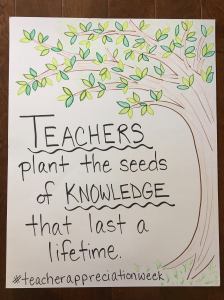
A poster that the author created for Teacher Appreciation Week.

The views expressed are the author’s own and do not represent the views of Prince George’s County Advocates for Better Schools.

by Lori Morrow

I originally planned to speak during the public comment portion of the Prince George’s County board of education meeting on June 22. However, I was informed on June 20 that the BOE had reached its limit* of 15 speakers.

The text below is from an email I sent to the CEO and board of education members, with the subject line “PGCPS Budget Priorities: Happy Teachers and Engaged Students”:

I’ve been encouraging people to send inputs in advance of the Thursday meeting, so here is my short list…

Things I want:

1. Whatever the teachers want, including the freedom and resources to be innovative and keep students engaged with hands-on activities

2. Resources to meet the needs of students at all levels of the academic spectrum, including math & literacy support and TAG training for teachers

3. Language exposure at neighborhood elementary schools through programs like ICAL [International Culture and Language, used at Talented and Gifted centers] or sharing language teachers like we do for art and music

4. Maintenance funding to ensure safe, functional buildings for our students and staff

5. Focused interventions and support for students impacted by lack of core teachers due to administrative leave issues this year (Get creative…use executives & central office staff as tutors once a week if necessary. Perhaps more interaction with schools and students will help remind everyone that students should ALWAYS be our central focus.)

Things I do not consider priorities:

1. Things that do not touch classrooms or students

2. Programs that only benefit a few students through the lottery and increase transportation needs/cost

3. Test fees for all students (I believe students should need to demonstrate financial need and/or a minimum grade in their courses to justify reimbursement).

4. The start of new programs before we have met basic needs at neighborhood schools.

I support PGCPS teachers’ priorities because happier teachers will be more effective. Our teachers should have the freedom to teach in creative and innovative ways without being mired in paperwork and restrictions. They should also have the resources to make learning fun and engaging for our children. Additionally, our county’s students should have opportunities for language exposure and gifted programs in every neighborhood. They should not have to literally “win a lottery” to access programs that challenge them academically.

Continue reading