
Teacher Raises Questions About Grading and Reporting Changes

Natalie Barnes is a math teacher at a Prince George’s County middle school. The views expressed are the author’s own and do not necessarily reflect the views of Prince George’s County Advocates for Better Schools.

by Natalie Barnes

100_3373As a middle school math teacher, I wholeheartedly support some of the thirteen recommended changes to the grading and reporting policy. Teachers should provide a syllabus (recommendation #6), use approved grading systems (#12), and grade and return student work within ten school days (#9). Similarly, administers should ensure that grading is applied uniformly (#13). These seem to be teaching practices that are already common among quality educators.

Yet, there are some policies with which I disagree. Regarding behavior, attendance,and grades (#2 & #3), Gorman Brown explained during the June 9th Board of Education work session (at 40:35 in the video) that grading should be based on course standards. Yet, the mathematical standards include “use appropriate tools strategically”and “critique the reasoning of others” (Standards for Mathematical Practice). From a teacher’s perspective, if a student is throwing rulers across the room or refusing to participate in a lesson, they are failing these standards. During class discussions, Socratic seminars, or classwork in general, what grade should be given to students who do not participate appropriately? That said, a rubric or other more objective scale should be used to reduce subjectivity, but behavior is an important part of a student’s classwork. When asked about the role of participation in grading, Dr. Shawn Joseph responded that “participation is not part of our administrative procedure” (1:02:03) so it is unclear as to how this impacts behavior (1:03:14).

I also have concerns, as do many others, about the uniform minimum grade of a 50%
provided students put forth a good faith effort (#1 & #4). Even though “good faith effort” has been defined by the panel as “any assignment in which a student completes at least 50% of the required content,” this still leaves a great deal of room for subjectivity. As a math teacher, I have seen students write down random numbers and assume that this is quality work deserving of a 50%. Like Board member Ms. Perry (1:18:30), I wonder if only expecting students to turn in work half done is reinforcing good work ethic. Furthermore, I question, as does Board member Edward Burroughs (1:32:45), whether this practice actually prepares students for life beyond high school, including college. True, research shows this helps students avoid giving up. However, in my experience, it also enables students to put forth only a minimum effort.

Lastly, the policies for make-up work are of great concern to me (#3 & #10). I am supportive of make-up work and have my own procedures for it within my classroom. But I do not think a uniform sliding scale is appropriate for the entire county. Each classroom and subject area has different needs. Even within my own classroom, the policy for homework is different from that of projects and classwork. For example, I assign five equations to solve for homework, which are due the following school day; I walk around the room and check for completion. After assigning their completion grades, we review the problems as a class. Should students who did not do the homework be allowed to turn it in for a 95% just by copying down the work and turning it in that day? I think not.
Continue reading

Proposed Changes to Grading and Reporting Policy

by Genevieve Demos Kelley

100_3394A cross-functional team of advisors has made recommendations for significant changes in the way students in Prince George’s County are graded. The 28-member project team, which included parents, teachers, principals, administrators, community organizations, and union representatives, began studying PGCPS’s grading and reporting administrative procedures in February of 2015.

In a presentation made to the Board during a June 9th work session, project team member and high school Principal Gorman Brown outlined thirteen recommendations for revising the grading procedures:

  • Recommendation #1: Teachers will assign a quarter grade of no less than 50% for quarters one, two and three.
  • Recommendation #2: Behavior cannot be used as a grading factor.
  • Recommendation #3: Attendance and tardiness cannot be used as grading factor. Teachers shall allow makeup work, regardless of the reason for the student’s absence. (Make-up work must be returned within 10 days, and student grades may be reduced by 5% each day.)
  • Recommendation #4: Teachers must give grades of no less than 50% on all assignments for good faith effort.
  • Recommendation #5: Schools shall organize one parent conference per semester to discuss students’ grades.

Continue reading

Parents, Board Address Transportation Issues

by Genevieve Demos Kelley
IMG_6355The Prince George’s County Board of Education held its last meeting of the school year on June 14th and adopted—in a 9 to 4 vote—a $1.93 billion Annual Operating Budget for Fiscal Year 2017. Dissenting votes were cast by Edward Burroughs III, Beverly Anderson, Verjeana Jacobs, and Zabrina Epps.
The budget was significantly smaller than the $2 billion that the Board had requested from the County Executive in February. Dozens of cuts were made during the budget reconciliation process, including the $1.27 million proposal to hire 25 additional bus drivers for the 2016-2017 school year.

While the issue of bus transportation was by no means the only topic of the evening, it got plenty of attention from parents, students, Board members, and PGCPS employees. Here are some highlights of the transportation-related comments made during the meeting.

During the Public Comment portion:

A parent at 49:34 in the video of the meeting:

I was disappointed to see that the additional 25 bus drivers were cut in the reconciliation budget. The ongoing shortage of bus drivers has led to doubled-up routes, significant delays, and even the inability to answer the transportation hotline in the morning, because staff are needed to drive . . . Without the additional drivers, I sincerely hope that the transportation department is spending the summer looking for a more efficient way to get students where they need to be, because what we have now is not working well. Students cannot learn if they cannot get to school.

A Northwestern High student representing the Hyattsville Teen Advisory Committee at 1:11:17 (this is a must-watch testimony):

We did some research to find out what was causing the problem of late school buses, and we found two causes: poor pay and poor working conditions [boisterous applause from audience].  .  . [Bus drivers] are often disrespected by students on the bus, and students say that they don’t even know their bus drivers’ names. We recommend that all schools include bus drivers in their orientation at the beginning of the year, and the principal introduce the bus drivers to students and review the rules and consequences for riding the bus [more applause from audience]. We recommend that the school board pass a bus driver appreciation day for the district to honor and recognize the work of bus drivers who support our students and their schools.

Jossalyn Ford, chief steward for the Transportation Chapter of Local 2250 bus driver at 1:17:26:

We work very hard every day to transport the children who attend Prince George’s County Public Schools to and from safely. As we approach the end of the year, we are short of help. As you have very well know that we are doubling, tripling runs. We are tired. We’re doing our very best to transport these kids every single day. But as we do so, we have bus attendants also working with us who have been waiting two or more years to become permanent, to have benefits. HR keeps saying, ‘We don’t have the positions.’ They don’t have the money to hire these people.  .  . And we, as a local, can’t defend a sub-employee .  .  . But I’m telling you right now, we cannot go into next year doing what we’re doing this year.  .  . We have meetings on a month-to-month basis, where we come together and try to address all these issues, and nothing is being done.

A parent at 1:25:16:

I’m mom of a third grader at Tulip Grove Elementary, and for the past several weeks, we’ve been experiencing inconsistent and unreliable bus pickups in the morning. In particular, because of the doubling up on the routes and the tripling up on the routes, you know, sometimes it will be fifteen to thirty minutes before the children are picked up to go to school. We’ve had occasions when the bus just hasn’t appeared .  .  . [W]e could use some communication in some way shape or form, some kind of system in place that could notify parents of an issue, if a bus is going to be late, if a bus is not going to arrive. I’m thinking something similar to bus ETA, like what WMATA uses, something like that. Where we can have warning of notice of a late arrival time . . .If we know, as parent, what’s happening, what to expect, we can make other plans to get our children to school and to get ourselves to work on time. . . I would really urge you to reconsider the staffing levels for bus drivers, because we need to get these kids to school, rather than leave them standing out on the corner for 30 minutes in the morning.

During the Budget Consent Agenda Discussion:

Board member Verjeana Jacobs’s comments at 1:35:03 regarding the value of hiring additional bus drivers vs. adding Lacrosse as a varsity sport:

It’s really disheartening that our employees, bus drivers included, have gone years without adequate funding in the budget, and every year we expect them to just accept that we don’t have money, and it’s just not acceptable .  .  .  A lot of people in my district [District 5], let’s just be clear, love lacrosse. And I do too. But not at the expense of bus drivers who have to get our kids safe here every day, and not at the expense of class size, math specialists, and reading specialists.

Continue reading

Charter Schools, Specialty Programs, and the Issue of Equitable Access

by Genevieve Demos Kelley

The lively discussion about equitable access to College Park Academy that took place during last month’s Board of Education meeting (beginning at 1:51:27 in the video) is must-watch TV—and not just for the moment when Board Chair Segun Eubanks told Edward Burroughs to “shut up and let the parliamentarian answer the question (at 1:54:50).”

Board Member Edward Burroughs (District 8) proposed amending the resolution granting a one-year extension to College Park Academy, a public charter school for students in grades six through nine which offers blended learning in partnership with the University of Maryland. Referring to the University of Maryland’s request that some slots be allotted to the children of University employees and to residents of College Park, Burroughs emphasized that all students, including “our most disadvantaged students,” should have access to the charter school, “not the select few, not those that come from the elite class in the county or in College Park.”

Burroughs’s amendment—which was adopted after a vote by the Board—adds the clause, “whereas the Board of Education wants to ensure equity and access for all students, regardless of socioeconomic status or zip code,” to the language of the resolution.

Contributing to the conversation surrounding equitable access, Board Member Jeana Jacobs (District 5) raised the question of whether children with special needs were being well-served at the school: “You do a review of our special needs population that’s there. There is some suggestion that they’re encouraged to home school or go to their neighborhood school.” (For Jacobs’s remarks, go to 2:06:20 in the video.)

What do the numbers say? Are “our most disadvantaged students” well-represented at College Park Academy? Data from the 2015 Maryland Report Card suggest that College Park Academy serves disproportionately few students needing special services, particularly when compared with the six closest neighboring middle schools (see map of area school locations here).

The table below shows the percentages of students who qualify for Free and Reduced Meals (FARMs), who have limited English proficiency (LEP), and who receive special education services, respectively, at the seven schools listed.

SmallChartv2

Percentages of students qualifying for Free and Reduced Meals, with Limited English Proficiency, receiving special education. An asterisk (*)  is used to indicate fewer than ten students in a category1. Source: 2015 Maryland Report Card, “Students Receiving Special Services”

Continue reading

Parent Calls for Improvement Plan Instead of $120k Survey

Lori Morrow presented a version of this testimony during the public comment portion of the May 12th Board of Education Meeting. The views expressed are the author’s own and do not necessarily reflect the views of Prince George’s County Advocates for Better Schools.

by Lori Morrow

A few weeks ago, I watched the April 28th Board of Education meeting at home and
was surprised to hear about a $120,000 survey to determine community
perceptions of PGCPS. I agree with comments made by some board members that
night: We already know many of the negative perceptions that persist from existing surveys.

IMG_0510A few months ago, I noticed each of the school pages on the PGCPS website includes a link to the 2013 School Climate Survey, as well as a note indicating the next biannual survey would be published in Fall 2015. I recall getting an email to fill out the survey last June, and know that my son participated in a survey this school year.

I’ve been attempting to get a copy of this climate survey report and, after more than two months and many emails, I was finally able to access a copy of the report this very morning from a helpful staff member in the Research and Evaluation Department. I was particularly interested in the report for my son’s middle school because of comments I regularly hear from him. While a quick comparison with the 2013 report does show some improvement for the school, a number of areas are rather disappointing.

For example:

  •  31% of Parents disagree with the statement that they are proud to send their
    child to this school
  • 31% of Parents do not believe that teachers will provide students individual
    attention if needed.
  • 44% of Students disagree with the statement that they feel safe in school.
  • 61% of Students do not believe that students respect the authority of
    teachers at this school.
  • 54% of Students do not feel like they are an important part of their school
    community.

Continue reading

18 Ways to Be an Involved Parent

IMG_6326As a parent of a child in Prince George’s County Public Schools, how can you become more involved in the school system? How can you make a difference, both in your neighborhood school and in the system at large? Members of Prince George’s County Advocates for Better Schools came up with this list of ideas:
1. Communicate regularly with your child’s teacher. Be sure to include specific expressions of gratitude and appreciation. Contact the teacher first, before going to the principal or supervisor, if you have concerns about what’s going on in the classroom. You may eventually need to work with your school’s guidance counselor or principal for additional assistance.

2. Get to know PGCPS’s new Ombudsman Office. The ombudsman serves as a neutral party to resolve school-related concerns. The ombudsman office should not be your first point of contact, however. Here is PGCPS’s official “Guide to Addressing Questions and Concerns.”

3. Participate in PGCPS’s online surveys and feedback forms. During the 2015-2016 school year, parent feedback was solicited on several topics, including the school systems’ operating budget, proposed new grading policies, and student safety, for example. Watch for these opportunities on the pgcps.org home page.

4. Sign up for email updates. Go here to sign up for email and text updates. Once you submit your email address, you will be given the option to subscribe to a variety of updates. Besides school closings and delays, you may choose announcements from Board of Education members, monthly newsletters from PGCPS, college and career information, lunch menus, and more.
5. Keep track of grades and assignments through SchoolMAX, and communicate with your child’s teacher if you have questions.

6. Get to know other parents and talk with them about their experiences and ideas. Whether they have found frustration or success as they have advocated for their children, you will learn from their stories, and you may be able to work together for a common cause. You might join one of several Facebook groups for PGCPS parents: PGCPS Education Forum, Parents and PGCPS, and PG Parents for Education are good options.

7. Know who your Board of Education representative is and communicate with them about issues that are important to you. (See this map if you’re not sure which Board District you are in.) Most BOE representatives hold forums, community meetings, or morning coffees at several points during the year. Try to attend one for your district. Even if you don’t have a specific concern to bring up, you’ll learn much by meeting the Board member who represents you and listening to what other parents have to say.

8.  Several times each year, PGCPS holds community meetings on various topics. Attending these meetings gives you a chance to talk to PGCPS officials, meet other parents, and give feedback about the school system.

9. If you really want to know more about how the Board of Education works, attend one of its monthly meetings, or watch online.

Continue reading

Journey to Kindergarten, Part 4

This is the fourth part of a series documenting the steps one family is taking to prepare for their son’s entrance into kindergarten next year. Read Part 1 here, Part 2 here, and Part 3 here.

by Gail Z.

IMG_6404In my last post, I told the story of my unreturned calls to our neighborhood school. I had wanted to tour the school but was unable to get in touch with anyone who could help. I was, however, able to make an appointment to visit the school on the other side of the neighborhood, the school where a number of children who “graduated” from my son’s preschool attend. We are hoping that this schoola TAG schoolwill be an option for us.

On the day of the visit, we were running a few minutes late. Though I called ahead to let the front office staff know, I was a little nervous. I thought, What if we can get into this school, but our tardiness hurts our chances? I quickly brushed that off and instead turned my thoughts to the questions I needed to ask about the school, the schedule, and our chances of getting in.

When we arrived, we were greeted by the school counselor, who would be our tour guide. I thought it was nice that they had a designated person to do this for parents interested in the school.

We walked through the halls, peeking into classrooms along the way. I thought to myself, These children are working and focused, but not stressed or overwhelmed. At one point, we passed students walking through the halls with their teacher. My former-teacher self praised them, in a whisper to my husband, “Look at how on-task they are!” I was giddy, both as a parent and as a former teacher. Maybe it was the sheer excitement of checking out a school for my first-born and imagining the possibilities he’d have there. They offer World Languages at this school, and notebook laptop computers. There’s also a computer lab available so that teachers can bring an entire class at a time! I was pleased. My husband and I were both pleased.

Continue reading

Gardening at School: How We Made It Work

by Ingrid Cowan Hass
IMG_6547A few years ago parents of the PTA at our neighborhood elementary school started talking about adding some landscaping to the school grounds. The principal liked the idea of a pollinator garden in front of the school. There was also an abandoned courtyard garden that had been started with a grant by a teacher who was no longer at the school. We wondered if that could be revived.
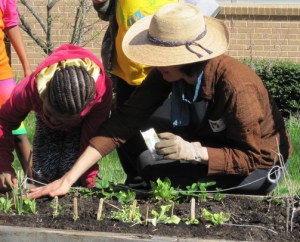
The project began with just a few parents weeding over a period of time. Then, last spring, we created two garden beds out of the mound of grass and weeds surrounding the flagpoles in front of the school. We communicated with the school building manager about our plans. His schedule didn’t allow him to do more than mow the grass, so he was thrilled to have the extra help. We met with the principal, talked about the placement, and got approval to put up cedar edging to hold the earth and mulch. I weeded the existing raised beds in the courtyard and collaborated with a teacher about planting some lettuce and kale with her classes. We uncovered strawberries that we replanted with new compost. With the extra care, the strawberries produced a bumper crop!

IMG_8235I started taking a small bucket and gloves to school every day and weeding during drop-off and pick-up for 10 minutes. This generated conversation, awareness, and new volunteers among the other parents. We asked for parents to bring in flowering perennials from their gardens to plant in the new bed. Some dads brought mulch in their trucks. We visited a few other schools that had gardens to learn about what they were doing.
Continue reading

Journey to Kindergarten, Part 3

This is the third part of a series documenting the steps one family is taking to prepare for their son’s entrance into kindergarten next year. Read Part 1 here and Part 2 here.

by Gail Z.

20160406_080252Since my last post, there have been some new developments in our family’s journey to kindergarten.

Back in early March, I made a call to our neighborhood school. Since, as far as I knew, this school did not schedule open houses or group tours for prospective parents, I wanted to set up an appointment to tour the school. I briefly explained to the secretary who answered the phone that I’d be registering my child for kindergarten and would like to come in for a visit. She didn’t sound at all surprised, which actually surprised me, and gave me the feeling that school visits (even to one’s neighborhood school) are a normal thing. She said the principal would call me back (which was also surprising—I would have direct access to the principal?), but that it might be a couple of days. “No problem,” I said. Having taught elementary school, I know how it is.

I figured I’d get a call back that next morning, but it didn’t happen. Each day that passed, I got excited about seeing my son’s potential school, and held out hope that I was somewhere on the principal’s priority list. But apparently, I wasn’t.

After a week had passed, I thought to myself, I’ll give it more time. But almost in the same moment, I thought, she’s not going to call me back.

So I decided to try again.

I spoke to a secretary—the same one, I’m pretty sure—and she said they had been very busy, and that state testing was in progress. In fact, that was the reason that I hadn’t heard anything. The secretary assured me that she would pass along my name and number again. The call ended with my saying, “I understand. Thank you.”

But something didn’t sit right with me when I hung up. I thought about it for a bit, and it occurred to me that maybe I could enroll my son at his neighborhood school (as required by PGCPS) and potentially submit a transfer request before the school year even begins in August. And if that transfer request is accepted, maybe I could send him to that other school— the same one that his classmates from preschool attend—if that’s what we choose.

Continue reading

Elections 2016: Ahmed, Landis, Burroughs, and Hinton Prevail in Districts 5 and 8

Residents of Prince George’s County Board of Education Districts 5 and 8 had the opportunity to vote for a school board candidate in the Maryland primary election on Tuesday. The two candidates with the most votes will go on to the general election in November.

Here are the Maryland State Board of Elections‘s unofficial results for the two school board races:

District 5:

*Raaheela Ahmed, 36.5%

*Cheryl Landis, 30.6%

Jeana Jacobs, 22.8%

Robert Johnson, 10.1%

District 8:

*Edward Burroughs, III, 59.9%

*Stephanie Hinton, 25.3%

Carlton C. Carter, 14.8%

(*) Candidates will appear on the ballot in the general election.

In all, there will be five school board races in the general election this November. Candidates from Board of Education Districts 1, 4, and 7 did not participate in the primary election, because there are only two candidates vying for each seat in those districts. See the candidate listing on the State Board of Elections site for the full list of candidates for each district.

School board seats in Districts 2, 3, 6, and 9 will be up for election in 2018. For a map of the Board of Education districts, click here.

Continue reading