Notes on the August 25th Board of Education Meeting

by Laura Rammelsberg

To view the agenda for the August 25th Board Meeting in BoardDocs, go here.


At 3:33 in the video. Student Board Member Juwan Blocker called for a Motion (Emergency Item) to discuss Head Start; Jacobs seconded the motion to discuss Head Start. Chairman Eubanks said it should be an Agenda Item so that the CEO and Board have time to prepare. Request was denied.

MOTION: At 9:15. Board Member Burroughs requested a Federal & State External Investigation into Head Start Case. Motion required 2/3 majority vote.
Yes – Anderson, Blocker, Burroughs, Epps, Jacobs
No –Boston ?, Eubanks, Hernandez, Quinteros-Grady, Valentine, Chairman Eubanks
Abstain – Roche, Wallace, Williams
Motion failed.

Continue reading

Proposed Policy Update to Require Training for Parent Volunteers

Lori Morrow presented a version of this testimony during the public comment portion of the May 12th Board of Education Meeting. The views expressed are the author’s own and do not necessarily reflect the views of Prince George’s County Advocates for Better Schools.

by Lori Morrow

I would like to share my thoughts on the volunteer policies on the agenda tonight. I am glad to see that the administrative policies about volunteers will be updated, as there were certainly some gray areas and inconsistent implementation in Administrative Procedures for Volunteers and Criminal Background Checks.

However, as I read the updated language for Board Policy 0106, I’m concerned some of these new procedures have the potential to create barriers for parents who are interested in volunteering. In particular, I believe that, while “Requiring all volunteers and leadership of Parent Teacher Associations and Parent Teacher Organizations to undergo specific training on reporting suspected child abuse and neglect” is an understandable reaction to incidents this year, depending on the form that training takes, it is yet another requirement we’re levying on volunteers that could result in diminished volunteerism.

I am a former Elementary School PTA President, and incoming Middle School PTSO President and I know how difficult it can be to engage parents and recruit them as volunteers. It is my hope that parent leaders and advocates will be included in your process as you establish volunteer training and monitoring procedures. Parents, grandparents and community members who choose to provide free labor in our schools should be treated as welcomed partners, not suspects. We accept the locked doors and Raptor checks and the sign-in procedures, but we also want reassurance that volunteers are welcome and needed.

In my personal experience, I think we lost some of that welcome feeling both when Parent Liaison positions were eliminated in the budget cuts years ago, and also as security measures have increased in recent years. If parents, school staff, and the administration work together, I believe we can find a balance between the transparent, welcoming atmosphere parents and volunteers appreciate, while still maintaining the safe learning environment our students deserve.

Continue reading

Party Politics, Exhibit A: Sample Ballots

by Genevieve Demos Kelley

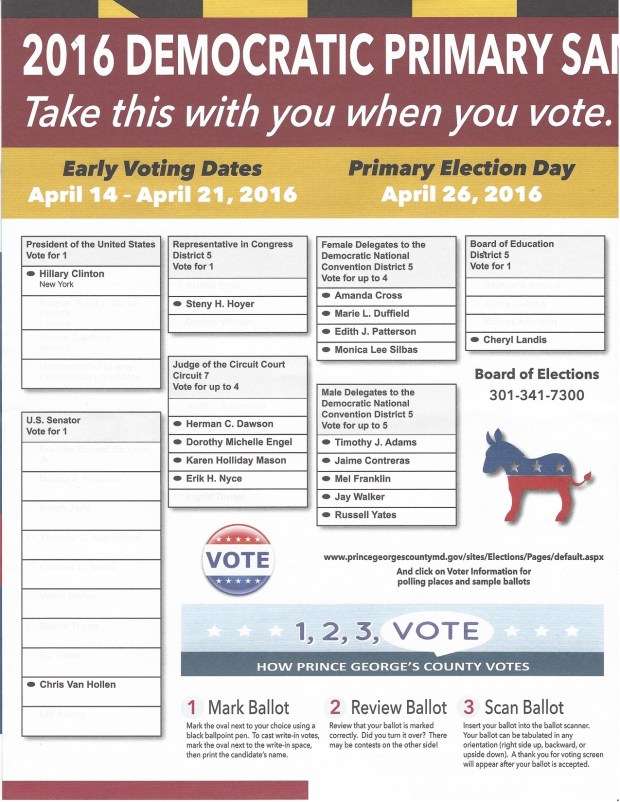
2016 sample ballot mailer2

Last week, I eagerly listened to a segment on Kojo Nnamdi’s WAMU radio show that addressed our politicized school board elections. David Cahn, Co-Chair of Citizens for an Elected Board, and Cheryl Landis, District 5 Board of Education Candidate and Chair of the Democratic Central Committee for Prince George’s County were guests on the show.

At one point, Mr. Nnamdi seemed to understate—or even misstate—the concern that so many of us have about partisan meddling in our school board elections. Speaking to Cheryl Landis, Mr. Nnamdi said, “Mr. Cahn and presumably others are concerned that you make it clear in some of your campaigning that you are a Democrat.”

If Mr. Nnamdi thinks that simply stating one’s party affiliation sums up the problem with partisan campaigns for school board, he is sadly missing the point.

Among the campaign literature for April’s primary election was a mailer sent to District 5 residents touting County Executive Baker’s endorsed candidates. Note the “sample ballot” on page 2 (pictured above), with the banner at the top reading, “2016 Democratic Primary Sample Ballot, Take this with you when you vote.” Names of the preferred candidates are highlighted; names of the other candidates are printed so lightly that only those with sharp eyesight can read them.

When a school board candidate is presented on a sample ballot as the preferred choice (or, in this case, the only choice) of party leaders, it is nearly impossible for any other candidate to prevail. This is the kind of partisan meddling that has led many county residents to conclude that party leaders are stacking the board with hand-selected members, members who owe them their loyalty.


Should the Democratic Central Committee Endorse School Board Candidates?

Tommi Makila wrote the following letter urging the Democratic Central Committee not to endorse specific Board of Education candidates in the upcoming elections.

July 17, 2016

TO: Prince George’s County Democratic Central Committee

RE: Board of Education election endorsements

Dear Central Committee Members:

I am a Democratic community activist who is closely involved in the Prince George’s County Public Schools. I have served on the PTSA board of my child’s school for five years. I have also served for two years as the legislative chair of the Prince George’s County PTA Council, and during that time I have also served on the Maryland PTA legislative committee. I am a member of Prince George’s County Advocates for Better Schools and a founding member of the Alliance for Nonpartisan School Board Elections. I am writing this letter, however, as a concerned parent and individual community activist.

I am writing to you to urge that the Democratic Central Committee not make any endorsements in the November 2016 Prince George’s County Board of Education elections. As the Central Committee makes its decision about potential endorsements in BOE races, I would like you to keep the following issues in mind:

1. By Maryland law, school board elections are to be nonpartisan. I have a hard time coming up with anything else that could be as much against the spirit of this law than the central committee of one of the major parties making endorsements in these races.

2. In a down ballot race such as a BOE election, a Democratic Central Committee endorsement and its accompanying significant financial benefit in the form of the Democratic sample ballot is nearly certain to be decisive. In a down ballot race, it is virtually impossible for any opponent to garner enough financial resources to match the Democratic Party resources. I want us voters to decide the race based on the ideas the candidates present to us. I don’t want the Central Committee with its significant financial resources to make the decision for us voters.

Continue reading

Prince George’s Schools Advocate on Kojo Nnamdi Show

Tommi Makila coordinates the Alliance for Nonpartisan School Board Elections. He is the parent of a student in the Prince George’s County Public Schools system.

by Tommi Makila

A long-time school advocate, David Cahn, will be a guest on WAMU’s The Kojo Nnamdi Show on Wednesday, July 13 at noon. You can listen to the show on WAMU’s frequency of 88.5 MHz, or online. The show is typically divided into two half-hour segments; at this time it is unknown which segment David will be on.

The show’s website assigns this title to the segment: “Is Partisan Politics Poisoning Prince George’s School Board?” David Cahn will address the school board restructuring that happened under House Bill 1107. He is a long-time proponent of a fully elected school board, serving as co-chair of the advocacy group Citizens for an Elected Board. (You can connect with the group through its Facebook page.)

David was invited to be on the Kojo Nnamdi Show after the Washington Post published an opinion piece regarding school board elections that he and I co-authored.

HB 1107 has been getting a lot of attention in the school advocate circles as of late, so please consider calling in to the show to discuss the issue. WAMU’s call-in number is 1-800-433-8850.

Continue reading

The Grading Policy Changes: One Parent’s View

Chelai Johnson is a Prince George’s County parent. The views expressed are the author’s own and do not necessarily reflect the views of Prince George’s County Advocates for Better Schools.

by Chelai Johnson

100_3384 (1)I applaud Prince George’s County Public Schools (PGCPS) for being proactive and convening a project team to assess current grading procedures and policies. A lot of thought and research was put forth by the team. However, there are two recommendations that concern me.

Recommendation #4: Teachers must give grades of no less than 50% on all assignments for good faith effort.

To get credit for putting forth effort is a good thought when kids have struggled. But, as a parent, I would like to think that my children put forth effort in all work, as that’s the expectation my husband and I set in our home. On the other hand, as a parent, I will never know my children’s true level of mastering a subject area if I don’t have access to their true grade. How can they put forth more effort if we don’t know the true effort that was made in the first place?

This leads me to Recommendation #1: Teachers will assign a quarter grade of no less than 50% for quarters one, two and three.

If a student’s grades are not reflective of 50%, why act as if they earned higher averages? Student grades should reflect what they earn. The key word is earned. If I were to decide to obtain a tutor to assist my children or tap into other avenues of assistance, it’s difficult to mark progression with a minimum of 50% implemented. Moving from a 20% to 50% shows a level of early mastery. But the way PGCPS presents the grade, you won’t see progression at the lower levels of mastery, from quarter to quarter. Even though 20% is low, 20 to 50 is a large jump that should not be discounted.

Although there are two recommendations that I oppose, there are two that I support strongly:

Recommendation #7: Students shall have one additional opportunity to improve their score on a qualifying assessment/project which demonstrates knowledge of course content, skills and standards.

Continue reading

Teacher Raises Questions About Grading and Reporting Changes

Natalie Barnes is a math teacher at a Prince George’s County middle school. The views expressed are the author’s own and do not necessarily reflect the views of Prince George’s County Advocates for Better Schools.

by Natalie Barnes

100_3373As a middle school math teacher, I wholeheartedly support some of the thirteen recommended changes to the grading and reporting policy. Teachers should provide a syllabus (recommendation #6), use approved grading systems (#12), and grade and return student work within ten school days (#9). Similarly, administers should ensure that grading is applied uniformly (#13). These seem to be teaching practices that are already common among quality educators.

Yet, there are some policies with which I disagree. Regarding behavior, attendance,and grades (#2 & #3), Gorman Brown explained during the June 9th Board of Education work session (at 40:35 in the video) that grading should be based on course standards. Yet, the mathematical standards include “use appropriate tools strategically”and “critique the reasoning of others” (Standards for Mathematical Practice). From a teacher’s perspective, if a student is throwing rulers across the room or refusing to participate in a lesson, they are failing these standards. During class discussions, Socratic seminars, or classwork in general, what grade should be given to students who do not participate appropriately? That said, a rubric or other more objective scale should be used to reduce subjectivity, but behavior is an important part of a student’s classwork. When asked about the role of participation in grading, Dr. Shawn Joseph responded that “participation is not part of our administrative procedure” (1:02:03) so it is unclear as to how this impacts behavior (1:03:14).

I also have concerns, as do many others, about the uniform minimum grade of a 50%
provided students put forth a good faith effort (#1 & #4). Even though “good faith effort” has been defined by the panel as “any assignment in which a student completes at least 50% of the required content,” this still leaves a great deal of room for subjectivity. As a math teacher, I have seen students write down random numbers and assume that this is quality work deserving of a 50%. Like Board member Ms. Perry (1:18:30), I wonder if only expecting students to turn in work half done is reinforcing good work ethic. Furthermore, I question, as does Board member Edward Burroughs (1:32:45), whether this practice actually prepares students for life beyond high school, including college. True, research shows this helps students avoid giving up. However, in my experience, it also enables students to put forth only a minimum effort.

Lastly, the policies for make-up work are of great concern to me (#3 & #10). I am supportive of make-up work and have my own procedures for it within my classroom. But I do not think a uniform sliding scale is appropriate for the entire county. Each classroom and subject area has different needs. Even within my own classroom, the policy for homework is different from that of projects and classwork. For example, I assign five equations to solve for homework, which are due the following school day; I walk around the room and check for completion. After assigning their completion grades, we review the problems as a class. Should students who did not do the homework be allowed to turn it in for a 95% just by copying down the work and turning it in that day? I think not.

Continue reading

Proposed Changes to Grading and Reporting Policy

by Genevieve Demos Kelley

100_3394A cross-functional team of advisors has made recommendations for significant changes in the way students in Prince George’s County are graded. The 28-member project team, which included parents, teachers, principals, administrators, community organizations, and union representatives, began studying PGCPS’s grading and reporting administrative procedures in February of 2015.

In a presentation made to the Board during a June 9th work session, project team member and high school Principal Gorman Brown outlined thirteen recommendations for revising the grading procedures:

  • Recommendation #1: Teachers will assign a quarter grade of no less than 50% for quarters one, two and three.
  • Recommendation #2: Behavior cannot be used as a grading factor.
  • Recommendation #3: Attendance and tardiness cannot be used as grading factor. Teachers shall allow makeup work, regardless of the reason for the student’s absence. (Make-up work must be returned within 10 days, and student grades may be reduced by 5% each day.)
  • Recommendation #4: Teachers must give grades of no less than 50% on all assignments for good faith effort.
  • Recommendation #5: Schools shall organize one parent conference per semester to discuss students’ grades.

Continue reading

Parents, Board Address Transportation Issues

by Genevieve Demos Kelley
IMG_6355The Prince George’s County Board of Education held its last meeting of the school year on June 14th and adopted—in a 9 to 4 vote—a $1.93 billion Annual Operating Budget for Fiscal Year 2017. Dissenting votes were cast by Edward Burroughs III, Beverly Anderson, Verjeana Jacobs, and Zabrina Epps.

The budget was significantly smaller than the $2 billion that the Board had requested from the County Executive in February. Dozens of cuts were made during the budget reconciliation process, including the $1.27 million proposal to hire 25 additional bus drivers for the 2016-2017 school year.

While the issue of bus transportation was by no means the only topic of the evening, it got plenty of attention from parents, students, Board members, and PGCPS employees. Here are some highlights of the transportation-related comments made during the meeting.

During the Public Comment portion:

A parent at 49:34 in the video of the meeting:

I was disappointed to see that the additional 25 bus drivers were cut in the reconciliation budget. The ongoing shortage of bus drivers has led to doubled-up routes, significant delays, and even the inability to answer the transportation hotline in the morning, because staff are needed to drive . . . Without the additional drivers, I sincerely hope that the transportation department is spending the summer looking for a more efficient way to get students where they need to be, because what we have now is not working well. Students cannot learn if they cannot get to school.

A Northwestern High student representing the Hyattsville Teen Advisory Committee at 1:11:17 (this is a must-watch testimony):

We did some research to find out what was causing the problem of late school buses, and we found two causes: poor pay and poor working conditions [boisterous applause from audience].  .  . [Bus drivers] are often disrespected by students on the bus, and students say that they don’t even know their bus drivers’ names. We recommend that all schools include bus drivers in their orientation at the beginning of the year, and the principal introduce the bus drivers to students and review the rules and consequences for riding the bus [more applause from audience]. We recommend that the school board pass a bus driver appreciation day for the district to honor and recognize the work of bus drivers who support our students and their schools.

Jossalyn Ford, chief steward for the Transportation Chapter of Local 2250 bus driver at 1:17:26:

We work very hard every day to transport the children who attend Prince George’s County Public Schools to and from safely. As we approach the end of the year, we are short of help. As you have very well know that we are doubling, tripling runs. We are tired. We’re doing our very best to transport these kids every single day. But as we do so, we have bus attendants also working with us who have been waiting two or more years to become permanent, to have benefits. HR keeps saying, ‘We don’t have the positions.’ They don’t have the money to hire these people.  .  . And we, as a local, can’t defend a sub-employee .  .  . But I’m telling you right now, we cannot go into next year doing what we’re doing this year.  .  . We have meetings on a month-to-month basis, where we come together and try to address all these issues, and nothing is being done.

A parent at 1:25:16:

I’m mom of a third grader at Tulip Grove Elementary, and for the past several weeks, we’ve been experiencing inconsistent and unreliable bus pickups in the morning. In particular, because of the doubling up on the routes and the tripling up on the routes, you know, sometimes it will be fifteen to thirty minutes before the children are picked up to go to school. We’ve had occasions when the bus just hasn’t appeared .  .  . [W]e could use some communication in some way shape or form, some kind of system in place that could notify parents of an issue, if a bus is going to be late, if a bus is not going to arrive. I’m thinking something similar to bus ETA, like what WMATA uses, something like that. Where we can have warning of notice of a late arrival time . . .If we know, as parent, what’s happening, what to expect, we can make other plans to get our children to school and to get ourselves to work on time. . . I would really urge you to reconsider the staffing levels for bus drivers, because we need to get these kids to school, rather than leave them standing out on the corner for 30 minutes in the morning.

During the Budget Consent Agenda Discussion:

Board member Verjeana Jacobs’s comments at 1:35:03 regarding the value of hiring additional bus drivers vs. adding Lacrosse as a varsity sport:

It’s really disheartening that our employees, bus drivers included, have gone years without adequate funding in the budget, and every year we expect them to just accept that we don’t have money, and it’s just not acceptable .  .  .  A lot of people in my district [District 5], let’s just be clear, love lacrosse. And I do too. But not at the expense of bus drivers who have to get our kids safe here every day, and not at the expense of class size, math specialists, and reading specialists.

Continue reading

Charter Schools, Specialty Programs, and the Issue of Equitable Access

by Genevieve Demos Kelley

The lively discussion about equitable access to College Park Academy that took place during last month’s Board of Education meeting (beginning at 1:51:27 in the video) is must-watch TV—and not just for the moment when Board Chair Segun Eubanks told Edward Burroughs to “shut up and let the parliamentarian answer the question (at 1:54:50).”

Board Member Edward Burroughs (District 8) proposed amending the resolution granting a one-year extension to College Park Academy, a public charter school for students in grades six through nine which offers blended learning in partnership with the University of Maryland. Referring to the University of Maryland’s request that some slots be allotted to the children of University employees and to residents of College Park, Burroughs emphasized that all students, including “our most disadvantaged students,” should have access to the charter school, “not the select few, not those that come from the elite class in the county or in College Park.”

Burroughs’s amendment—which was adopted after a vote by the Board—adds the clause, “whereas the Board of Education wants to ensure equity and access for all students, regardless of socioeconomic status or zip code,” to the language of the resolution.

Contributing to the conversation surrounding equitable access, Board Member Jeana Jacobs (District 5) raised the question of whether children with special needs were being well-served at the school: “You do a review of our special needs population that’s there. There is some suggestion that they’re encouraged to home school or go to their neighborhood school.” (For Jacobs’s remarks, go to 2:06:20 in the video.)

What do the numbers say? Are “our most disadvantaged students” well-represented at College Park Academy? Data from the 2015 Maryland Report Card suggest that College Park Academy serves disproportionately few students needing special services, particularly when compared with the six closest neighboring middle schools (see map of area school locations here).

The table below shows the percentages of students who qualify for Free and Reduced Meals (FARMs), who have limited English proficiency (LEP), and who receive special education services, respectively, at the seven schools listed.

SmallChartv2

Percentages of students qualifying for Free and Reduced Meals, with Limited English Proficiency, receiving special education. An asterisk (*)  is used to indicate fewer than ten students in a category1. Source: 2015 Maryland Report Card, “Students Receiving Special Services”

Continue reading