Notes on the May 11 Board of Education Meeting

by Laura Rammelsberg

To view the agenda for the meeting as a PDF file, go here . To view in BoardDocs, go here.

Board members Raaheela Ahmed, Edward Burroughs, Patricia Eubanks, Sinora Hernandez, David Murray, Lupi Quinteros-Grady, Curtis Valentine, K. Alexander Wallace, Sonia Williams, and Chair Segun Eubanks were in attendance.

At the beginning of the video of the meeting, Report of the CEO.

On this day, 93 graduating seniors were honored who have worked through Hillside Work-Scholarship Connection at their senior celebration. He thanked entire staff at Hillside for expanding these students’ education opportunities.

He also visited the 2017 student-built house, which was built and designed by PGCPS students. Thanked the partners who helped make this opportunity a success.  This was the 41st house the students built. Every house on the cul-de-sac was built by PGCPS students. They have secured 5 more lots nearby so the work will continue going forward. The house is for sale for $459,000.

He recognized all outstanding students and employees for employee recognition dinner. May 25 at Martin Crosswinds in Greenbelt. Tickets are available at pgcps.org deadline to register is May 19.

Please thank a teacher during Teacher Appreciation Week. National School Nurses day was also celebrated.

Special Olympics had 600 PGCPS students participate in the spring games at the Sports and Learning Complex this year. Students trained for twelve weeks, coached by special education program motor development staff.

Prom and Graduation season is here. The 2017 graduation dates are on the PGCPS website here. Parents please speak to children about celebrating in a responsible manner.

At 4:52 in the video, Newsbreak.

Declarations of Independence (Senior Signing Day) at Oxon Hill and Flowers HS:

Dr. Eubanks’s comment about video: Exciting time for our seniors. The speaker at Flowers HS was Dr. John King, former U.S. Secretary of Education. We are attracting some of the greatest minds in the U.S. to celebrate with us.

At 10:21, Legislative Report — Demetria Tobias, Associate General Counsel, Legislative Programs

There is a report in April 25 posted with details about Maryland state budget, local bills and state bills. She is highlighting a few things this evening.

Local Bills — Took many positions, based on Board of Education’s legislative platform.

*HB 1568 Work Group on Transportation for Middle and High School Students in PG County — Look at overlaps in bus routes, look at systems used to transport students, cost savings for transporting middle and high school students. Report due by August.

*Bill that Impacted BOE structure — Bill as amended sought to change election of vice chair, override votes for recommendations by CEO. This bill did not pass. Law as written is what remains. Final report from school system, CEO and BOE due by Dec. 2017. BOE can provide feedback at that point.
Continue reading

SAT Scores Continue Decline, ACT Scores Increase

by Genevieve Demos Kelley

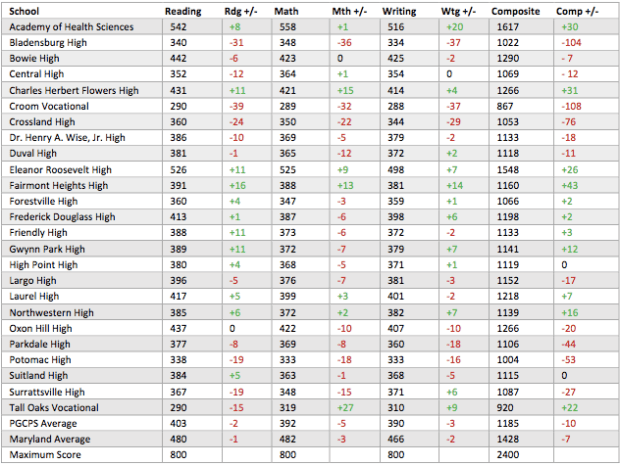
According to the Maryland Report Card, the 2016 mean composite SAT score for Prince George’s County high schools is ten points lower than it was in 2015, representing the eighth straight year of decline. Since 2008 — the earliest year for which data is available — the mean composite score has dropped by nearly 100 points, from 1282 to 1185. The composite score includes a math, critical reading, and writing component*; the maximum score is 2400. The school system’s mean math subscore was 392 in 2016, compared with 397 the previous year. The mean 2016 critical reading and writing subscores were 403 and 390 respectively, compared with 405 and 393 in 2015.

One possible explanation for the decline is that the number of test takers was slightly higher compared with the year before (6,669 vs. 6,630 in 2015), though the cohort of seniors appears to be smaller, based on Maryland Report Card data.

While SAT scores have been declining since 2008, ACT scores in the county have been inching up. The mean composite score in 2016 was 19, compared with 18 in 2015, and 17, in 2008. (The maximum ACT score is 36.) While the number of PGCPS students taking the ACT has increased significantly (1,183 in 2016 compared with 871 in 2008), it is still much smaller than the number of students taking the SAT. It is interesting to note that an ACT score of 19 puts a test taker at about the 44th percentile, compared with students nationwide, making PGCPS’s ACT performance look respectable, if not impressive. (Looking at PGCPS’s SAT scores in the context of national benchmarks and percentile ranks presents a much bleaker picture.)

The table below shows the average reading, math, and writing subscores and the average composite SAT scores for 2016 college bound seniors in each of the county’s public high schools, as well as the average scores for PGCPS and the state of Maryland. Next to each score, the change from the previous year, 2015, is displayed in either red or green. (For example, at the Academy of Health Sciences, the average reading SAT score was 542 in 2016, eight points higher than it was in 2015.)

SAT_table

Mean SAT scores for college-bound seniors, as reported by the MSDE on the 2016 Maryland Report Card; changes (+/-) from 2015.

Continue reading

Update on Administrative Leave Situation in Prince George’s County Schools

An earlier post documented the large number of staff on administrative leave in the Prince George’s County Public Schools (PGCPS).

by Justine C. 

IMG_6404Since I wrote about this issue on March 1, 2017, there has been increased reporting in the local media on the problem. School board members Edward Burroughs (Distrct 8), David Murray (District 1), Raaheela Ahmed (District 5), and Juwan Blocker (Student Member) have created a petition in April to review and revamp the administrative leave policy. Their stated goals are to host listening sessions and create recommendations for improvements to the current policies and procedures.

In addition, this month, PGCPS’s Office of Monitoring, Accountability and Compliance will be providing any recommendations they have for changes to policies and procedures regarding student safety. (See minutes from March 7 Policy, Legal, and Legislative Committee Meeting.) The office was created on July 1, 2016, to oversee the development and implementation of procedures and protocols related to student safety.

In response to a Public Information Act request, PGCPS reports that as of May 2, 2017, there are 153 teachers — compared with 160 on January 31 — and 248 additional staff on administrative leave for a total of 401 personnel, indicating either a decline in the number of reports or faster investigations.

PGCPS also indicated in their response to my Public Information Act request that they implemented a tracking system in early April that includes the disposition of cases, referring to whether or not a staff person was reprimanded, terminated, or some other course of action was taken. However, they do not track the amount of time a case takes to investigate and how long teachers are out of the classroom on administrative leave.

Response to the Public Information Act request is embedded below.

Continue reading

Making Advocacy More Effective

Printby Lori Morrow

After much feedback from constituents — including the Parent and Community Advisory Council — the Prince George’s County Board of Education’s Policy, Legal and Legislative Committee voted not to revise the Board Policy 8345 – Public Comment at this time. Board members acknowledged that the changes were being perceived as limiting public comment, and that this was not their intention. Instead, there is an understanding that many people speak at Board of Education meetings because they are not feeling heard elsewhere. That is something that the system needs to address.


I’ve been a PGCPS parent for nine years, including three years as a PTA/PTSO President, two years on a PTA/PTSO Executive Board, and this past year as a member of the Parent & Community Advisory Council.  I have found myself in front of the Board of Education more times than I can count, and I want to offer some suggestions for parents who are looking to be heard:

  1. Work with your school’s parent organization. Ask to add the issue of concern as a meeting agenda item, so that you canget input from other families. Members of your Parent Teacher Association/Organization (PTA/PTO) Board may have heard from other parents dealing with the same situation or may know if school staff is already working on a resolution.
  2. For PTA/PTO leaders, network with other parent organizations in your area. Find out if they have dealt with similar issues and how they have been able to resolve them.  PGCABS is a great resource to find out what is going on at other schools as well!
  3. Refer to the Ombudsman’s “Guide to Addressing Questions and Concerns”. Finding the right office may help solve your issue sooner.
  4. If you have thoughts on a Board of Education meeting agenda item, consider submitting your testimony to your Board of Education Member a day or two in advance of any vote. This allows the members time to review the information and follow-up with any questions for you or other PGCPS offices.
  5. Take advantage of opportunities to speak with members of the administration or Board of Education at community forums, Family Institute events, and public hearings.
  6. If you plan to speak at a Board of Education meeting as a group, coordinate your message and identify your strongest speakers. Bring other community members to support you in the audience, but often your points can be made with 2-4 speakers.
  7. Suggest a solution or a desired outcome whenever possible. You may have insight or a fresh perspective that members of the administration or Board of Education may not have considered.
  8. When you do speak during the public comment portion of a board meeting, be concise and direct. Respect the time limits and Board of Education guidelines to keep the process running smoothly. Showing that we understand and respect the process will help keep it available as an avenue for engaging school leadership.

Continue reading

Notes on the Apr 25 Board of Education Meeting

by Laura Rammelsberg

To view the agenda for the April 25 Board meeting, go here.

Board members Patricia Eubanks (ill), Lupi Quinteros-Grady (ill), Mary Roche (expecting baby, due this week), and Beverly Anderson were not present.

All items under 8.0 Governance struck from the agenda.

At 17:03 in the video. Report of the Chair

Honored the lives of three middle schoolers who passed away recently.

This was the 31st season of the Science Bowl for PGCPS. Glen Arden Woods ES and Martin Luther King Jr. MS won the bowl this season. Congratulated the students.

Congratulated Brandywine ES, local partners and community volunteers for their outdoor garden/classroom. This effort reflects a great partnership with a community who helped to make the school more beautiful and ready-to-learn.

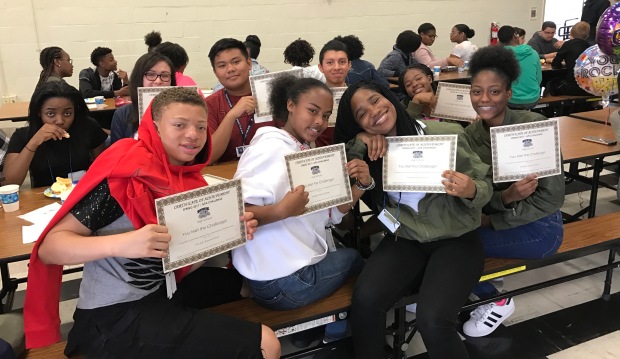
At 21:19. Board Member Raaheela Ahmed — April 12 she co-sponsored Bowie HS Annex challenge to raise their GPAs. 100 students enrolled in the challenge and 30% achieved the goal. This grassroots collaboration was a success, and Board Member Ahmed would like to see more projects like it across the county. Important to encourage growth in our students. Board Member Ahmed acknowledged some of the Bowie HS students and parents in the audience.

May 11 Board Meeting is at 5 pm.

At 23:53. Report of the CEO

PARCC is in progress in schools across the County. Students start this test in 3rd Grade. Parents should ensure students are well-rested.

Congratulated PGCPS Teacher of the Year Carolyn Marzke of Ridgecrest Elementary School, and the runners-up.

Washington Post Principal of the Year and Teacher of the Year — Denise Dunn, Principal of Ridgecrest Elementary School and teacher at Maria Wood of William Hall Academy were nominated for this honor and have made the list of finalists.

Please thank teachers during National Teacher Appreciation Week (May 8 – May 12). Theme is “Teachers Deliver.” Tag photos with #thankateacher to PGCPS twitter account (#PGCPS)

Legislative Report posted in BoardDocs, link to PDF here.

Board Committee Reports

At 27:43. Board Member Curtis Valentine, Chair of Policy & Legislative Committee — Established a priority at beginning of the year to review and assess current policies. Four main goals:

  1. student safety
  2. student equity
  3. health and wellness
  4. teacher quality and pipeline programs

Reviewed travel policy. Looked at Board Handbook to make sure meetings are timely and efficient. Active in participating in MD Legislative Session, testified in Annapolis. Represent Maryland Association of Boards of Education Legislative Committee. Review of minority-based enterprises policy to ensure equity. First Minority-based Enterprises Policy Advisory Board Meeting will be in May. Reviewing student safety/administrative leave policies. Rights of substitute teachers, rights of teachers to communicate with substitute in their absence. Ensuring timely case review. Their committee meetings are public and public can participate. Dates of their meetings are on their website. You can email him as well.

At 32:21. Board Vice Chair Boston, Chair of Governance Committee­ — Congratulated Mr. Brown and team for recognition they received for their finance work. This Committee identifies activities to increase knowledge and skill sets of Board members — professional development of the Board. Last report was in November. Held January committee meeting. Board retreat held on February 3-4. At the retreat, board reviewed book, Courageous Conversations on Race, by Glen Singleton, that anchored a conversation on equity. Also had CEO/Administration presentation on Strategic Plan, updates from all Board committee chairs on their committees. Board was briefed on internal / external communications. March and April meetings discussed equity and Equity Task Force. First meeting of Equity Task Force was held on April 1. This task force will report to Board on a monthly basis. The first report is due on April 1, 2018.

Public Comment on Non-Agenda Items

At 40:30Mt. Rainer K-6 Language Immersion — Parent would like to implement language immersion in Mt. Rainer ES. Cultural mix of PGC is quite vast, our greatest needs are for investments in the future for the county and the country. America is becoming more diverse and he applauds the Board for the programs they are implementing to help the students to learn better. He commends the CEO for his letter to the head of Homeland Security and drawing a line of safety around our community.

At 44:00. District Heights ES — Parent gave very emotional testimony about chemicals released within the school. It is not a safe environment. Contractors walking in and out without badges who don’t sign in and just walk through the building. The children need to be moved until the work is done. The chemicals released today were harmful. The parent and her children had headaches. Other children feeling sick. 40% of the teachers weren’t there because they are sick. It is not safe for the children to be in that building. The children are there to get an education and not to get sick or die. The band-aids are fine, but get the children out while the rest of the work is done. They need help and they need the Board to do something.

Continue reading

It Takes a Village

GPA Challenge Picture.JPG

by Aiyshen Padilla and Llew Brown

Today was a good day. I witnessed an event at Bowie High School that reminded me of all the good that happens when we work together. I was reminded that although we don’t literally live in villages, we still need the support of the village community, especially for our young people.

My village is comprised of both rich and poor. Parents who can afford the best for their children and don’t need help, and parents who desperately need help so their children can grow up healthy with the opportunity to reach their full potential. A community of people who send their kids to private school, and a growing contingent of committed parents who are investing in their local public school. That is where I fall. I believe in public schools and the children who attend them. I am committed to helping change schools for the better.

As parents, we all want the best for our children, but so often we don’t know what is needed or how to get it done. So we came together. It was during a conversation after a Parent Teacher Student Organization (PTSO) meeting this past February when the idea blossomed to create the 9th grade Grade Point Average (GPA) Challenge at Bowie High School. This initiative was a great opportunity to show how we can all come together as a village – parents, administrators, the school board and local businesses.

The Challenge:  The concept was simple: Challenge the 9th graders at Bowie High School to improve their GPA by 10% between the 2nd and 3rd quarters (the third quarter ended March 24, 2017). Make it open to all 9th graders, not just the usual suspects — the high achievers. Invite them to a celebration event at the end of the challenge. Provide certificates of achievement to the students that met the goal and enter them into a raffle for a chance to win gift cards from local establishments. One goal of the program was to inspire other busy parents to get involved in a highly visible way with the school and their student, during future initiatives. Another was to demonstrate a true collaboration across stakeholders in our community.

The Village:  Several parents joined forces to implement the challenge. Collaborating mostly through conference calls and email, extra tutoring was arranged, a menu for the party was developed, and strategies for securing additional support were executed. For example, businesses and a school board representative provided much-needed funds for supplies and food. Additional families donated to the cause. School administrators promoted the GPA challenge by including mention of the challenge during the school’s morning announcements. Administrators also crunched the data and created the space for the celebration to occur.

Continue reading

A Closer Look at 7th Grade Math PARCC Scores

by Lori Morrow

Over the next two months, PGCPS will administer the Partnership for Assessment of Readiness for College and Careers (PARCC) test for the third year. For more about PARCC visit the PGCPS website at http://www1.pgcps.org/parcc/.

In late September 2016, PGCPS announced that students had made gains on the PARCC test at most grade levels. However, there was an exception for seventh grade, my child’s grade. According to a PGCPS press release, “Overall, the percentage of students who met or exceeded expectations was higher this year, with the exception of the seventh-grade math test, whose testing pool excluded higher-performing students enrolled in eighth-grade math or Algebra I.”

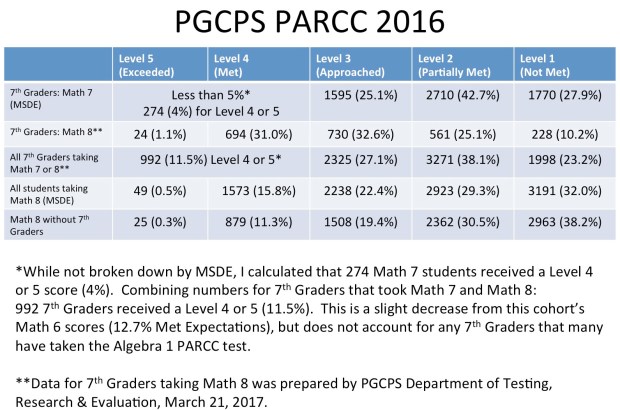
I had initially missed the note about this “exception” but began to look closer at PARCC scores on the Maryland State Department of Education (MSDE) Maryland Report Card after receiving my son’s individual score sheet in October. I was surprised to see so few Level 4 or Level 5 scores for the Math 7 test; those blocks were labeled only with an asterisk, indicating less than 5%. Why had this cohort—students who took the MSA in fifth grade and started with PARCC in sixth grade—fallen behind?

In an email response, PGCPS CEO Dr. Kevin Maxwell said that the apparent drop for the Math 7 scores was due to a change in the testing pool. He explained that in the spring of 2015, seventh-grade students, regardless of their math class, took the PARCC score aligned with their grade, Math 7. However, in 2016, PGCPS chose to have seventh-grade students enrolled in Honors Math/Accelerated 2 take the Math 8 PARCC exam, since the accelerated course curriculum was designed to cover Math 7 and 8. This is a question that I never thought to ask when I attended PARCC nights in the spring, but it made a difference in the score results.

On the MSDE website, it is not intuitive that some students are tested at a level other than their assigned grade before high school. Results are broken down by test level and demographics but not by student’s grade. Furthermore, my follow-up questions to PGCPS about the results of seventh graders alone were met with the answer that the information was not publicly available. I knew that my child’s score level had dropped from taking the Math 6 PARCC test in sixth grade to taking the Math 8 PARCC in seventh grade, but I wanted to know how the rest of the seventh graders in Honors/Accelerated 2 fared on the Math 8 exam. After filing a Maryland Public Information Act request, I received the results.

pgcps parcc2016 with mpia

Continue reading

PGCPS Responds to Concerns About Lead in Water

Earlier this month, Prince George’s County Advocates for Better Schools published a blog post about lead in the water in the county schools. Here is the response from the Office of Communications of Prince George’s County Public Schools:

Thanks for your post about the safety of Prince George’s County Public Schools (PGCPS) students and staff.

Over the past 13 years, PGCPS has taken numerous steps to ensure the safety of drinking water in our buildings. Since 2004, PGCPS has implemented a methodical approach to water quality with drinking sources as our priority. We will soon launch the final phase of our four-pronged program. Prior actions have included sampling and testing all water sources; flushing, replacing or valving off fixtures; and providing bottled water when drinking water sources could not be cleared expeditiously. Our actions to date comply with EPA requirements.

The final phase of our water quality program will allow for retesting of all drinking sources currently in use and the installation of filtered water fountains throughout the system. You can find more information, including a timeline of steps taken to date, on the PGCPS website. We appreciate the community advocacy on this topic and the support from our government partners to complete this work.

Today, PGCPS issued a news release with further information about efforts to address water safety concerns.

PGCPS Home Schooling Office Helps Families Transition to Learning at Home

by Alana Cole-Faber

Last month, my family made the big, scary transition to home schooling. For years, I was one of those parents who proclaimed loudly and repeatedly, “I could never, ever home school my children! People who do that must be crazy!” However, after a less-than-ideal public school experience, we were having a hard time getting our children to maintain a positive attitude about learning. I felt like we needed to hit the reset button, so I took a deep breath — okay, several deep breaths — and filled out the application to home school.

IMG_4875Parents wishing to home school in Prince George’s County essentially have two options: 1) join an umbrella group that will oversee your home s
chool or 2) create your own curriculum and submit a portfolio to PGCPS for review. I decided I wanted to be on my own rather than join an umbrella group. Research told me this would mean participating in two PGCPS portfolio reviews each year. Ack! Scary! I read horror stories online about other parents in Maryland who had terrible experiences with their portfolio reviews. These stories had me convinced that at portfolio review time, I would have to sit across a table from some judgmental person in a suit yelling at me that I was a terrible teacher and a complete failure as a parent! (Note to self: Don’t read the Internet. The Internet is terrifying.) I was so intimidated that I very nearly gave up. There was no way I could do this!

Just when I was beginning to lose my nerve, I attended a PGCPS workshop for parents who are new to home schooling. It was led by the PGCPS Home Schooling Office, which is responsible for providing support and ensuring that parents are complying with Maryland state law. The workshop was fantastic. They reviewed what the law requires, discussed what is entailed in a portfolio review, and even shared some sample portfolios. They came across as very knowledgeable and experienced. Most importantly, they were kind and helpful. It was not scary at all! For me, the greatest value came in the reassurances from PGCPS staff that their goal was to support parents, not judge them. As long as I was covering the required subjects* on a regular basis, I could teach whatever I wanted, however I wanted, and no one was going to yell at me. If I wanted to plan a physical education lesson on how to juggle live mice, I could do that. I would just have to document it for the portfolio.

Continue reading

Destination Imagination Program Brings Rewards and Challenges

by Jane McDougal IMG_2650

Destination Imagination (DI) is an international competition for students of all ages that promotes independence, leadership, creativity, critical thinking and teamwork. Teams compete at regional tournaments, and qualifying teams move on to States and Globals.

My husband has enjoyed managing our oldest son’s DI team for four years at the TAG elementary school. This year I took on the challenge of managing a team for our middle child, a third grader at the neighborhood school. His school did not have a DI program in place, so I reached out to our new principal and the regional DI coordinator for help in getting a team started. This year, we started small with a team of five: four boys and one girl. As a mom of three boys, I felt I could handle it.

Destination Imagination is completely led by the students on the team. Teams choose one of seven challenges (Fine Arts, Engineering, Scientific, Improv, Service/learning, Technical, and Early Learning) and present their solution at a regional tournament in February, March, or April. The team also chooses their team name and decides how they will divide the work and solve the challenge.

My team chose the Fine Arts Challenge: Vanished! They were tasked with presenting a story about the disappearance of a color and how it affected a world. Additionally, they had to create a colorful character that was either involved in or affected by the disappearance of the color. And finally, they had to use a theatrical method to create a vanishing act. This was to be an eight-minute presentation. It’s a tall order for two third graders, two fourth graders, and one fifth grader.

Continue reading