Prince George’s Schools Advocate on Kojo Nnamdi Show

Tommi Makila coordinates the Alliance for Nonpartisan School Board Elections. He is the parent of a student in the Prince George’s County Public Schools system.

by Tommi Makila

A long-time school advocate, David Cahn, will be a guest on WAMU’s The Kojo Nnamdi Show on Wednesday, July 13 at noon. You can listen to the show on WAMU’s frequency of 88.5 MHz, or online. The show is typically divided into two half-hour segments; at this time it is unknown which segment David will be on.

The show’s website assigns this title to the segment: “Is Partisan Politics Poisoning Prince George’s School Board?” David Cahn will address the school board restructuring that happened under House Bill 1107. He is a long-time proponent of a fully elected school board, serving as co-chair of the advocacy group Citizens for an Elected Board. (You can connect with the group through its Facebook page.)

David was invited to be on the Kojo Nnamdi Show after the Washington Post published an opinion piece regarding school board elections that he and I co-authored.

HB 1107 has been getting a lot of attention in the school advocate circles as of late, so please consider calling in to the show to discuss the issue. WAMU’s call-in number is 1-800-433-8850.

Continue reading

Journey to Kindergarten, Part 5

This is the fifth part of a series documenting the steps one family is taking to prepare for their son’s entrance into kindergarten next year. Read Part 1 here, Part 2 here, Part 3 here, and Part 4 here

by Gail Z.

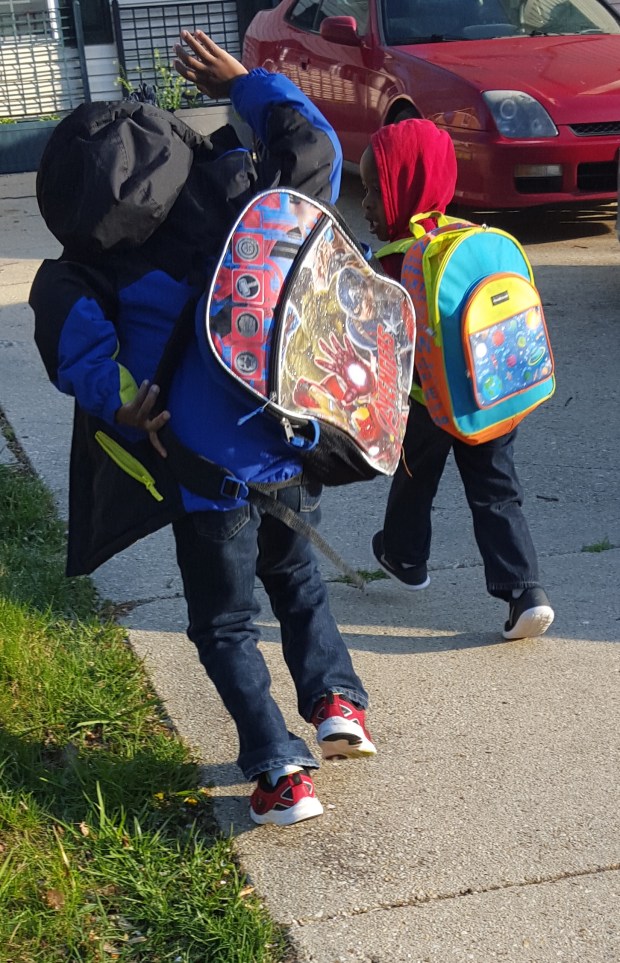
20160406_080252 (1)It’s official. Summer is here, and now that we’ve celebrated my son’s graduation from preschool, we’re starting to prepare for the school year. And now that we know where he’ll go to school, I thought that it would be a good time to share how we arrived at our decision.
In part four of this series, I wrote about our visit to the school on the other side of our neighborhood, and how impressed we were. Not long after, we finally got word that our neighborhood school was offering new kindergarten families a tour of the school. We were encouraged to bring our son along, but we opted not to because we didn’t want to get him excited about a school he might not attend.

On the day of the visit, I had an open mind and was very interested in learning about the school. The principal apologized to those of us to whom she hadn’t been responsive. I appreciated that. During the tour we later learned that her delayed responses were due to PARCC testing.

Much like the tour at the “other” school, we walked from class to class and were able to peek in at what was going on in each room. At both schools, we were told and could see all that is offered to students. But here, something was different. Maybe it was the excitement in the principal’s voice, or that there’s a poetry slam night, during which students perform. Maybe it was the retired art teacher who returned to the district and was now at this school just to ensure that students could experience art class on a bi-weekly basis, or that the students had created musical instruments for a project. Maybe it had something to do with the tone the principal took with the children she encountered in the halls, ensuring that the boys’ shirts were tucked in, thanking them for good behavior, and offering them bucks as a reward. Whatever it was, it felt like a good place for my child to be.

Continue reading

The Grading Policy Changes: One Parent’s View

Chelai Johnson is a Prince George’s County parent. The views expressed are the author’s own and do not necessarily reflect the views of Prince George’s County Advocates for Better Schools.

by Chelai Johnson

100_3384 (1)I applaud Prince George’s County Public Schools (PGCPS) for being proactive and convening a project team to assess current grading procedures and policies. A lot of thought and research was put forth by the team. However, there are two recommendations that concern me.

Recommendation #4: Teachers must give grades of no less than 50% on all assignments for good faith effort.

To get credit for putting forth effort is a good thought when kids have struggled. But, as a parent, I would like to think that my children put forth effort in all work, as that’s the expectation my husband and I set in our home. On the other hand, as a parent, I will never know my children’s true level of mastering a subject area if I don’t have access to their true grade. How can they put forth more effort if we don’t know the true effort that was made in the first place?

This leads me to Recommendation #1: Teachers will assign a quarter grade of no less than 50% for quarters one, two and three.

If a student’s grades are not reflective of 50%, why act as if they earned higher averages? Student grades should reflect what they earn. The key word is earned. If I were to decide to obtain a tutor to assist my children or tap into other avenues of assistance, it’s difficult to mark progression with a minimum of 50% implemented. Moving from a 20% to 50% shows a level of early mastery. But the way PGCPS presents the grade, you won’t see progression at the lower levels of mastery, from quarter to quarter. Even though 20% is low, 20 to 50 is a large jump that should not be discounted.

Although there are two recommendations that I oppose, there are two that I support strongly:

Recommendation #7: Students shall have one additional opportunity to improve their score on a qualifying assessment/project which demonstrates knowledge of course content, skills and standards.

Continue reading

Teacher Raises Questions About Grading and Reporting Changes

Natalie Barnes is a math teacher at a Prince George’s County middle school. The views expressed are the author’s own and do not necessarily reflect the views of Prince George’s County Advocates for Better Schools.

by Natalie Barnes

100_3373As a middle school math teacher, I wholeheartedly support some of the thirteen recommended changes to the grading and reporting policy. Teachers should provide a syllabus (recommendation #6), use approved grading systems (#12), and grade and return student work within ten school days (#9). Similarly, administers should ensure that grading is applied uniformly (#13). These seem to be teaching practices that are already common among quality educators.

Yet, there are some policies with which I disagree. Regarding behavior, attendance,and grades (#2 & #3), Gorman Brown explained during the June 9th Board of Education work session (at 40:35 in the video) that grading should be based on course standards. Yet, the mathematical standards include “use appropriate tools strategically”and “critique the reasoning of others” (Standards for Mathematical Practice). From a teacher’s perspective, if a student is throwing rulers across the room or refusing to participate in a lesson, they are failing these standards. During class discussions, Socratic seminars, or classwork in general, what grade should be given to students who do not participate appropriately? That said, a rubric or other more objective scale should be used to reduce subjectivity, but behavior is an important part of a student’s classwork. When asked about the role of participation in grading, Dr. Shawn Joseph responded that “participation is not part of our administrative procedure” (1:02:03) so it is unclear as to how this impacts behavior (1:03:14).

I also have concerns, as do many others, about the uniform minimum grade of a 50%
provided students put forth a good faith effort (#1 & #4). Even though “good faith effort” has been defined by the panel as “any assignment in which a student completes at least 50% of the required content,” this still leaves a great deal of room for subjectivity. As a math teacher, I have seen students write down random numbers and assume that this is quality work deserving of a 50%. Like Board member Ms. Perry (1:18:30), I wonder if only expecting students to turn in work half done is reinforcing good work ethic. Furthermore, I question, as does Board member Edward Burroughs (1:32:45), whether this practice actually prepares students for life beyond high school, including college. True, research shows this helps students avoid giving up. However, in my experience, it also enables students to put forth only a minimum effort.

Lastly, the policies for make-up work are of great concern to me (#3 & #10). I am supportive of make-up work and have my own procedures for it within my classroom. But I do not think a uniform sliding scale is appropriate for the entire county. Each classroom and subject area has different needs. Even within my own classroom, the policy for homework is different from that of projects and classwork. For example, I assign five equations to solve for homework, which are due the following school day; I walk around the room and check for completion. After assigning their completion grades, we review the problems as a class. Should students who did not do the homework be allowed to turn it in for a 95% just by copying down the work and turning it in that day? I think not.

Continue reading

18 Ways to Be an Involved Parent

IMG_6326As a parent of a child in Prince George’s County Public Schools, how can you become more involved in the school system? How can you make a difference, both in your neighborhood school and in the system at large? Members of Prince George’s County Advocates for Better Schools came up with this list of ideas:

1. Communicate regularly with your child’s teacher. Be sure to include specific expressions of gratitude and appreciation. Contact the teacher first, before going to the principal or supervisor, if you have concerns about what’s going on in the classroom. You may eventually need to work with your school’s guidance counselor or principal for additional assistance.

2. Get to know PGCPS’s new Ombudsman Office. The ombudsman serves as a neutral party to resolve school-related concerns. The ombudsman office should not be your first point of contact, however. Here is PGCPS’s official “Guide to Addressing Questions and Concerns.”

3. Participate in PGCPS’s online surveys and feedback forms. During the 2015-2016 school year, parent feedback was solicited on several topics, including the school systems’ operating budget, proposed new grading policies, and student safety, for example. Watch for these opportunities on the pgcps.org home page.

4. Sign up for email updates. Go here to sign up for email and text updates. Once you submit your email address, you will be given the option to subscribe to a variety of updates. Besides school closings and delays, you may choose announcements from Board of Education members, monthly newsletters from PGCPS, college and career information, lunch menus, and more.
5. Keep track of grades and assignments through SchoolMAX, and communicate with your child’s teacher if you have questions.

6. Get to know other parents and talk with them about their experiences and ideas. Whether they have found frustration or success as they have advocated for their children, you will learn from their stories, and you may be able to work together for a common cause. You might join one of several Facebook groups for PGCPS parents: PGCPS Education Forum, Parents and PGCPS, and PG Parents for Education are good options.

7. Know who your Board of Education representative is and communicate with them about issues that are important to you. (See this map if you’re not sure which Board District you are in.) Most BOE representatives hold forums, community meetings, or morning coffees at several points during the year. Try to attend one for your district. Even if you don’t have a specific concern to bring up, you’ll learn much by meeting the Board member who represents you and listening to what other parents have to say.

8.  Several times each year, PGCPS holds community meetings on various topics. Attending these meetings gives you a chance to talk to PGCPS officials, meet other parents, and give feedback about the school system.

9. If you really want to know more about how the Board of Education works, attend one of its monthly meetings, or watch online.

Continue reading

Q & A with Stephanie Hinton, District 8 Board of Education Candidate

20160227 Stephanie Hinton Portrait

Photo © David Sachs / Studio 20Seven Photography

This is part of a series of interviews with PGCPS Board of Education candidates. Stephanie Hinton is one of three candidates from District 8 (see district map here) whose names will be on the ballot in the April 26th primary election. Ms. Hinton answered questions generated by members of Prince George’s County Advocates for Better Schools. 

Prince George’s County Advocates for Better Schools does not endorse or oppose Board of Education candidates.

Tell us about your background and why you are running for the Board of Education.

I am an educator with over 20 years of experience. I currently teach 34 fifth graders in southern Prince George’s County. I am the coordinator for the STEAM Robotics after-school program, as well as, the science chairperson. I also work as a student-parent advocate, with a focus in special education. I have partnered with a local church to form an after-school tutoring program. I am an original member of the My Brother’s Keeper organization in Prince George’s County.

I decided to run for the Board of Education because of my Magnificent 34. My class had a spell of incidents occur in which I had to fight for them. At one point, it seemed as if something happened weekly. Then, there was a major issue and I had to write to Dr. Maxwell’s office to handle it. It was at that point, that someone suggested I run for the Board of Education, so that I could champion for the rest of the students in this county the way I do for my own students.

Every Prince Georgian deserves the best education this county has to offer. I want to bring that to the students of District 8, and the rest of the county as a whole.

What are your top three goals for PGCPS, and how do you plan to accomplish them if elected?

I created an 8 point path that I feel with assist with bringing equality to District 8. Although all are important, I feel that the following three should definitely be the focus for making District 8 great, along with all of Prince George’s County.

  • Reduce class sizes
  • Create a parent resource center in southern Prince George’s County
  • Institute an anonymous tip line for teachers

I believe the way to accomplish all of my points is through community action. The citizens of District 8, and the rest of the county, have to join together to ensure that our voices are heard. We have to advocate for our students, educators, and community as a whole. If parents have a student in a class of 34, they must make calls daily, and show up to meetings to discuss their displeasure. To travel up to an hour and a half to two hours for assistance is utterly ridiculous.

Continue reading

Please Send Us Your Stories

100_3401We want you to write for us! Send your original content to Genevieve Demos Kelley at pgcabschools@gmail.com. If we like it, we’ll publish it on this blog.

Your story may fall into one or more of the following categories:

  • Opinions. (Go here, here, and here for examples.) Opinion pieces must take a respectful and reasonable tone and must be grounded in documented evidence. Constructive criticism of ideas, policies, and practices is welcome; character attacks are not.
  • Personal narratives. (Go here, here, and here for examples.) We want to read about your experiences — good and bad — with Prince George’s County Public Schools. Stories should not focus on one particular school, unless the narrative is instructive for the larger PGCPS community. Some pieces are a mix of story telling and opinion (like this one, for example). That’s fine.
  • News, information, and analysis. (Go here, here, and here for examples.) Almost any topic is fair game, as long as it is directly tied to PGCPS and follows the guidelines below.
  • Positive pieces. (See here, here, and here for examples.) We love publishing stories that put our schools in a positive light. Keep the good news coming.

Some points to keep in mind:

Continue reading

A Dozen Years of Changes in PGCPS Governance Structure

by Amy Alford

Over the last dozen years, the PGCPS Board of Education has been structured in several different ways. Each time, the change occurred as the result of an act of the Maryland General Assembly.

The governance of PGCPS is unusual compared to school districts across the country. Nationwide, 90% of school districts are termed “Independent School Districts” which means that the elected school board has taxing authority. In Prince George’s County (and in Maryland in general), the school board depends on the county government to partially fund its budget (other money comes from the state and federal government). ([12])

In 2003, the elected board of education was replaced by a board appointed by the county executive (Wayne Curry at the time), and the governor. At the same time, the superintendent position was renamed the CEO, forcing Iris Metts, the superintendent at the time, to reapply for her job. ([1], [2]) She was rehired, but did not seek a new contract in 2003. The dissolution of the school board was in part caused by an attempt by the board to fire Metts. After Metts left, the appointed board hired Andre Hornsby, who resigned in 2005 during a federal investigation that ended with his conviction. ([3]). Howard Burnett served as acting CEO until John Deasy was hired in 2006.

Continue reading