Weekly News Roundup: Tragedy in Oxon Hill

A 14-year-old Oxon Hill teenager was fatally stabbed on Monday as he tried to protect his mother, who was being held at knifepoint by her boyfriend. His 18-year-old brother was also injured in the attack. Keyshuan Mason was a freshman at Potomac High school, and his family has seen an outpouring of support from the school community. (Washington Post)

Five were injured when a school bus and a pickup truck collided in Brandywine on Friday. Fifteen children were on the bus when the accident occurred. One student, the driver, and three others were injured. None of the injuries were life threatening. (WTOP, ABC 7)

Prince George’s County Public Schools is expanding its commitment to integrating arts with core academic subjects like math and English. The five-year plan is to expand the program to all schools in the system. (CBS DC)

A student recorded a cellphone video of a PGCPS school bus driver texting while the bus was in motion on the way to James Madison Middle School. The bus driver is still employed but is under investigation and may be temporarily suspended with the right to appeal. Changes in the PGCPS policy to include termination in the future are under consideration. (WTOP)

Continue reading

When Teachers Hit Children: One PGCPS Parent’s Experience

Alana Cole-Faber, a parent with children in PGCPS, has shared her story here, with the hope that any other parents who have had similar experiences will come forward and work for positive change. You may contact Ms. Cole-Faber at pgparentscircle@gmail.com

by Alana Cole-Faber

In August of 2014, my children began school at Dora Kennedy French Immersion School (formerly Robert Goddard), one of PGCPS’s Specialty Schools. Having completed a successful year of preschool, our children were so excited to finally be attending “real school” with the big kids. We felt incredibly fortunate that we had won the lottery and that our children would have the privilege of attending a National Blue Ribbon school. We have moved a lot as a family, and as parents we were looking forward to settling down in Prince George’s County and getting to know our new community, the teachers, parents, and the school system in general. Instead, we have spent a large portion of the last year dealing with an appalling problem.

In October 2014, our children came home and told us that my son had been spanked at Dora Kennedy French Immersion School. We were stunned. We immediately separated and interviewed our children to find out what had happened and to be sure all of the details of their stories matched up. The children told us that my son had been jumping up and down while the class was singing, so the teacher asked the class to tell her which child had misbehaved and deserved to be punished. The majority of students pointed to my son, so he was called to the front of the class and struck until he cried. I asked my daughter if she thought our son had been hit hard, and my daughter said, “The teacher hit him hard, but she hits another boy even harder.”

My children then went on to name three other children who had been struck by their teacher during the year. (Corporal punishment is illegal in public schools in Maryland. Even so, it is worth noting that we had never received so much as a note home from this teacher to say that our son had misbehaved in class.)

The next morning, we went to the school to report the abuse. We spoke to a supervisory staff member at the school first. The supervisor listened to our story, then left to remove the teacher from the classroom and sent in a security officer to take our written statement. It was explained to us that any time there are allegations of abuse or harassment, a written report is sent to the county for investigation. It was also explained to us that this teacher would not be left alone with students during the investigation. We wrote a written report, including the names of the other children who had been struck. We also asked that our children be moved to other classrooms, just in case the teacher were allowed to return to the classroom following the investigation.

Continue reading

Weekly News Roundup: School Lunches, Arts Integration, Saturday School, and Standardized Testing

CEO Responds to School Lunch Reports:  As part of National School Lunch Week, PGCPS CEO Kevin Maxwell invited FOX 5 along to a Bowie school to have lunch and discuss the recent reports of substandard quality in school lunches.  FOX5

PG County School Closed Due to Fire:  Samuel Chase Elementary School in Temple Hills, MD, was closed Wednesday and Thursday due to a fire caused by an overhead fan.  Students were relocated to a nearby high school.  WTOP

State Lawmakers Investigate Overtesting Complaints:  Lawmakers in the State House and Senate hold a hearing to investigate the common complaint of too many standardized tests in schools.  WBALTV

PGCPS Officials Look to State for School Repair Funds:  Maryland Comptroller visits Suitland High School in a bid by PGCPS to have the state provide matching funds for renovations to ailing schools.  CBSDC

Arts Integration Gains Momentum:  An initiative in PGCPS to integrate arts into the classroom has expanded from 15 to 41 schools over the last year.  This follows a national trend as research emerges showing how combining arts with academics can improve learning.  The Washington Post Continue reading

What’s Working: Great Teaching in Second Grade

by Genevieve Demos Kelley

My son is enjoying his second grade year so far, and I am impressed with the learning that is happening in his class. Here are some instructional practices that seem to be working well:

Spelling pretests and posttests. There are no spelling groups in my son’s class (when I was that age, we had the “green apple group” and the “red apple group”), but there is certainly differentiated instruction. Instead of being grouped by ability, children are given a pretest each Monday on ten spelling words. Students who can spell at least eight of those words correctly are given a list of more challenging words to study that week (called the “star” list), while the rest of the class sticks with the original list (the “smile” list). This means that there is no rigid differentiation between good spellers and not-so-good spellers: A child might be on the “smile” list one week and the “star” list the next.

Moreover, the spelling lists for the upcoming week are included in the weekly newsletter, which is emailed to parents on Friday. This lets my son study the easier words before he takes his pretest on Monday so that he can be on the star list that week. This is his choice, not mine! Spelling has always been a struggle for him, and being assigned the challenging words after a successful pretest seems to be a big confidence booster.

Flexible spelling assignments. Each week, students choose three spelling activities from a list of nine and turn them in at the end of the week. There is a wide range of options (they change from week to week), and students are explicitly given permission to replace any of the activities with something else that is not on the list. Some of the activities are quick and fun (e.g. writing your speling words on your parent’s back with your finger) and some are more arduous (e.g. writing down the dictionary definitions). We always do a practice test as one of the three activities, whether or not it is on the list of options for that week.

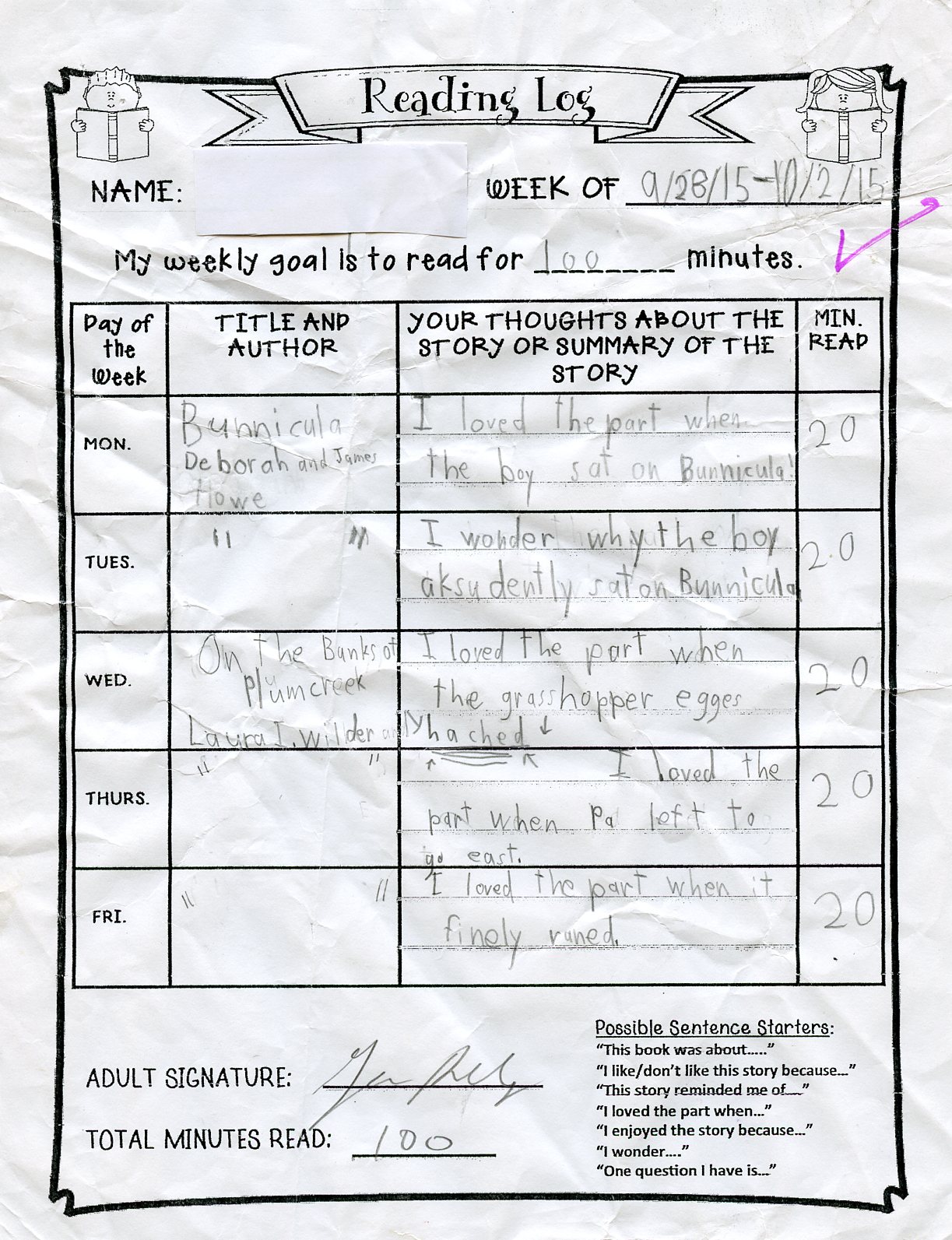
img116_readingLog

What day did he actually read Bunnicula? Who knows? But he is writing about books, and that’s what matters.

Flexible reading log. I have a hard time with reading logs. Though I understand that they are supposed to promote daily reading, I can’t stand the thought of timing one’s reading and keeping a record, as if reading is a chore to be endured. But the reading logs that my son completes each week are flexible enough that we can adapt them to our read-for-pleasure-with-abandon lifestyle.

  • For each day (Monday through Friday), there is a space for students to fill in the number of minutes that they’ve read, but we don’t keep track. My son just writes “20” for each day, though he usually reads for much longer.
  • He has to write one sentence per day on what he’s read, but the sentence can be anything at all, as long as it says something about the book. This really helps. My son needs practice writing sentences about what he reads, but at this point, he doesn’t need something overly prescriptive.
  • And here’s what really makes the reading log doable for us: We don’t worry about filling in the chart every day. My son does most of his reading before bedtime, and it would be extremely disruptive to have him fill out his reading log just before bed. Besides, reading is pure fun for him, and I don’t want the reading log — a task that he does not enjoy — to intrude on that experience. So he sometimes writes a week’s worth of sentences in one day. He still gets practice writing sentences about what he reads, but its not really a daily log anymore after we’re done with it. And that works better for us.

Continue reading

Art Class: Coloring in the Lines?

One PGCPS parent has shared with us her recent observations about her daughter’s art class curriculum. She has asked to remain anonymous until her concerns are addressed and resolved. The views and opinions expressed are the author’s own and do not necessarily represent the views of PGCABS.

As an art teacher and professional illustrator, I was happy to learn that my kindergartener would have art class once a week, and I was very curious to see what kind of art curriculum would be implemented in class. I have over 5 years of experience teaching art, especially focusing on ages eight and under. My classes are structured around the elements and principles of art, and I have found kids even as young as three to be very receptive to these concepts, not to mention the frame-worthy artwork they create while learning them.

So far this year, my five-year-old has had six art classes (once per week), and for all but one she has brought home nothing but pixellated coloring pages printed from the internet, with the web address still intact at the bottom. The one day that she didn’t bring home coloring pages, she proudly showed me a scrap of paper with some fringe cut off the bottom. She told me they were supposed to glue things to it, but they didn’t have glue that day. She reported that their most recent art lesson was “learning to color inside the lines,” which some might argue could be considered an anti-art lesson.

Continue reading

Weekly News Roundup: Construction Delays, Maintenance Concerns, Literacy Coaches, Openings for Bus Drivers and Nurses

Accokeek Academy middle school students thought that they would begin the new school year in a newly renovated building, but due to construction delays, they are still in portable classrooms. The Academy is a K-8 school, and the elementary school portion of the renovation was completed in 2014. However, the new HVAC system has not worked properly since the upgraded building opened. (Sentinel)

In a September 24 meeting, the Board of Education discussed the need for better maintenance of facilities and debated whether there is inequity between schools in the southern and northern regions with respect to the system’s responsiveness to maintenance needs. (Sentinel)

In 2014, only 12% of PGCPS students who took the SAT demonstrated college readiness, compared with a 41% of students in the state of Maryland. PGCPS hopes that literacy coaches in schools will help to change that. (ABC 7)

Arne Duncan’s departure as Education Secretary — happening in December — has been met with a wide range of reactions. The Washington Post publishes a roundup of reactions, from Duncan’s critics and supporters. (Washington Post)

Continue reading

Give Input on Next Year’s Budget at Oct. 13 Forum

by Genevieve Demos Kelley

CEO Kevin Maxwell and his team are already developing the Fiscal Year 2017 operating budget for Prince George’s County Public Schools and will present a proposed budget to the Board of Education some time in December. On Tuesday, October 13 at 7 pm, members of the community will have the opportunity to present testimony in the Sasscer board room regarding budget priorities for FY 2017. This public input will be shared with CEO Maxwell.

Speakers will be given two minutes to speak at the forum and must register by 4:30 p.m. on the day of the forum by calling 301-952-6001. Read more details in the Oct. 7 news release.

Wondering why we’re already talking about the 2017 budget? Here’s a quick review of the budget process:

  • The Fiscal Year 2017 budget actually goes into effect in 2016. It covers the period from July 2016 through June 2017.
  • The CEO and his team begin crafting a budget during the summer, a full year before it will go into effect. The CEO then presents a recommended budget to the Board of Education some time in December.
  • After work sessions and public hearings, the Board of Education adopts a version of the budget, using the CEO’s proposed budget as a starting point. Once the Board votes on the budget (probably in some time in February), it is known as the “requested budget” for the next fiscal year.
  • Why “requested”? Because the Board then sends the budget to the County Executive and County Council for approval. The County Council may or may not decide to fully fund the Board’s requested budget. (In the case of the FY 2016 budget, the Council gave PGCPS less than they asked for.)
  • Once the County Council has approved a spending level, the Board of Education must go through a process of reconciliation — making the budget fit the constraints set by the Council’s funding decision.
  • The Board of Education then votes to pass a final budget in June.

Weekly News Roundup: Health Director Placed on Leave, New U.S. Secretary of Education

Dr. Angela Wakhweya, PGCPS’s director of health services, has been placed on leave for reasons that are not entirely clear. School records indicate that thousands of students have not been properly immunized (NBC 4).

Related stories: Dr. Wahkweya discussed challenges of immunization and blamed PGCPS administration for failing to help her get the job done (NBC 4). Almost 2,000 students were not permitted to attend Prince George’s County schools on October 1, because they did not have up-to-date vaccinations on record (NBC 4).

Forty-one schools are participating in PGCPS’s arts integration program, where students learn academic concepts through visual art, music, and movement. PGCPS hopes to expand the program to all schools in the county within five years. (The video at WUSA 9 is a more complete story than the text below the video viewing window.)

Twenty-nine elementary schools will benefit from a federally funded grant of $911,200 aimed at helping students sample fresh fruits and vegetables that they might not otherwise experience (e.g. asparagus, star fruit). Schools will be given $50-75 to spend per student for a vegetable or fruit snack during the day. (PGCPS News Release)

Secretary of Education Arne Duncan will step down in December. President Obama has chosen deputy secretary John B. King, Jr. as his successor. King previously served as New York state’s commissioner of education, where he came under fire for implementing new teacher evalutions tied to test scores and for pushing the state to adopt new Common Core tests. King also has a background in charter school leadership. (Washington Post)

Continue reading

Sixth Grader Excited about Composting, Gardening, and Recycling at School

Berwyn Heights Elementary has been certified as a green school by the Maryland Association for Environmental and Outdoor Education (MAEOE). One student member of the school’s environmental club wrote about how Berwyn Heights Elementary runs a successful composting and gardening program.

Hi, I’m Zada and I’m in 6th grade at Berwyn Heights Elementary School in Prince George’s County. I’m a member of the school’s environmental club for the second year now. In the environmental club we do many activities. Some things we do are composting, recycling, and trying to be as green as possible!

Composting was the main thing we did. We would compost every week last year. This year we have buckets for compost in the lunchroom and outside classrooms. Every day some sixth graders, including me, collect the buckets from the cafeteria and classrooms and empty the compost. It is later dumped into a larger compost bin that is located outside of our school. In the compost we put in greens and browns. Greens are things like apple cores, banana peels, orange peels, coffee grounds, egg shells, and salad without dressing, cheese or meat. Browns are things like leaves, grass clippings, and hay. Meat, cheese, dressing, and large sticks and twigs cannot be composted. The ratio is every bucket of greens needs three buckets of browns.

When we began composting last year, we only collected food scraps from breakfast. It took us a long time to fill our large compost bin outside. When we finally filled it, we mixed it up really well and then let it “cook.” While it “cooked” (which was really just sitting there breaking down), we took the temperature of it a few times a week. When it was really breaking down the temperatures got as high as 130 degrees! Once during the cooking process, we pulled everything out, mixed it again and then put it back in the bin.

Continue reading

Will 28,000 PGCPS students miss school tomorrow because of missing vaccinations?

by Kate McElhenny

http://www.nbcwashington.com/video/#!/news/local/Health-Director-Blames-Discrimination-on-Immunization-Rates/330012861

This clip from NBC Washington misstates the number of students missing vaccinations as 28,000. (That would be almost 25 percent of the total student population!) A quick call to Sherrie Johnson, PGCPS Public Information Officer cleared up the confusion. Drop a zero.

The number remains disturbing at 2800. For comparison, Montgomery and Charles Counties have numbers of students without proper vaccinations in the single digits.

In the above clip, Dr. Angela Wakhweya, PGCPS Health Director, cites PGCPS for failing to reach out to residents with language and economic challenges as the reason for the high number of those without necessary vaccinations.

Missing student records were also mentioned as a cause. Some parents have questioned whether the number of students without proper immunization is actually as high as reported.

As a parent of a kindergartener, I was contacted by the district (after registration and before the start of school) for not having her immunizations on file. When reached, staff at her elementary school assured me that they did possess her files and there was no need for concern. A district employee called days later again stating that they did not have our daughter’s immunizations on file.

Continue reading