Weekly News Roundup: Salary Disparities, Cricket Leagues, Proposed Legislation

A report from the Washington Area Boards of Education (WABE) shows large disparities in average teacher salary between school districts in the Washington area. The average teacher salary in Prince George’s County is $9,300 less than it is in Montgomery County. Virginia’s Prince William County has the lowest average teacher salary in the region, and Arlington County is the highest-paying suburban district in the region (Washington Post). To read the entire WABE report, which includes other information such as cost per pupil, total enrollment, and funding sources, go here.

The Prince George’s County delegation is proposing more than two dozen bills in the upcoming legislative session. Among them are a pilot program that would move schools toward a restorative justice discipline model, as an alternative to suspensions, a bill to establish an inspector general over Prince George’s County Public Schools, and a proposal to require CEO Maxwell to report regularly to the general assembly about the school system’s finances (Washington Post).

Delegate Alonzo Washington provides more details about his proposal to establish an Office of the Inspector General in PGCPS and his proposal to move toward a restorative justice model of discipline in his November 18th newsletter.

Andre Brown, a former High Point High School teacher who was convicted in September of sexually abusing a student, was sentenced on Thursday to ten years in prison. (NBC 4)

Continue reading

New Dist. 7 Board of Education Member Welcomed

K. Alexander Wallace, the new District 7 Board of Education member, was introduced at the November 12 Board of Education meeting.

You may watch Board Chair Eubanks’s welcome and Mr. Wallace’s introductory remarks, beginning at 14:50 and ending at 16:45 in the video of the November 12 meeting below.


Mr. Wallace is pursuing a Master in Public Administration at the University of Baltimore, after having earned a Bachelor of Science degree in political science from Towson University. He is a graduate of Dr. Henry A. Wise, Jr. High School in Prince George’s County and currently lives in Upper Marlboro.

Continue reading

Sound Off: PGCPS Parents Share Top Concerns

At a recent community event , we asked participants to jot down what theyIMG_6404 thought were the top concerns facing Prince George’s County Public Schools. They wrote their ideas on sticky notes and posted them anonymously on a poster board.
The answers we got are listed below. These are unedited and in no particular order.

Readers, what would you add to our list? Tell us in the comments section.

  • Low rankings.
  • Community detachment.
  • Lack of link between school and jobs.
  • Lack of community confidence in the schools.
  • Some great specialty programs, but “comprehensive” students and regular neighborhood schools seem to be falling through cracks.
  • Lack of youth and parent engagement to help students succeed or prepare them for their next steps.
  • Parents have to struggle to get needed services for their kids.
  • Lack of community schools.
  • Poor communication between PGCPS and parents.
  • Not enough teacher input when decisions are made.
  • Poor communication between schools and families.
  • No entrepreneur academy for vocation and alternative career youth.
  • Abuse in public schools.
  • No oversight or follow-up to abuse complaints.
  • Teachers are overwhelmed/pulled in, a lot of directions/exhausted, etc.
  • Lack of community schools.
  • Too much standardized testing.
  • What about the children?
  • Seeking progressive education models.
  • Full state funding for schol projects/programs
  • Better engagement between the school district admin and BOE with the parent and private sector community.
  • More transparency.

Continue reading

Weekly News Roundup: State Funding Issues, Charter School Applications, PARCC Scores

With budget surpluses on the horizon, Democrat lawmakers are urging Governor Hogan to release the $68 million in GCEI education funds he withheld in May. The money would go to high-cost school districts, with the lion’s share going to Prince George’s, Montgomery, and Baltimore Counties and Baltimore City. (Washington Post)

Governor Hogan and Comptroller Franchot expressed frustration with Maryland’s spending on school construction, at a Board of Public Works meeting on Wednesday. “We can’t just keep shoveling more and more money without accountability,” Hogan said. “The taxpayers are getting pretty frustrated the results.” (Maryland Reporter)

Venture Philanthropy Partners is working with PGCPS to create a new program called “Ready for Work: Champions for Career and College Ready Graduates.” The group has already donated $5 million and has made a committment to work with graduates from Suitland, Oxon Hill, and High Point high schools to “provide internships, to give kids job coaches, to create opportunities for kids to be successful,” according to CEO Kevin Maxwell. (CBSDC)

Continue reading

PARCC Results Released for Prince George’s County

According to a PGCPS news release, the school system has received the PARCC results for the English 10, Algebra 1, and Algebra 2 tests. The new PARCC tests were administered for the first time in the spring of this year. Scores for elementary and middle school tests will be released in early December. (Update: Click here to read our story on the PARCC results for grades 3 through 8.)

Tests are scored with on a five-point grading scale, with a score of 4 indicating that expectations were met and 5 indicating that the student exceeded expectations. On the whole, Prince George’s County’s results were poor compared with the statewide results, but some PGCPS subgroups fared better than their peers: For example, 13.4% of African American students in Prince George’s County scored at a Level 4 or 5, compared with 12.8% of African American students statewide.

On the English 10 test, 28.9% of PGCPS students scored a 4 or 5, compared with 39.7% in the state of Maryland. On the Algebra 1 test, 15.1% of county students scored a 4 or 5, compared with 31.2% of students statewide. In Algebra 2, 8.3% scored a 4 or 5, compared with 23.2% of students in the state.

Read the full news release here.

To find a detailed breakdown of scores, including scores by racial/ethnic subgroup and other groups (e.g. FARMs qualifying, English language learners), go to the Maryland Report Card. Find scores for each school system in Maryland by selecting the county or city under the “County” pulldown menu.

Below is a roundup of what major news outlets have to say about the results:

  • The Washington Post reports that less than half of the Montgomery County students who took the Algebra and English tests and less than a third of those in Prince George’s County students are considered on track for college and careers, according to the PARCC test results. But deputy superintendent Shawn Joseph pointed out that Prince George’s County scores look better when broken down by racial subgroup: white students in the county outperformed their peers across the state on all three exams, and African American students beat state averages on two of the three exams.

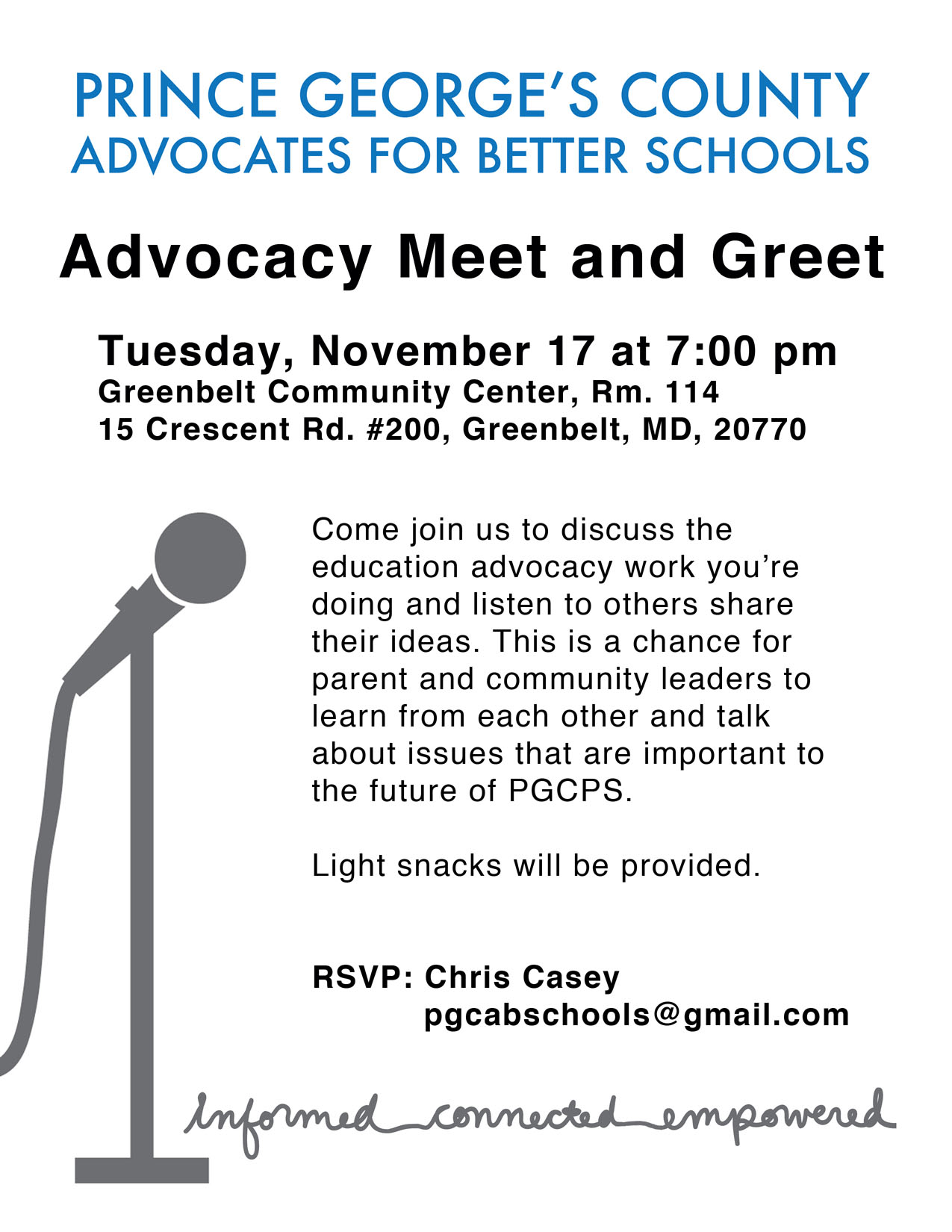
Come Talk About Your Advocacy Efforts at Nov. 17 Meet and Greet

Prince George’s County Advocates for Better Schools is hosting a Meet and Greet on Tuesday, November 17th, at 7 pm, in Room 114 of the Greenbelt Community Center.

This is a chance for parents and community members to meet informally and talk about the education advocacy work they are doing in the PGCPS community. We are hoping that participants will share ideas, make connections, and find common ground as they listen and learn from each other. Anyone with an interest is invited! You do not have to consider yourself a parent or community leader or education advocate to attend.

Please send questions and RSVPs to Chris Casey at pgcabschools@gmail.com.

PGCABSflyer.v2.small

Demographic Shifts Accompany Growth in PGCPS Enrollment

by Genevieve Demos Kelley

The 2015 Maryland Report Card is here. The 2015 data are not released all at once; county-specific numbers about standardized assessments and graduation rates will be published later. But in the meantime, the report has some interesting things to say about demographic trends in enrollment.

Enrollment in Prince George’s County Public Schools has been increasing since 2013, reversing a nine-year decline. The 2015 enrollment for PGCPS is 127,576, an increase of 2,440 students from 2014 enrollment and a total increase of 3,839 students since 2013.

But not all racial/ethnic subgroups are seeing growth. Though African American students still make up the largest subgroup (62.7% of all students), enrollment among African American students has declined over the last two years, from 81,786 in 2013, to 80,821 in 2014, to 79,915 in 2015.

Meanwhile, enrollment among Latino students has climbed to 35,597. That’s an increase of 3,267 since 2014, and 5,693 since 2013. Notice that the two-year gain in enrollment in the Latino subgroup (5,693) exceeds the two-year gain in total enrollment for the school system (3,839).

Continue reading

Weekly News Roundup: Financial Literacy “Mini-city” Opens, Low PARCC and NAEP Scores

After a student filmed a PGCPS school bus driver texting while the bus was in motion, PGCPS is changing its transportation discipline handbook so that drivers who misuse cellphones on a school bus can be fired. (NBC 4)

A new financial literacy center opened Tuesday on the campus of G. James Gholson Middle School. The Prince George’s County Junior Achievement Finance Park is a partnership with PGCPS, Capitol One, and Junior Achievement of Greater Washington. It is a 13,500 square foot experiential learning center that will serve 9,000 students per year. Students visiting the center will take on a role (e.g. career, salary, financial obligations) and, using a digital tablet, put their financial skills to the test in a “mini-city” with storefronts and kiosks. (PGCPS)

Columnist Michelle Singletary writes of the need to be wary of conflict of interests in financial literacy programs. (Washington Post)

An Eleanor Roosevelt HS freshman writes an opinion piece for the Washington Post, questioning whether extracurricular activities should affect college admissions. (Washington Post)

At Central High School, a student’s cell phone went missing, and campus security searched the binder and book bag of every student in the class. Now the family of one of the students who was searched has filed a lawsuit, claiming that the search was illegal. (Washington Post)

Continue reading

Clara Yancey Named New Acting Principal at Dora Kennedy French Immersion

The following is a letter written to parents of children at Dora Kennedy French Immersion School dated October 27, 2015. Note that the letterhead reflects the former name of the school, Robert Goddard French Immersion. The school was officially renamed this year.

DoraKennedyLetter10_27_15

The content of the letter is transcribed below:

October 27, 2015

Dear Members of the Dora Kennedy Community:

In recent days, some of you may have participated in discussions or viewed media reports surrounding allegations of student abuse at Dora Kennedy French Immersion. I’m writing to you today to share the steps we are taking to address this situation.

First, please know that PGCPS continues its full investigation into the alleged incidents. While I would like to provide you with the details of the exact steps we have taken, I am bound by the district’s confidentiality measures that are designed to protect both the families and the employees involved. If information becomes available that we can share, you have my committment that I will do so in a quick and transparent manner.

Second, effective immediately, Mrs. Clara Yancey will serve as acting principal of Dora Kennedy French Immersion. We feel it was best to make this change, so that we can be assured we are moving forward on a path that is guided by fairness, integrity, and transparency for everyone. Mrs. Clara Yancey is a retired principal from Prince George’s County Public Schools with a distinguished and proven record as an effective instructional leader. She is a seasoned administrator with decades of professional experience and extensive expertise across a full suite of academic disciplines. Please be assured that the academic environment will continue to thrive Mrs. Yancey’s leadership.

Continue reading

When Teachers Hit Children, Part 2: Responding to Suspected Abuse

Alana Cole-Faber shared her story with us last week in “When Teachers Hit Children: One PGCPS Parent’s Experience.” In this post as well as in the previous post, she writes from the basis of her personal experience as a parent, not as a legal proffessional, child psychologist or expert in abuse.

by Alana Cole-Faber

As I have shared in a previous post, last year our children reported to us that they had experienced physical and emotional abuse at their school. When our children first reported this to us, we were alarmed and terrified. We had so many questions. What should we do? Whom should we tell? Are we the only ones? What will happen when we report this? Will there be retribution against us or our children?

We are not experts on abuse or child psychology, so we would always recommend consulting an expert when it comes to concerns of abuse and have done so ourselves for the sake of our own children. However, based on our experiences, these are the actions we would suggest to other parents whose children may have experienced abuse at school.

At Home

1. Aim for prevention. Talk to your child about what behaviors are not appropriate from teachers and classmates. Tell your child exactly what they should do if they believe a teacher or classmate is behaving inappropriately. Repeat this conversation regularly, and be sure to give your child the opportunity to ask questions.

2. Create an environment in which your child feels secure and knows that he/she can come to you with problems. We made a rule with our children that if they got in trouble at school and were punished at school, we would not punish them at home as long as they told us the truth about what had happened at school. This did not mean we did not care about misbehavior, but rather that we placed more emphasis on honesty and openness in our home. We believe this was the critical thing that made our children feel comfortable talking to us after our son was struck by his teacher.

3. Keep an eye on your child’s behavior. If your child’s behavior or attitude towards school changes suddenly, this could be a sign that your child has had a negative experience. This negative experience might simply have to do with finding school work more challenging, or it might be an indicator that something more serious has taken place. In our children’s case, their attitude toward school changed dramatically almost overnight. They began asking to stay home, whereas before they had always loved going to school and would barely take a moment to hug us goodbye before running off to join their class.

4. Talk to your child about his/her experiences at school. When you talk to your child about school experiences, try to talk to your child alone, without siblings or others present who may distract or otherwise influence your child. It may help your child relax if you talk while doing another activity that he/she enjoys, such as putting together a puzzle or coloring. One of our children was always very comfortable talking about experiences, but our other child felt most comfortable having a stuffed animal tell us what happened. Ask open-ended questions whenever possible and avoid asking leading questions, even if you think you know exactly what happened during the incident in question. Try to remain calm and avoid reacting emotionally to the things your child describes. If your child describes an event that alarms you, calmly ask questions like, “What happened next? What did the teacher say? Who else was there?” Reassure your child that he/she is not in trouble for reporting information to you. In our experience, it took multiple conversations before our children were willing to reveal all of the details of the event.

5. Do your best to help your child identify and understand his/her feelings about the event. Validate any feelings your child may have. You can try saying something like, “You said that behavior made you feel sad. I understand. I think I might feel sad, too, if something like that happened to me.”

Continue reading