A Closer Look at 7th Grade Math PARCC Scores

by Lori Morrow

Over the next two months, PGCPS will administer the Partnership for Assessment of Readiness for College and Careers (PARCC) test for the third year. For more about PARCC visit the PGCPS website at http://www1.pgcps.org/parcc/.

In late September 2016, PGCPS announced that students had made gains on the PARCC test at most grade levels. However, there was an exception for seventh grade, my child’s grade. According to a PGCPS press release, “Overall, the percentage of students who met or exceeded expectations was higher this year, with the exception of the seventh-grade math test, whose testing pool excluded higher-performing students enrolled in eighth-grade math or Algebra I.”

I had initially missed the note about this “exception” but began to look closer at PARCC scores on the Maryland State Department of Education (MSDE) Maryland Report Card after receiving my son’s individual score sheet in October. I was surprised to see so few Level 4 or Level 5 scores for the Math 7 test; those blocks were labeled only with an asterisk, indicating less than 5%. Why had this cohort—students who took the MSA in fifth grade and started with PARCC in sixth grade—fallen behind?

In an email response, PGCPS CEO Dr. Kevin Maxwell said that the apparent drop for the Math 7 scores was due to a change in the testing pool. He explained that in the spring of 2015, seventh-grade students, regardless of their math class, took the PARCC score aligned with their grade, Math 7. However, in 2016, PGCPS chose to have seventh-grade students enrolled in Honors Math/Accelerated 2 take the Math 8 PARCC exam, since the accelerated course curriculum was designed to cover Math 7 and 8. This is a question that I never thought to ask when I attended PARCC nights in the spring, but it made a difference in the score results.

On the MSDE website, it is not intuitive that some students are tested at a level other than their assigned grade before high school. Results are broken down by test level and demographics but not by student’s grade. Furthermore, my follow-up questions to PGCPS about the results of seventh graders alone were met with the answer that the information was not publicly available. I knew that my child’s score level had dropped from taking the Math 6 PARCC test in sixth grade to taking the Math 8 PARCC in seventh grade, but I wanted to know how the rest of the seventh graders in Honors/Accelerated 2 fared on the Math 8 exam. After filing a Maryland Public Information Act request, I received the results.
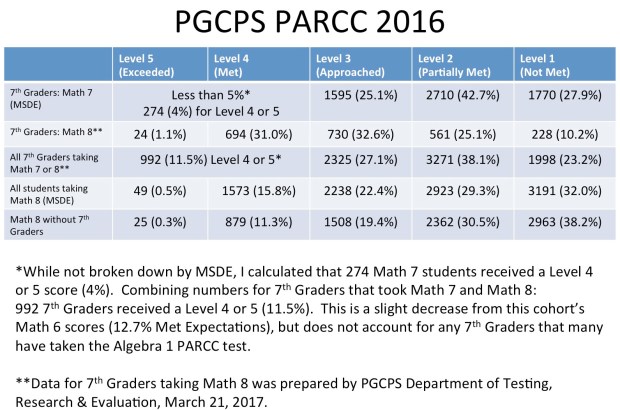
pgcps parcc2016 with mpia

Continue reading

PGCPS Responds to Concerns About Lead in Water

Earlier this month, Prince George’s County Advocates for Better Schools published a blog post about lead in the water in the county schools. Here is the response from the Office of Communications of Prince George’s County Public Schools:

Thanks for your post about the safety of Prince George’s County Public Schools (PGCPS) students and staff.

Over the past 13 years, PGCPS has taken numerous steps to ensure the safety of drinking water in our buildings. Since 2004, PGCPS has implemented a methodical approach to water quality with drinking sources as our priority. We will soon launch the final phase of our four-pronged program. Prior actions have included sampling and testing all water sources; flushing, replacing or valving off fixtures; and providing bottled water when drinking water sources could not be cleared expeditiously. Our actions to date comply with EPA requirements.

The final phase of our water quality program will allow for retesting of all drinking sources currently in use and the installation of filtered water fountains throughout the system. You can find more information, including a timeline of steps taken to date, on the PGCPS website. We appreciate the community advocacy on this topic and the support from our government partners to complete this work.

Today, PGCPS issued a news release with further information about efforts to address water safety concerns.

PGCPS Home Schooling Office Helps Families Transition to Learning at Home

by Alana Cole-Faber

Last month, my family made the big, scary transition to home schooling. For years, I was one of those parents who proclaimed loudly and repeatedly, “I could never, ever home school my children! People who do that must be crazy!” However, after a less-than-ideal public school experience, we were having a hard time getting our children to maintain a positive attitude about learning. I felt like we needed to hit the reset button, so I took a deep breath — okay, several deep breaths — and filled out the application to home school.

IMG_4875Parents wishing to home school in Prince George’s County essentially have two options: 1) join an umbrella group that will oversee your home s
chool or 2) create your own curriculum and submit a portfolio to PGCPS for review. I decided I wanted to be on my own rather than join an umbrella group. Research told me this would mean participating in two PGCPS portfolio reviews each year. Ack! Scary! I read horror stories online about other parents in Maryland who had terrible experiences with their portfolio reviews. These stories had me convinced that at portfolio review time, I would have to sit across a table from some judgmental person in a suit yelling at me that I was a terrible teacher and a complete failure as a parent! (Note to self: Don’t read the Internet. The Internet is terrifying.) I was so intimidated that I very nearly gave up. There was no way I could do this!

Just when I was beginning to lose my nerve, I attended a PGCPS workshop for parents who are new to home schooling. It was led by the PGCPS Home Schooling Office, which is responsible for providing support and ensuring that parents are complying with Maryland state law. The workshop was fantastic. They reviewed what the law requires, discussed what is entailed in a portfolio review, and even shared some sample portfolios. They came across as very knowledgeable and experienced. Most importantly, they were kind and helpful. It was not scary at all! For me, the greatest value came in the reassurances from PGCPS staff that their goal was to support parents, not judge them. As long as I was covering the required subjects* on a regular basis, I could teach whatever I wanted, however I wanted, and no one was going to yell at me. If I wanted to plan a physical education lesson on how to juggle live mice, I could do that. I would just have to document it for the portfolio.

Continue reading

Destination Imagination Program Brings Rewards and Challenges

by Jane McDougal IMG_2650

Destination Imagination (DI) is an international competition for students of all ages that promotes independence, leadership, creativity, critical thinking and teamwork. Teams compete at regional tournaments, and qualifying teams move on to States and Globals.

My husband has enjoyed managing our oldest son’s DI team for four years at the TAG elementary school. This year I took on the challenge of managing a team for our middle child, a third grader at the neighborhood school. His school did not have a DI program in place, so I reached out to our new principal and the regional DI coordinator for help in getting a team started. This year, we started small with a team of five: four boys and one girl. As a mom of three boys, I felt I could handle it.

Destination Imagination is completely led by the students on the team. Teams choose one of seven challenges (Fine Arts, Engineering, Scientific, Improv, Service/learning, Technical, and Early Learning) and present their solution at a regional tournament in February, March, or April. The team also chooses their team name and decides how they will divide the work and solve the challenge.

My team chose the Fine Arts Challenge: Vanished! They were tasked with presenting a story about the disappearance of a color and how it affected a world. Additionally, they had to create a colorful character that was either involved in or affected by the disappearance of the color. And finally, they had to use a theatrical method to create a vanishing act. This was to be an eight-minute presentation. It’s a tall order for two third graders, two fourth graders, and one fifth grader.

Continue reading

What I Learned About Lead in the Water in Prince George’s County Schools

water-1357270_1920

The opinions expressed are the author’s own and do not necessarily represent the positions of Prince George’s County Advocates for Better Schools.
Update: See PGCPS’s response to this post here.

by Theodora Scarato

After the story of the Flint Michigan water crisis unfolded in the media last year, I read a news story reporting that lead had been found in the water at Ardmore Elementary School and that water fountains and sinks had been turned off. I became curious. Was the drinking water in our county schools safe?

So in January of 2016 I decided to write to PGCPS CEO Dr. Maxwell and began a long inquiry asking what tests had been done in Prince George’s County Schools to measure for lead. Here is what I learned:

The school system performed water tests from 2009 to 2012 and found that at least 88 schools exceeded EPA allowable lead levels. (Read the list of “Prince George’s County Public Schools Fixtures that are Valved Off” which was sent to me from PGCPS). The majority of  schools with lead contamination are elementary schools.

As of December 2016, the school system had not done anything to remediate this other than simply to turn off faucets in the majority of these schools.

At first, PGCPS told me that they were fixing the lead problem. I was sent a document titled “PGCPS Lead in Water Program” that explained a four-phase plan to fix the lead problem. This document said that a Request for Proposals (RFP) had been submitted “to remediate the remaining classroom water fountains and sinks throughout the system.” This was “Phase Four” of the plan.

You can imagine my surprise to learn that in fact the information PGCPS had sent me was not accurate. When I asked PGCPS to share the details of the “Phase Four” plan, they responded on October 7, 2016 with an email saying that they had made a mistake.

According to this October email, the “RFP issued in 2012 was published but not awarded to an acceptable vendor. Staff prepared to re-issue the RFP again in 2014, but the funding had to be re-allocated for remediation efforts at Ardmore Elementary School and other priority projects in the Building Services Department.”  

If I correctly understand the information I have been given, little has been done to remediate elevated levels of lead found in testing done over the last decade. Despite remediation work at Ardmore Elementary — which did result in reducing but not eliminating lead levels — the water fountains are off. To my knowledge, nothing has been done in other schools other than simply turning off faucets and drinking fountains.

After a year-long email exchange with PGCPS, I recieved water tests reports for the years 2009 through 2016. I repeatedly wrote to PGCPS asking about how they were fixing the problem and ensuring safe drinking water for all students. I have since received a letter providing each school’s name and listing each fountain and faucet which was turned off. Read it here.

According to this December 2016 letter from PGCPS, parents were not notified about elevated levels of lead during any of the years from 2004 to 2016 by the Environmental Office, and it was unknown whether notification was received from the Communications Office. Only at Ardmore, where parents advocated for safe water, was any remediation done, as far as I am aware.

Despite this, the Lead in Water Document sent to me by PGCPS in September states that, “Prince George’s County Public Schools continues to aggressively address lead in drinking water. PGCPS is confident that all schools have water sources that are free of lead.” I do not believe such statements to be accurate.

Continue reading

Notes on the Feb 21 Prince George’s County Council Town Hall Meeting

by Laura Rammelsberg

Informal notes on the Prince George’s County Council Town Hall Meeting that was held on February 21, 2017.

This is the first meeting in a series of meetings discussing the FY2018 Budget and the fiscal future of Prince George’s County. There will be more public hearings in the coming months.

Council Members in Attendance: Mary Lehman (District 1), Deni Taveras (District 2), Dannielle Glaros (District 3), Andrea Harrison (District 5), Mel Franklin (District 8), Obie Patterson (District 9)

Resources and materials:

Highlights of the Meeting:

The county has not recovered from the recession yet. Structural deficit will grow over the next six years.

Projected annual budget gap is $28 million to $229 million between FY2018 and FY2023, even after accounting for MGM Revenues.

There are three unique constraints on the county, which no other Maryland county has in this combination. The Blue Ribbon Commission on Addressing the Structural Deficit recommends the following:

  1. Repeal TRIM (Property Tax Cap)
  2. Repeal Question I, which prohibits levying new taxes without a public referendum.
  3. Maximize use of Homestead Tax Credit Cap (this cap is most restrictive in the State of Maryland). The County is losing $56-60 Million a year from the Homestead Tax Credit every year.

Continue reading

Updated: ‘Hidden Figures’ Field Trip Is Back On After Parents Write Letter

hidden-figures4

The following letter was sent to Dr. Judith White, in the Department of Curriculum and Instruction of Prince George’s County Public Schools, in response to a decision not to approve a field trip to see the film Hidden Figures.

UPDATE: After additional research by the Department of Curriculum and Research, Dr. White has approved this film for PGCPS students in grades 4-12.

Dear Dr. White,

We are parents of fourth graders at Greenbelt Elementary School. We were dismayed to learn that our children’s field trip to see the movie Hidden Figures was canceled because your office has deemed the movie inappropriate for fourth grade students, and we urge you to reconsider.

We are sure you’re aware that the movie features the true story of African-American women who worked on the first moon landing. You may not be aware that the movie has been a very popular choice for teachers in upper elementary grades who want to inform and inspire their students. Schools around the country, including some in St. Louis, MO, Seattle, WA, and Nashville, TN have arranged showings of the movie for their fourth graders. There is a great variety of background information and sample lesson plans available to teachers who wish to make the outing more than just a trip to the movies. The parent-run media information site Common Sense Media, which we have found to be fair and also quite conservative in their age recommendations, suggests the movie is appropriate for ages 10 and up.

The Greenbelt Elementary School field trip was nearly ideal. Students would be able to walk from their school to an historic theater in town, encouraging healthful habits in addition to the inspiring content of the film. Women engineers from NASA were going to be on hand to answer student’s questions after the movie. Parents who object to the film have the option, as they have with every field trip, to refuse to give permission for their child to participate. Given the County’s push for students who are college and career ready, especially in STEM fields, we hope you will reconsider your decision and allow the field trip to go on as planned.

Sincerely,

Continue reading

PGCPS Grappling with Large Number of Teachers on Administrative Leave

IMG_6404The views expressed are the author’s own and do not necessarily reflect the positions or opinions of Prince George’s County Advocates for Better Schools.

by Justine C.

In response to the horrific incidents at Judge Sylvania Woods Elementary School and the resulting Prince George’s County Public Schools (PGCPS) Student Safety Task Force Final Report (completed May 2016), the PGCPS administration revised Administrative Procedure 5145 “Reporting Suspected Child Abuse and Neglect” in August 2016.

According to Dr. Kevin Maxwell in an email to me dated January 18, “added emphasis was placed on the training of all employees to ensure that as a district we are providing the safest possible atmosphere for all students.” Maxwell continued, “while the large number of reports that have been generated as a result of the renewed emphasis on training, could be viewed as an unintended consequence, it only takes one incident, to one child to demonstrate how important it is for us as a district to remain diligent in this area.”

It’s hard to argue with that.

But I believe that PGCPS needs to be honest that there has been a significant overcorrection and that this is negatively impacting classrooms and students across the county. In fact, it was reported at a public meeting with PGCPS officials hosted by our local PTA on February 1 that Child Protective Services (CPS) has told PGCPS that many reports are not abuse and are not even reportable offenses. I can attest to how disruptive the procedures changes have been.

During the fall and winter of this school year, one of my child’s teachers had to take an extended period of family leave. This resulted in the class having a number of different substitutes of varying temperaments and abilities. There was general confusion on a daily basis about whether or not there would even be a substitute for that day. The lack of continuous instruction meant very little material was covered. If a substitute did not pick up the job for the day, students in the affected class were given a packet of work and sent to sit in other classrooms. When a 9-year-old bemoans the fact that they aren’t learning any math, you know that there is a problem.

Just prior to the winter break, my other child’s teacher disappeared. After parent inquiries were made, it was discovered that the teacher had been placed on administrative leave pending an investigation. Again, the students were subject to the vagaries of the substitute teaching pool. Other staff had to develop lesson plans based on the curriculum, grade papers, and input grades into School Max, in addition to their regular duties. And once again, students recognized that the worksheets they were doing were in no way equal to the exciting projects, lessons, and differentiated instruction they had previously enjoyed.

How did this situation evolve?

While I am still somewhat murky on the details of how reports regarding child abuse are made and what the county considers to be abuse, it is clear that these investigations take a significant amount of time due to the sheer number of offices involved. A report goes directly to CPS, who must investigate and give their findings to PGCPS’ Security Services. Employee Relations must also make a determination, and then the area instructional leader and principal weigh in on the outcome.

A Maryland Public Information Act request revealed that as of January 31, 2017, there have been 296 teachers placed on paid administrative leave for the school year, and as of that date, 160 remained on paid administrative leave. At the February 1 PTA meeting, Cesar Pacheco, Assistant Director of Security Services, stated that his office currently has nearly 700 pending cases pertaining to staff throughout the system. This reflects a marked increase from seven years ago when the office handled 250 cases for the entire year.

Continue reading

More Questions Answered on FY 2018 Budget

A previous post featured budget-related questions from the community, along with answers prepared by the Office of Budget and Management Services, under the direction of John Pfister. These questions were submitted in advance of the Jan 23 PGCPS Budget 101 Event, co-sponsored by PGCPS and Prince George’s County Advocates for Better Schools.

Five additional questions, submitted after the Budget 101 Event, and their answers, prepared by the Office of Budget and Management Services, are found below (and available in PDF format here). It may be helpful to refer to the proposed Operating Budget for Fiscal Year 2018, found here.

1. Are total budgets and/or school based budget amounts per each school available anywhere? Either proposed amounts for next year or actual amounts for the current year. It would also be interesting and helpful to see actual per student funding for each school.

The school based budget for each Prince George’s County public school is available on our website at:

http://www1.pgcps.org/sbb/sbb2017.aspx

2. What exactly will the proposed charter school program expansion entail (37.6 FTE, $3.9 million additional funding)?

The FY 2018 proposed budget includes $3.9 million and 37.60 FTE to support existing charter school enrollment increases and the expansion of grade levels at the following Charter schools:

  • Chesapeake Math and IT Academy (6-12) – adding 10th Grade
  • College Park Academy (6-12) – adding 11th Grade
  • Imagine Foundations Phase II (Morningside K-8) – adding 8th Grade

3. There is a significant proposed increase for the per pupil allocation for charter schools (page 71 of the budget document), from $9,812 to $12,977. What explains this?

The overall increase in the per pupil allocation (PPA) for charter schools is directly related to the $122.6 million budget proposal for FY 2018. Although this is a proposed budget, the Charter School – Per Pupil Allocation Formula takes this amount into consideration when projecting the FY 2018 allocation. The PPA will be revised based on the Board’s requested and approved budgets.

4. PGCPS spends over $50 million per year to send students to private schools. I believe this is for special needs students. Has there been an evaluation if it would be more cost effective for PGCPS itself to provide at least some of these services?

The non-public budget for PGCPS is $53 million. In an effort to address this area of concern, PGCPS’ Department of Special Education conducted an analysis of the disability categories served in non-public schools in FY 2016. The analysis was conducted to determine which disability categories are predominately served in non-public schools. Results indicated that, of the 847 students served in non-public schools, 39% had a specific learning disability. The data indicated that these students are served in non-public schools to address their needs in the area of reading. In an effort to address this concern, the Department of Special Education is in the process of examining the use of appropriate reading interventions to ensure students with deficits in this area can be served within the school system.

In addition, due to the rising increase in the number of students with autism, the Department of Special Education is preparing to consult with a national expert to develop and design services to address the needs of students with significant cognitive and behavioral needs. This multi-year plan will enhance and expand access to services within the school system.

5. At the Budget 101 session, it seemed somewhat unclear what the budget plan for building maintenance is. Is there an overall increase or decrease in building maintenance expenditures? Which specific line items related to building maintenance are being adjusted and what is the reasoning for those changes?

In the FY 2018 proposed budget, there are two significant increases in the overall budget for Building Services. The line item for Maintenance Supplies was increased as well as the line item for Overtime. Both of these increases were made to reflect historical spending levels.

You may find the first set of community questions and answers regarding the FY 2018 Operating Budget here

Every Comment From the Jan 24 Budget Hearing

by Genevieve Demos Kelley

The Prince George’s County Board of Education held its first public hearing on the fiscal year 2018 operating budget on January 24, at Charles Herbert Flowers High School. A Board of Education budget work session immediately preceded the hearing.

Fifteen members of the public spoke at the hearing. Their comments are recapped below:

  1. At 1:45:23 in the video, special educator: Increase the amount of funding for special education beyond what is proposed in the budget. “Special educators are leaving the county and field of special education in droves.” Special educators spend twelve to fourteen hours a week on legally required compliance paperwork. “Time spent on compliance paperwork is time spent out of the classroom and away from servicing our students.
  2.  At 1:48:02, special educator, paraprofessional in autism program: Adequately budget for our special education and autism programs. Our special education programs are not adequately staffed to safely manage the students. Special educators are close to burnout. “How many times must I document that a student ran away or tried to throw himself down the stairs before an additional staff person is approved? Also, when a specialist comes to observe our students to assess staffing or proper placement, why not have him or her actually do the job for an entire day instead of making an assessment based on a 15 or 20 minute slice of time?”
  3. At 1:50:57, special educator: It has become increasingly hard to do the job without adequate staffing. Describes a “day in the life of a special education teacher,” including assessing newly referred students to special education, writing IEPs, preparing paperwork for meetings, collecting data, collaborating with teachers, completing follow-up paperwork for IEP meetings, writing progress reports, providing assessment accommodations for students, as well as general school duties such as lunch duty. It is often necessary to spend several hours over the weekend working on
  4. At 1:53:42, special educator: “Special educators often fulfill two distinct jobs: We’re case managers, and we’re specialized instructors. However, we only have 45 minutes of planning time to fulfill these dual roles. . . .The overwhelming amount of time required to complete paperwork diminishes the amount of time that we have to provide supports in the classroom, with less specialized instruction for students with disabilities. . . I’m here today because so many of my colleagues leave the field of special education each year, due to the overwhelming pressure of compliance, as paperwork often becomes a priority over teaching.” Increased special education funding is needed for additional special educators, instructional specialists, and IEP clerks.
  5. At 1:56:43, parent of 9th grader at Bowie High School who has recently transitioned from private school: “As my daughter complained about sweltering classrooms at the start of the school year and frigid classrooms last month, I have to ask, is academic excellence really a priority? As my daughter has had a substitute teacher for science the entire semester and about three weeks for math, I must ask, how can we expect her to excel on the standardized tests . . . ?” Pay attention to a hierarchy of needs. There are tough choices to be made. Should such items as culture training for teachers (at around $610,000) and additional world languages funding ($1.2 million) compete for basic needs such as heating and cooling, or instruction in math and English?
  6. At 1:59:45, parent of a 5th grade Heather Hills Elementary student: There is confusion surrounding next year’s placement of some rising middle school Talented and Gifted (TAG) students from Heather Hills Elementary. Students who had anticipated attending the TAG center at Kenmoor Middle School next year received a letter stating that they must enroll in the TAG program at Benjamin Tasker Middle School instead. However, there has been no other mention of a TAG center at Benjamin Tasker Middle School. After numerous phone calls, parents were able to learn nothing about a potential TAG center at Tasker. The request is that students should be permitted to remain at Kenmoor until the TAG center at Tasker is fully operational.
  7. At 2:02:24, community member and parent of PGCPS alumni: Was hired in 2011 as a senior purchasing specialist, and subsequently discovered and reported waste, fraud, and abuse in the school system. The Strategic Plan implemented in 2016 and scheduled to go through 2018 does not actually address the goals of academic excellence, high-performing workforce, safe and supportive environments , family and community engagement, and organizational effectiveness. “How is it that we have a plan that went from 2016 to 2018, and you have not shown us any data or statistics that support what you’re doing?”
  8. At 2:05:25, community member and “watchdog advocate”: The budget document contains several discrepancies, and it is difficult, in some cases, to track where the money is going. For example, 17 Full-Time Equivalent (FTE) positions are listed at a cost of $2.8 million to develop the Strategic Plan and obtaining grants in support of the plan.
  9. At 2:08:13, student at Whitehall Elementary School: School lacks adequate heating. “It is hard being so cold in my classroom. Sometimes when I write, I shiver . . . It can be hard to take tests too, because all I can think about is how cold I am.”
  10. At 2:09: 14, PTA president at Whitehall Elementary School: There are currently 833 open work orders related to heat for the 208 schools in the county. Whitehall’s heat is not working properly, even after months of requests for repairs. Classroom temperatures have been documented to be as low as 49 degrees, and kids are wearing coats and long johns in the classroom. Whitehall Elementary is overenrolled, with 576 students at a school that has a capacity for 420 students. “Please consider allowing room in your budget to repair so many of our buildings that our failing your scholars. You cannot continue to have high expectations academically while requiring such low maintenance standards of yourselves.” 

Continue reading