Parent Asks Board of Education for Longer Recess

The following opinion was presented by Genevieve Demos Kelley, a member of Prince George’s County Advocates for Better Schools, in the public comment portion of the May 14, 2015 Board of Education meeting. Much of the content here is sourced from a post published on this blog that Kelley had written previously.

Good evening. Thank you for giving me the opportunity to speak about an issue that has been the topic of countless playground conversations, PTA meetings, and gripe sessions among the parents in my community: the length of recess for elementary school students. According to PGCPS policy, elementary students may have as little as 15 minutes of recess per day. Among my circle of friends, this is a favorite complaint. One of my friends has even decided to start home-schooling her son, in part because he was not getting enough unstructured time in his kindergarten year.

Continue reading

Highlights of the 2015 MD General Assembly Legislative Session

by Katherine McElhenny

Wondering what went on in the MD Assembly that pertains to PG Education? The 2015 Legislation page won’t help; it still hasn’t been updated! Check below for a video clip of highlights as well as a handy table of significant legislation.

The following is a MD State Legislative Update as provided to the PGCPS Board of Education on 4/16/15 by Ms. Demetria Tobias, Esq., Associate General Counsel.

Continue reading

Recess: A Thing of the Past?

The following is an opinion piece written by Prince George’s County parent Li’l Dan Celdran. The views expressed here do not necessarily reflect those of the owner of this website, Prince George’s County Advocates for Better Schools, or its members.

My son attends our neighborhood school as a kindergartner this year. As a product of Prince George’s County Public Schools myself, I knew that school would be different for my son: I just didn’t realize hoIMG_6473cropw much. For instance, at the orientation I learned that his school gets only 15 minutes of recess daily (weather permitting). When I attended kindergarten, I went for a half day. We had 30 minutes for lunch, then 30 minutes for recess. We used construction paper, scissors, crayons and glue. We played “house” and dress up. We used blocks to build structures. School was fun.

Now, students don’t go outdoors when it’s snowing, raining or too windy. Instead, they have recess indoors. This may include playing “quiet” games (e.g. board games), free play with manipulatives, or going to classroom “centers” (e.g. library corner, science area, drama-imaginative play). Although he receives regular Physical Education classes, this does not take the place of recess. Recess is a break that would allow children to play (or not play) as they wish. I want my child to have a break from his learning and more time for movement and creative play.

Continue reading

A GCEI Primer: Everything You Need to Know About Maryland’s Geographic Cost of Education Index

by Genevieve Demos Kelley

Much has been made of Governor Hogan’s refusal to release $68 million of the IMG_6467cropGeographic Cost of Education (GCEI) funds. Prince George’s County alone stands to lose more than $20 million in anticipated funding for Fiscal Year 2016. What excatly are GCEI funds, and what does Hogan’s move mean for Maryland schools?

What is the Geographic Cost of Education Index?

The Geographic Cost of Education Index is a supplemental funding program designed to appropriate extra funds to school districts in Maryland with a high cost of educating students. Of Maryland’s 24 local school districts, thirteen have been designated — to varying degrees — as “high cost” school districts and receive GCEI funds. Those thirteen districts serve approximately 80% of Maryland’s public school students. (Read more here.)

Each school district receiving GCEI funds is assigned a predetermined adjustment factor which is multiplied by the per pupil foundation (base) funding amount for that school district, resulting in increased state aid. Prince George’s County’s adjustment is the highest in the state at 0.048 (followed by Baltimore City and Montgomery County), translating into a 4.8% increase in state funding over the foundation amount. (Find the GCEI adjustment, as of 2008, for all school districts in Maryland here.1)

So, is GCEI just a cost-of-living adjustment for school districts with higher home prices and incomes?

No. It’s much more complicated than that. The GCEI’s personnel cost index, which accounts for the bulk of the GCEI adjustment,2 is formulated to reflect the wages needed to attract teachers and other personnel for each district. The cost of attracting personnel is estimated to be higher in school districts that, through factors beyond their control, are deemed to be less desirable. Cost-of-living is a large component here, but the personnel cost index also factors in quality of life and working conditions outside the control of the school district. In theory, for example, a school district with a high cost-of-living and poor working conditions would need to offer higher wages than a school district with a comparable cost-of-living and better working conditions. In other words, tougher school districts need to offer better salaries.

Continue reading

PGCPS Policy Prohibits Use of Food or Recess as Punishment/Reward, Lunch Must Last 30 Minutes

by Amy Alford

Prince Georges’ County Public Schools has a policy on Wellness, Nutrition, and Physical Activity (Administrative Procedure 0116) that specifically prohibits the use of food, physical activity, recess, or physical education as a reward or punishment.

playground_6403.v01a.25percentThe policy also states that lunch must last at least 30 minutes, and principals must ensure that students have at least 20 minutes to eat. Additionally, it calls for principals to provide a cafeteria environment that is “pleasant and conducive to appropriate food consumption and socialization.”

It may surprise some parents that the policy requires that “all elementary children will have multiple opportunities daily for physical activity lasting 15 minutes or more, in addition to a daily recess period, preferably before lunch.” Earlier in the document, physical activity is defined as, “Any bodily movement produced by skeletal muscles those [sic] results in an expenditure of energy.”

Continue reading

A Dozen Years of Changes in PGCPS Governance Structure

by Amy Alford

Over the last dozen years, the PGCPS Board of Education has been structured in several different ways. Each time, the change occurred as the result of an act of the Maryland General Assembly.

The governance of PGCPS is unusual compared to school districts across the country. Nationwide, 90% of school districts are termed “Independent School Districts” which means that the elected school board has taxing authority. In Prince George’s County (and in Maryland in general), the school board depends on the county government to partially fund its budget (other money comes from the state and federal government). ([12])

In 2003, the elected board of education was replaced by a board appointed by the county executive (Wayne Curry at the time), and the governor. At the same time, the superintendent position was renamed the CEO, forcing Iris Metts, the superintendent at the time, to reapply for her job. ([1], [2]) She was rehired, but did not seek a new contract in 2003. The dissolution of the school board was in part caused by an attempt by the board to fire Metts. After Metts left, the appointed board hired Andre Hornsby, who resigned in 2005 during a federal investigation that ended with his conviction. ([3]). Howard Burnett served as acting CEO until John Deasy was hired in 2006.

Continue reading

Hogan to Withhold Extra Funding for High-Cost School Systems This Year; Baker Issues Reponse Statement

From the Washington Post, reporter John Hicks, published May 14, 2015. For the complete story, go here.

Maryland Gov. Larry Hogan announced Thursday that he will withhold $68 million in funding for high-cost school systems this year, thwarting the wishes of Democratic legislators and top officials in Montgomery and Prince George’s counties.

The General Assembly passed a measure in April requiring the state to fully fund a program that sends extra money to the state’s costliest school systems.

Continue reading at the Washington Post.

Click here to read County Executive Rushern Baker’s statement in response to Governor Hogan’s decision to withhold the funds.

Online Poll Shows Little Support for Property Tax Increase

by Genevieve Demos Kelley

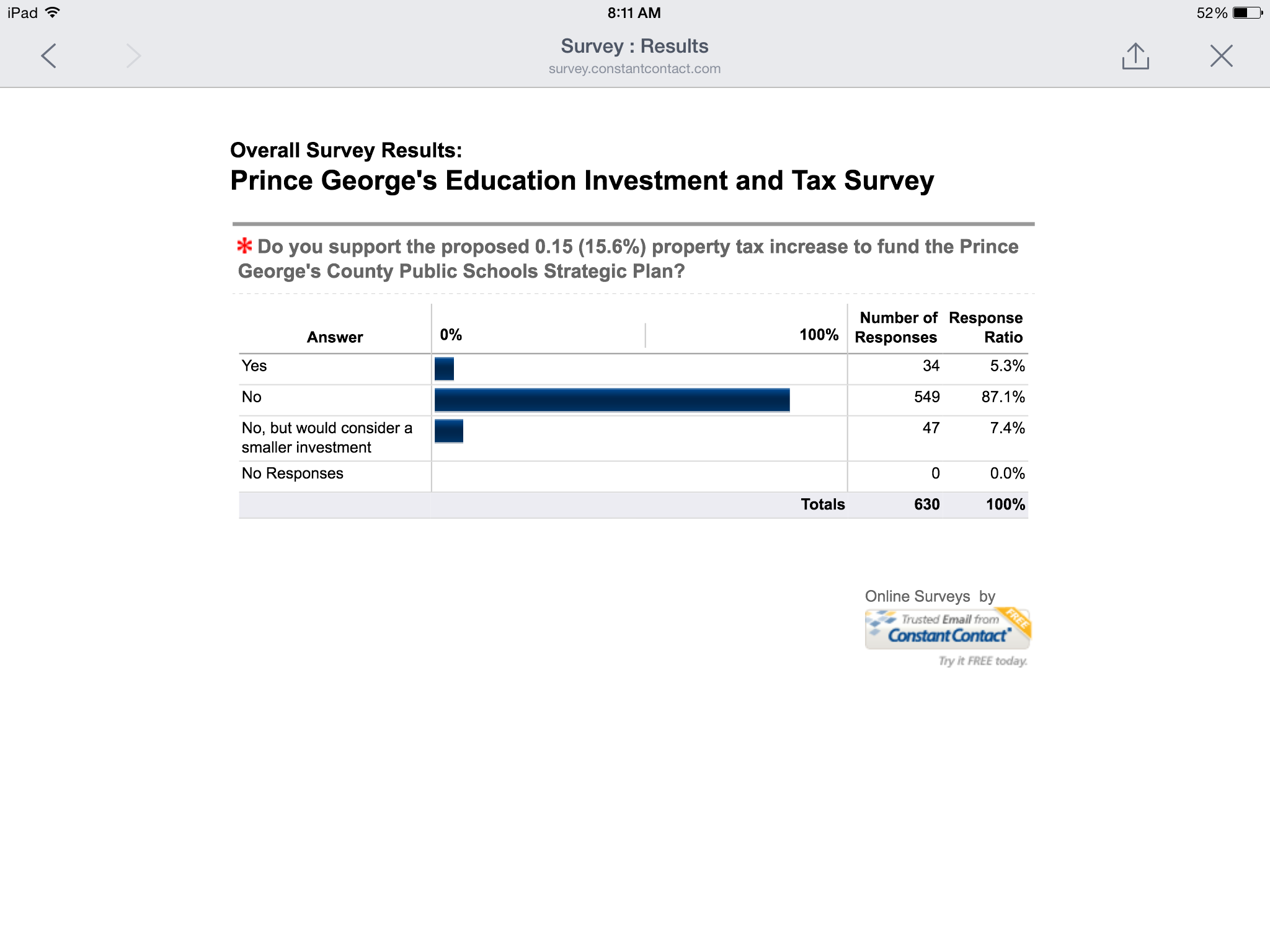
County Council Member Mel Franklin (Democrat, District 9, Council Chair) has invited residents to take a one-question, online poll regarding the proposed 15.6% property tax increase to fund Prince George’s County Public Schools. As of 8:11 am this morning, 549 out of 630 respondants answered that they opposed the proposed property tax increase. Only 5.3% of 630 respondants stated that they support the property tax increase outright, with 7.4% indicating that they would be willing to consider a smaller increase

While these numbers are certainly suggestive, we should be cautious about interpreting the survey results as representative of the views of county residents. Opponents of the tax increase have promoted the poll through social media and email. Hence the group of 630 respondants is far from being a random sample of voters; it is a self-selected group that may not accurately represent the opinions of voters in Prince Goerge’s County.

Screen capture of poll results.

Continue reading

15 Minute Minimum Recess in PGCPS Is Shortest in the Area

by Genevieve Demos Kelley

Some elementary school students in Prince George’s County have as little as 15 minutes of recess per day. PGCPS policy states that recess for students in kindergarten through fifth grade should be “no less than 15 minutes per day and for no more than 30 minutes per day.” (Middle school and high school students do not have recess.)

playground_6394.v01b.25percentIn a 2013 policy statement, the American Academy of Pediatrics has written about the “crucial role” of recess as an “essential, planned respite from rigorous cognitive tasks.”

The AAP does not recommend a specific number of minutes for daily recess. However, its recess policy statement notes that across the nation, “the length specified for recess ranges widely, from 20 to 60 minutes per day,” suggesting that a 15 minute recess is outside the norm.

Recess Policies of Nearby Districts

How does PGCPS’s recess policy for elementary schools compare with policies in nearby districts?

  • Montgomery County requires that recess for elementary school students be between 20 and 30 minutes.
  • Howard County elementary schools schedule a 30 minute recess into the school day.
  • Anne Arundel County Public Schools cites on its website the recommendation of the National Association for Sport and Physical Education (NASPE) that recess be at least 20 minutes per day. (Read the full NASPE statement here.)
  • Fairfax County elementary schools recently increased their scheduled recess to 20 minutes per day, after the recent move to a full-day schedule on Mondays.
  • DC Public Schools allow for a minimum of 20 minutes of recess per day in elementary school.

Continue reading

PGCPS Parent Urges School System to Look for Ways to Save Money

The following is a statement to be delivered by Tommi Makila at the Prince George’s County Council Budget Hearing on April 28, 2015. The views expressed are the author’s own and do not necessarily reflect the views of the owner of this website, Prince George’s County Advocates for Better Schools.

Good evening,

My name is Tommi Makila. I live in Accokeek, and my son attends Prince George’s County Public Schools. I am a PTA activist and heavily involved in my son’s school.

First of all, I consider improving our schools a high priority. Thus, I want to commend the County Executive for making our schools a high priority. However, I have serious concerns about the school budget proposal.

I believe the goals and strategies outlined in the County Executive’s school budget proposal make sense and seem likely to strengthen the school system and improve its performance. However, what seems to be lacking in the proposal is any serious effort to seek savings to fund the new proposals. When you ask for a significant investment in certain areas – significant enough to warrant a 15% property tax increase – I believe you also have the responsibility to look for meaningful savings opportunities in other areas of the budget. Our goal should be to try to minimize, or even eliminate, the need for a property tax increase. Just like any other organization, we will need to prioritize issues.

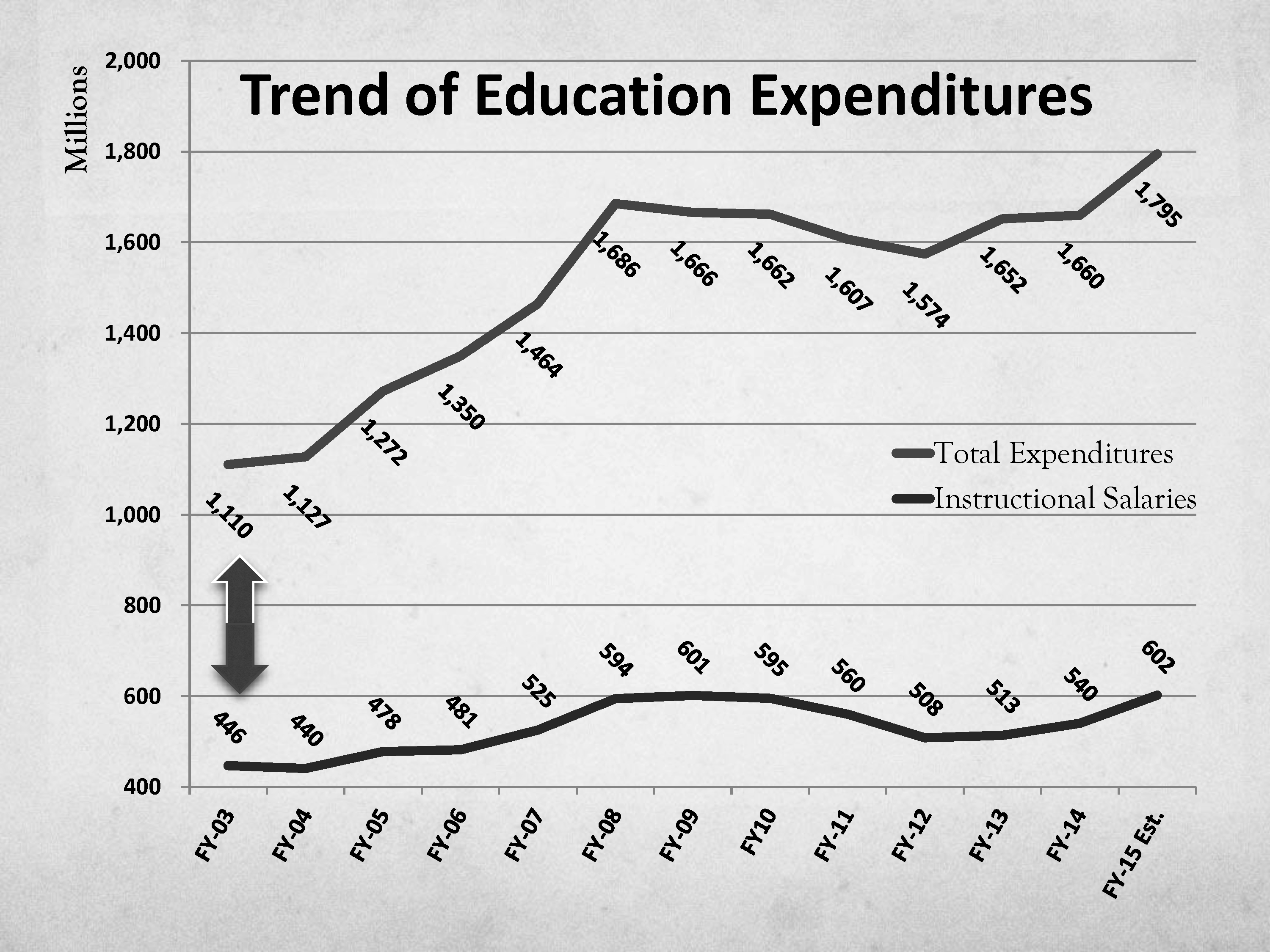
InstructionalExpendituresChart

Graph Credit: Tom Dernoga

To substantiate my belief that there is room in the school budget to prioritize items without sacrificing our investment in the classroom, I want to point out a couple of facts about the school budget. Between FY2003 and FY2015, total school system expenditures have risen by 685 million. During the same time period, instructional salaries have only risen by 156 million1.

Continue reading