Teacher Raises Questions About Grading and Reporting Changes

Natalie Barnes is a math teacher at a Prince George’s County middle school. The views expressed are the author’s own and do not necessarily reflect the views of Prince George’s County Advocates for Better Schools.

by Natalie Barnes

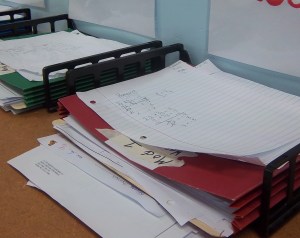
100_3373As a middle school math teacher, I wholeheartedly support some of the thirteen recommended changes to the grading and reporting policy. Teachers should provide a syllabus (recommendation #6), use approved grading systems (#12), and grade and return student work within ten school days (#9). Similarly, administers should ensure that grading is applied uniformly (#13). These seem to be teaching practices that are already common among quality educators.

Yet, there are some policies with which I disagree. Regarding behavior, attendance,and grades (#2 & #3), Gorman Brown explained during the June 9th Board of Education work session (at 40:35 in the video) that grading should be based on course standards. Yet, the mathematical standards include “use appropriate tools strategically”and “critique the reasoning of others” (Standards for Mathematical Practice). From a teacher’s perspective, if a student is throwing rulers across the room or refusing to participate in a lesson, they are failing these standards. During class discussions, Socratic seminars, or classwork in general, what grade should be given to students who do not participate appropriately? That said, a rubric or other more objective scale should be used to reduce subjectivity, but behavior is an important part of a student’s classwork. When asked about the role of participation in grading, Dr. Shawn Joseph responded that “participation is not part of our administrative procedure” (1:02:03) so it is unclear as to how this impacts behavior (1:03:14).

I also have concerns, as do many others, about the uniform minimum grade of a 50%
provided students put forth a good faith effort (#1 & #4). Even though “good faith effort” has been defined by the panel as “any assignment in which a student completes at least 50% of the required content,” this still leaves a great deal of room for subjectivity. As a math teacher, I have seen students write down random numbers and assume that this is quality work deserving of a 50%. Like Board member Ms. Perry (1:18:30), I wonder if only expecting students to turn in work half done is reinforcing good work ethic. Furthermore, I question, as does Board member Edward Burroughs (1:32:45), whether this practice actually prepares students for life beyond high school, including college. True, research shows this helps students avoid giving up. However, in my experience, it also enables students to put forth only a minimum effort.

Lastly, the policies for make-up work are of great concern to me (#3 & #10). I am supportive of make-up work and have my own procedures for it within my classroom. But I do not think a uniform sliding scale is appropriate for the entire county. Each classroom and subject area has different needs. Even within my own classroom, the policy for homework is different from that of projects and classwork. For example, I assign five equations to solve for homework, which are due the following school day; I walk around the room and check for completion. After assigning their completion grades, we review the problems as a class. Should students who did not do the homework be allowed to turn it in for a 95% just by copying down the work and turning it in that day? I think not.
Continue reading

Parent Calls for Improvement Plan Instead of $120k Survey

Lori Morrow presented a version of this testimony during the public comment portion of the May 12th Board of Education Meeting. The views expressed are the author’s own and do not necessarily reflect the views of Prince George’s County Advocates for Better Schools.

by Lori Morrow

A few weeks ago, I watched the April 28th Board of Education meeting at home and
was surprised to hear about a $120,000 survey to determine community
perceptions of PGCPS. I agree with comments made by some board members that
night: We already know many of the negative perceptions that persist from existing surveys.

IMG_0510A few months ago, I noticed each of the school pages on the PGCPS website includes a link to the 2013 School Climate Survey, as well as a note indicating the next biannual survey would be published in Fall 2015. I recall getting an email to fill out the survey last June, and know that my son participated in a survey this school year.

I’ve been attempting to get a copy of this climate survey report and, after more than two months and many emails, I was finally able to access a copy of the report this very morning from a helpful staff member in the Research and Evaluation Department. I was particularly interested in the report for my son’s middle school because of comments I regularly hear from him. While a quick comparison with the 2013 report does show some improvement for the school, a number of areas are rather disappointing.

For example:

  •  31% of Parents disagree with the statement that they are proud to send their
    child to this school
  • 31% of Parents do not believe that teachers will provide students individual
    attention if needed.
  • 44% of Students disagree with the statement that they feel safe in school.
  • 61% of Students do not believe that students respect the authority of
    teachers at this school.
  • 54% of Students do not feel like they are an important part of their school
    community.

Continue reading

Join Effort to Keep School Board Elections Nonpartisan

by Tommi Makila

The views expressed are the author’s own and do not necessarily reflect the views of Prince George’s County Advocates for Better Schools.

By law, Maryland school boards are to be nonpartisan. With the reorganization of the Prince George’s County Public Schools governance structure in 2013, the Board of Education was stripped of much of its power. However, this takeover of the school system has not been enough for the political establishment. Our partisan elected officials are shamelessly meddling in the school board elections through their endorsements and slates, making these elections “nonpartisan” in name only.

Politicization of the school system and the school board is not in the best interest of our students. In a well-governed school system, decision-makers feel more accountable to voters than to the political establishment and its agenda. But party endorsements of school board candidates undermine this principle, shifting the balance of power away from the voter and toward the party establishment.

To combat this corrosive influence, a group of concerned citizens is launching an effort: the “Alliance for Nonpartisan School Board Elections.” Our goal is to educate residents about the issue and mobilize advocacy efforts. We call for political parties to keep school board elections nonpartisan by refraining from endorsing Board of Education candidates or putting them on party slates and sample ballots. As the first step for the Alliance, we have established a Facebook group as a way of connecting interested individuals with each other. If this is an issue you care about, please join the group! You can find it through this link or by searching for “Alliance for Nonpartisan School Board Elections” on Facebook.

Continue reading

Please Send Us Your Stories

100_3401We want you to write for us! Send your original content to Genevieve Demos Kelley at pgcabschools@gmail.com. If we like it, we’ll publish it on this blog.
Your story may fall into one or more of the following categories:

  • Opinions. (Go here, here, and here for examples.) Opinion pieces must take a respectful and reasonable tone and must be grounded in documented evidence. Constructive criticism of ideas, policies, and practices is welcome; character attacks are not.
  • Personal narratives. (Go here, here, and here for examples.) We want to read about your experiences — good and bad — with Prince George’s County Public Schools. Stories should not focus on one particular school, unless the narrative is instructive for the larger PGCPS community. Some pieces are a mix of story telling and opinion (like this one, for example). That’s fine.
  • News, information, and analysis. (Go here, here, and here for examples.) Almost any topic is fair game, as long as it is directly tied to PGCPS and follows the guidelines below.
  • Positive pieces. (See here, here, and here for examples.) We love publishing stories that put our schools in a positive light. Keep the good news coming.

Some points to keep in mind:

Continue reading

Asking for a Culture of Kindness in Our Schools

by Christine D.

20151113_152926This morning as I brought my daughter into school, I saw a boy pulled aside by the teacher supervising the arrivals. He had been pushing the smaller children on the way through the door, it seemed, and was being spoken to in no uncertain terms. Another parent nodded in approval and said that he had also been pushing on the bus. He was in big trouble.

I didn’t see whether he was pushing in thoughtlessness or exuberance or out of a desire to hurt the smaller children, but I think the last is the least likely. Obviously, moving him to the side was a good way to resolve the issue for the moment. Speaking sternly to him about it was probably seen as the best way to ensure he might think twice about doing it again tomorrow.

I walked my daughter down to her classroom. When I came back up the corridor, the same teacher was just finishing off a diatribe to the same boy. I heard her end brusquely with “And there’s no need for crying. Now go to class. Go on.”

The boy shuffled slowly away from her and towards me, being passed by faster, happier children, his face a mask of misery. He wiped his eyes with the sleeve of his coat. He looked utterly downtrodden. My heart broke for him: I wanted to hug him and tell him it would be okay, that he’d remember to be gentle with the smaller children tomorrow and that school isn’t a place where people just yell at you and assume you’re being bad on purpose. He didn’t know me, though, so all I did was touch his shoulder as I passed.

Continue reading

Thoughts After a Boisterous Hearing on School Closings and Boundary Changes

by Tommi Makila

The views expressed are the author’s own and do not necessarily reflect the views of Prince George’s County Advocates for Better Schools.

The Prince George’s County Board of Education’s Public Hearing on Boundary Changes and Proposed School Consolidations on February 23, 2016 was an amazing and wild affair. If you were not able to attend the hearing, you may view a recording of it online.

The hearing was eye opening and thought provoking. The issues that generated the most comments were the proposed closures of Forestville High School and Skyline Elementary, as well as boundary changes in the Accokeek and Fort Washington areas.

As I was sitting at the hearing, many thoughts came to mind. It is hard to organize those feelings into a chronological narrative, so I am providing the following rather random list of thoughts:

  • CEO Kevin Maxwell did not attend the hearing. Yet, since 2013, when the school board was restructured (see Maryland House Bill 1107), it is the CEO — not the Board of Education — who has authority to close schools. Moreover, it was the CEO who introduced these proposals for school consolidations and boundary changes (see p. 17 of this document) to the Board of Education. It was a surprise not to see him there.
  • Sometimes people power works! The hearing was one of the most powerful public hearings I have ever attended—powerful enough to push the BOE to postpone all boundary decisions until next year. But residents and parents only seem to get involved when these kinds of drastic problems come up, issues that dramatically impact their children and families. In many ways this is natural, but we need to be engaged at other times too.
  • We need to keep the needs of our students first and foremost. The Skyline Elementary closure proposal was the most striking example of student needs getting lost in the shuffle. Skyline has a large population of autistic kids, and parents convincingly argued that the school provides high-quality services for them. Testimony from the Skyline parents was heartbreaking. It is obvious that we must find a way to maintain the existing special services for these kids.
  • Schools are important for communities. When we are looking at school closures or major boundary changes, we must work with the impacted communities and always try to find community solutions. Try to keep Accokeek students in Accokeek, Ft. Washington kids in Ft. Washington, Forestville in Forestville, and so forth. I believe that for local schools, strong community support and school pride are factors in their success.
  • When looking at school closures and boundary changes, central office personnel comes up with solutions that look fine on their spreadsheets and maps. But they may not be such great solutions for the people impacted. It is the responsibility of the CEO and Board of Education (BOE) members to work with communities to really understand all the issues and find the best solutions.
  • The process for handling these issues—school closures and major boundary changes—must be longer. While some community hearings on these issues were held in early December 2015, no specific plans were shared at that time. The first time actual proposals were made public was when the CEO presented his recommendations at the January 21 BOE meeting. The public hearing was held on February 23, and the BOE vote was originally scheduled for February 25. Considering the impact these changes have on communities, the process must be much longer and entail significant outreach and collaboration with local communities.

Continue reading

Prince George’s County Parents Speak up About Recess

The following opinion was presented by LaShayla Clark, one of four Prince George’s County parents who spoke during the public comment portion of the February 25, 2016 Board of Education meeting about the need for longer recess. You may view Ms. Clark’s comments beginning at 1:21:58 in the video below.

Good evening. Thank you for the opportunity to speak about the topic of recess. Two and a half years ago, my husband and I decided to move our family from Georgia to Maryland with the hopes of our children receiving a high quality education. Despite what we heard regarding education in Prince George’s county, we looked for a school that was ranked high and bought a home a little over a year ago. I have three small children, a four year old, a two year old and a 7 month old. My oldest will be starting school this fall.

Recently, my eyes have been opened to a number of issues that reside with our county’s school system. Many of the families that I have met here are planning to home school their children or send them to private school. One of those parents who send her children to private school said, “Our children will be done with school by the time they fix everything.” Nevertheless, I believe that my children can and will receive a great education in Prince George’s County and so I am here to ask you to consider research based policies for our school system.

It was while visiting schools, that I asked an administrator how much time the students have for recess. She told me 15 minutes. I was in shock. She went on to say that Prince George’s County schools require 15 minutes. I have since learned that each school has an option to allow up to 30 minutes of recess a day. However, many schools only provide the minimum. I recently spoke to a principal in Prince George’s County who increased the time of recess at her school. I learned a couple of things in my conversation with her. One is that she wants what is best for all of her students. Two, she wants her school to aim for the Bronze level for the Healthy Schools Program, which encourages at least 20 minutes of recess per day.

Continue reading

Alternatives to School Closings: One Resident’s View

The following is written testimony submitted by community member and longtime youth advocate Denise Joseph in advance of tonight’s Public Hearing on the proposed boundary changes, and school consolidations. The views expressed are the author’s own and do not necessarily reflect the views of Prince George’s County Advocates for Better Schools.

Greetings,

I would like to provide some ideas and suggestions as testimony for upcoming school decisions to be considered to help improve schools:

I would like to see PGCPS apply for grants to renovate and improve schools. Some grants to be considered are from the Gates Foundation, Microsoft, U.S. Department of Education or other organizations that specialize in grants for CIP funding.

I propose that Fort Washington Forest Elementary should become an ESOL or Spanish Immersion School to help populate the school so that it does not have to be part of the consolidation plan. I think that you should also consider a home school partnership program to help with the under enrollment, since the home school population is high in this area.

Please consider creating a middle years program at Stephen Decatur Middle to help with the enrollment and reduce the overcrowding of nearby schools.

I would like to see the creation of a 6-12 grade model, secondary school at Friendly High School, similar to Hayfield Secondary in Fairfax County Public Schools

Bring back the military academy to Forestville High School and make it a military career academy and partner with several branches of the military and possibly Andrews Air Force base. You can also partner with colleges that specialize in the military like VMI and Navy to encourage high school graduation and help students to become college and career ready. This will help with enrollment but will also help capture a portion of the students that might not go directly to college after graduation or drop out before graduating. This in turn will help the Prince George’s economy and tax base and provide hope to students that feel hopeless and trapped, because they feel like their only option is college.

Continue reading

Maryland Legislative Session: The Kindergarten Readiness Assessment

The following is a testimony given by Genevieve Demos Kelley at the Maryland House of Delegates Ways and Means Committee Public Hearing on February 18th, 2016, in support of House Bill 657, a bill that would limit the Kindergarten Readiness Assessment to a random sample of students. The views expressed are the author’s own and do not necessarily reflect the views of Prince George’s County Advocates for Better Schools.

Image 2-20-16 at 4.28 PMThank you for giving me the opportunity to speak in support of HB 657. I am a mother of two boys: a seven-year-old in the Prince George’s County school system and a four-year-old who is still in preschool.
My older son started kindergarten in the fall of 2013, one year before the Kindergarten Readiness Assessment was implemented statewide. I vividly remember the mix of anxiety and excitement that we both experienced as I took him to his classroom and then said goodbye. Of course I wanted him to learn to read and and to write, but most of all, I wanted him to learn to love learning, to learn to love school. And he did! He was fortunate to have a teacher who sparkled in the classroom. Her lessons were engaging, and she cared about her students. I was confident that my son was in good hands.

The next school year, as my son was adjusting to first grade, I kept hearing the same complaints from parents in my community whose kids had just entered kindergarten: Their children were underwhelmed, and they did not understand why the kindergarten teachers were so frequently absent.

Eventually, an article in the Washington Post and a quick google search led me to MSEA’s Report and Recommendations on the Kindergarten Readiness Assessment. I learned about the terrible disruption to the classroom that this new test was causing, as teachers were required to administer a one-on-one test to every child in their class. Hundreds of teachers had responded to MSEA’s survey, and I found pages and pages of heartbreaking comments from teachers — teachers who felt that they were no longer able to do their jobs effectively during the critical first few weeks of school.

Continue reading

Sound Off: PGCPS Parents Share Top Concerns

At a recent community event , we asked participants to jot down what theyIMG_6404 thought were the top concerns facing Prince George’s County Public Schools. They wrote their ideas on sticky notes and posted them anonymously on a poster board.

The answers we got are listed below. These are unedited and in no particular order.

Readers, what would you add to our list? Tell us in the comments section.

  • Low rankings.
  • Community detachment.
  • Lack of link between school and jobs.
  • Lack of community confidence in the schools.
  • Some great specialty programs, but “comprehensive” students and regular neighborhood schools seem to be falling through cracks.
  • Lack of youth and parent engagement to help students succeed or prepare them for their next steps.
  • Parents have to struggle to get needed services for their kids.
  • Lack of community schools.
  • Poor communication between PGCPS and parents.
  • Not enough teacher input when decisions are made.
  • Poor communication between schools and families.
  • No entrepreneur academy for vocation and alternative career youth.
  • Abuse in public schools.
  • No oversight or follow-up to abuse complaints.
  • Teachers are overwhelmed/pulled in, a lot of directions/exhausted, etc.
  • Lack of community schools.
  • Too much standardized testing.
  • What about the children?
  • Seeking progressive education models.
  • Full state funding for schol projects/programs
  • Better engagement between the school district admin and BOE with the parent and private sector community.
  • More transparency.

Continue reading