
by Carmel Jones

Eighteen schools in Prince George’s County were evaluated this year to receive green stormwater retrofits as part of the county’s Clean Water Partnership (CWP), a $100M public-private partnership with private company Corvias Solutions, to retrofit 2,000 impervious acres with green infrastructure in order to achieve regulatory compliance.
The CWP Schools program, designed to assist Prince George’s County Public Schools (PGCPS) with treating and managing stormwater runoff through the application of Best Management Practices (BMPs), will guarantee that PGC’s federal stormwater standards are met, while also providing an educational legacy for future generations committed to improving the water quality in our communities.
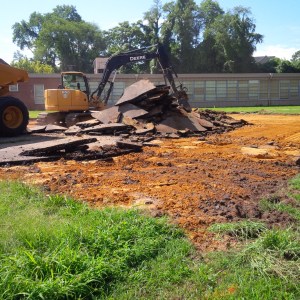
The program includes an educational component, and select schools will receive instructive signage, educating students about the benefits of managing stormwater runoff and displaying how installed BMPs will perform at each site. At the end of the summer, students and faculty from the schools will also have an opportunity to participate in a volunteer tree planting session that will support the installed BMP devices. These educational learning sessions will take place during school hours and will give students a hands-on experience in preserving our environment.
The initial eighteen schools identified to participate in the program include elementary, middle, and high schools in Prince George’s County. These schools include:
- Bond Mill Elementary School
- Calverton Elementary School
- Capital Heights Elementary School
- District Heights Elementary School
- Frances Scott Key Elementary School
- Friendly High School
- Gwynn Park High School
- High Point High School
- John Hanson Montessori
- Laurel Elementary School
- Magnolia Elementary School
- Oxon Hill Middle School
- Parkdale High School
- Potomac High School
- Rosa L. Parks Elementary School
- Scotchtown Hills Elementary School
- Templeton Elementary School
- Walker Mill Middle School
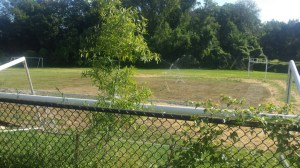 In the initial phase of the program, each school was given an individual plan, which included a customized package with pictures and concept designs, as well as a dialogue to help each school understand the purpose of the BMP devices. The retrofit needs for each school were pre-identified by the school’s students, faculty and maintenance staff, and customized to fit the unique needs of each facility. Since then, various types of BMPs, including bio-retention cells, sand filters and swales, to name a few, are now being installed by local workforce on the outdoor grounds of each location to capture and treat previously untreated stormwater runoff from the sites impervious surfaces.
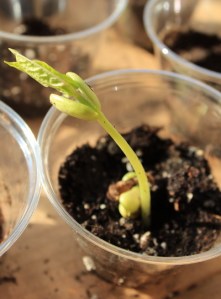 A few years ago parents of the PTA at our neighborhood elementary school started talking about adding some landscaping to the school grounds. The principal liked the idea of a pollinator garden in front of the school. There was also an abandoned courtyard garden that had been started with a grant by a teacher who was no longer at the school. We wondered if that could be revived.
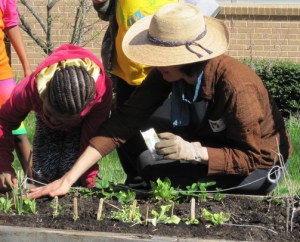 I started taking a small bucket and gloves to school every day and weeding during drop-off and pick-up for 10 minutes. This generated conversation, awareness, and new volunteers among the other parents. We asked for parents to bring in flowering perennials from their gardens to plant in the new bed. Some dads brought mulch in their trucks. We visited a few other schools that had gardens to learn about what they were doing.

 Prince George's County Advocates for Better Schools