Weekly News Roundup: Financial Literacy “Mini-city” Opens, Low PARCC and NAEP Scores

After a student filmed a PGCPS school bus driver texting while the bus was in motion, PGCPS is changing its transportation discipline handbook so that drivers who misuse cellphones on a school bus can be fired. (NBC 4)

A new financial literacy center opened Tuesday on the campus of G. James Gholson Middle School. The Prince George’s County Junior Achievement Finance Park is a partnership with PGCPS, Capitol One, and Junior Achievement of Greater Washington. It is a 13,500 square foot experiential learning center that will serve 9,000 students per year. Students visiting the center will take on a role (e.g. career, salary, financial obligations) and, using a digital tablet, put their financial skills to the test in a “mini-city” with storefronts and kiosks. (PGCPS)

Columnist Michelle Singletary writes of the need to be wary of conflict of interests in financial literacy programs. (Washington Post)

An Eleanor Roosevelt HS freshman writes an opinion piece for the Washington Post, questioning whether extracurricular activities should affect college admissions. (Washington Post)

At Central High School, a student’s cell phone went missing, and campus security searched the binder and book bag of every student in the class. Now the family of one of the students who was searched has filed a lawsuit, claiming that the search was illegal. (Washington Post)

Continue reading

Clara Yancey Named New Acting Principal at Dora Kennedy French Immersion

The following is a letter written to parents of children at Dora Kennedy French Immersion School dated October 27, 2015. Note that the letterhead reflects the former name of the school, Robert Goddard French Immersion. The school was officially renamed this year.

DoraKennedyLetter10_27_15

The content of the letter is transcribed below:

October 27, 2015

Dear Members of the Dora Kennedy Community:

In recent days, some of you may have participated in discussions or viewed media reports surrounding allegations of student abuse at Dora Kennedy French Immersion. I’m writing to you today to share the steps we are taking to address this situation.

First, please know that PGCPS continues its full investigation into the alleged incidents. While I would like to provide you with the details of the exact steps we have taken, I am bound by the district’s confidentiality measures that are designed to protect both the families and the employees involved. If information becomes available that we can share, you have my committment that I will do so in a quick and transparent manner.

Second, effective immediately, Mrs. Clara Yancey will serve as acting principal of Dora Kennedy French Immersion. We feel it was best to make this change, so that we can be assured we are moving forward on a path that is guided by fairness, integrity, and transparency for everyone. Mrs. Clara Yancey is a retired principal from Prince George’s County Public Schools with a distinguished and proven record as an effective instructional leader. She is a seasoned administrator with decades of professional experience and extensive expertise across a full suite of academic disciplines. Please be assured that the academic environment will continue to thrive Mrs. Yancey’s leadership.

Continue reading

When Teachers Hit Children, Part 2: Responding to Suspected Abuse

Alana Cole-Faber shared her story with us last week in “When Teachers Hit Children: One PGCPS Parent’s Experience.” In this post as well as in the previous post, she writes from the basis of her personal experience as a parent, not as a legal proffessional, child psychologist or expert in abuse.

by Alana Cole-Faber

As I have shared in a previous post, last year our children reported to us that they had experienced physical and emotional abuse at their school. When our children first reported this to us, we were alarmed and terrified. We had so many questions. What should we do? Whom should we tell? Are we the only ones? What will happen when we report this? Will there be retribution against us or our children?

We are not experts on abuse or child psychology, so we would always recommend consulting an expert when it comes to concerns of abuse and have done so ourselves for the sake of our own children. However, based on our experiences, these are the actions we would suggest to other parents whose children may have experienced abuse at school.

At Home

1. Aim for prevention. Talk to your child about what behaviors are not appropriate from teachers and classmates. Tell your child exactly what they should do if they believe a teacher or classmate is behaving inappropriately. Repeat this conversation regularly, and be sure to give your child the opportunity to ask questions.

2. Create an environment in which your child feels secure and knows that he/she can come to you with problems. We made a rule with our children that if they got in trouble at school and were punished at school, we would not punish them at home as long as they told us the truth about what had happened at school. This did not mean we did not care about misbehavior, but rather that we placed more emphasis on honesty and openness in our home. We believe this was the critical thing that made our children feel comfortable talking to us after our son was struck by his teacher.

3. Keep an eye on your child’s behavior. If your child’s behavior or attitude towards school changes suddenly, this could be a sign that your child has had a negative experience. This negative experience might simply have to do with finding school work more challenging, or it might be an indicator that something more serious has taken place. In our children’s case, their attitude toward school changed dramatically almost overnight. They began asking to stay home, whereas before they had always loved going to school and would barely take a moment to hug us goodbye before running off to join their class.

4. Talk to your child about his/her experiences at school. When you talk to your child about school experiences, try to talk to your child alone, without siblings or others present who may distract or otherwise influence your child. It may help your child relax if you talk while doing another activity that he/she enjoys, such as putting together a puzzle or coloring. One of our children was always very comfortable talking about experiences, but our other child felt most comfortable having a stuffed animal tell us what happened. Ask open-ended questions whenever possible and avoid asking leading questions, even if you think you know exactly what happened during the incident in question. Try to remain calm and avoid reacting emotionally to the things your child describes. If your child describes an event that alarms you, calmly ask questions like, “What happened next? What did the teacher say? Who else was there?” Reassure your child that he/she is not in trouble for reporting information to you. In our experience, it took multiple conversations before our children were willing to reveal all of the details of the event.

5. Do your best to help your child identify and understand his/her feelings about the event. Validate any feelings your child may have. You can try saying something like, “You said that behavior made you feel sad. I understand. I think I might feel sad, too, if something like that happened to me.”

Continue reading

Weekly News Roundup: Tragedy in Oxon Hill

A 14-year-old Oxon Hill teenager was fatally stabbed on Monday as he tried to protect his mother, who was being held at knifepoint by her boyfriend. His 18-year-old brother was also injured in the attack. Keyshuan Mason was a freshman at Potomac High school, and his family has seen an outpouring of support from the school community. (Washington Post)

Five were injured when a school bus and a pickup truck collided in Brandywine on Friday. Fifteen children were on the bus when the accident occurred. One student, the driver, and three others were injured. None of the injuries were life threatening. (WTOP, ABC 7)

Prince George’s County Public Schools is expanding its commitment to integrating arts with core academic subjects like math and English. The five-year plan is to expand the program to all schools in the system. (CBS DC)

A student recorded a cellphone video of a PGCPS school bus driver texting while the bus was in motion on the way to James Madison Middle School. The bus driver is still employed but is under investigation and may be temporarily suspended with the right to appeal. Changes in the PGCPS policy to include termination in the future are under consideration. (WTOP)

Continue reading

When Teachers Hit Children: One PGCPS Parent’s Experience

Alana Cole-Faber, a parent with children in PGCPS, has shared her story here, with the hope that any other parents who have had similar experiences will come forward and work for positive change. You may contact Ms. Cole-Faber at pgparentscircle@gmail.com

by Alana Cole-Faber

In August of 2014, my children began school at Dora Kennedy French Immersion School (formerly Robert Goddard), one of PGCPS’s Specialty Schools. Having completed a successful year of preschool, our children were so excited to finally be attending “real school” with the big kids. We felt incredibly fortunate that we had won the lottery and that our children would have the privilege of attending a National Blue Ribbon school. We have moved a lot as a family, and as parents we were looking forward to settling down in Prince George’s County and getting to know our new community, the teachers, parents, and the school system in general. Instead, we have spent a large portion of the last year dealing with an appalling problem.

In October 2014, our children came home and told us that my son had been spanked at Dora Kennedy French Immersion School. We were stunned. We immediately separated and interviewed our children to find out what had happened and to be sure all of the details of their stories matched up. The children told us that my son had been jumping up and down while the class was singing, so the teacher asked the class to tell her which child had misbehaved and deserved to be punished. The majority of students pointed to my son, so he was called to the front of the class and struck until he cried. I asked my daughter if she thought our son had been hit hard, and my daughter said, “The teacher hit him hard, but she hits another boy even harder.”

My children then went on to name three other children who had been struck by their teacher during the year. (Corporal punishment is illegal in public schools in Maryland. Even so, it is worth noting that we had never received so much as a note home from this teacher to say that our son had misbehaved in class.)

The next morning, we went to the school to report the abuse. We spoke to a supervisory staff member at the school first. The supervisor listened to our story, then left to remove the teacher from the classroom and sent in a security officer to take our written statement. It was explained to us that any time there are allegations of abuse or harassment, a written report is sent to the county for investigation. It was also explained to us that this teacher would not be left alone with students during the investigation. We wrote a written report, including the names of the other children who had been struck. We also asked that our children be moved to other classrooms, just in case the teacher were allowed to return to the classroom following the investigation.

Continue reading

What’s Working: Great Teaching in Second Grade

by Genevieve Demos Kelley

My son is enjoying his second grade year so far, and I am impressed with the learning that is happening in his class. Here are some instructional practices that seem to be working well:

Spelling pretests and posttests. There are no spelling groups in my son’s class (when I was that age, we had the “green apple group” and the “red apple group”), but there is certainly differentiated instruction. Instead of being grouped by ability, children are given a pretest each Monday on ten spelling words. Students who can spell at least eight of those words correctly are given a list of more challenging words to study that week (called the “star” list), while the rest of the class sticks with the original list (the “smile” list). This means that there is no rigid differentiation between good spellers and not-so-good spellers: A child might be on the “smile” list one week and the “star” list the next.

Moreover, the spelling lists for the upcoming week are included in the weekly newsletter, which is emailed to parents on Friday. This lets my son study the easier words before he takes his pretest on Monday so that he can be on the star list that week. This is his choice, not mine! Spelling has always been a struggle for him, and being assigned the challenging words after a successful pretest seems to be a big confidence booster.

Flexible spelling assignments. Each week, students choose three spelling activities from a list of nine and turn them in at the end of the week. There is a wide range of options (they change from week to week), and students are explicitly given permission to replace any of the activities with something else that is not on the list. Some of the activities are quick and fun (e.g. writing your speling words on your parent’s back with your finger) and some are more arduous (e.g. writing down the dictionary definitions). We always do a practice test as one of the three activities, whether or not it is on the list of options for that week.

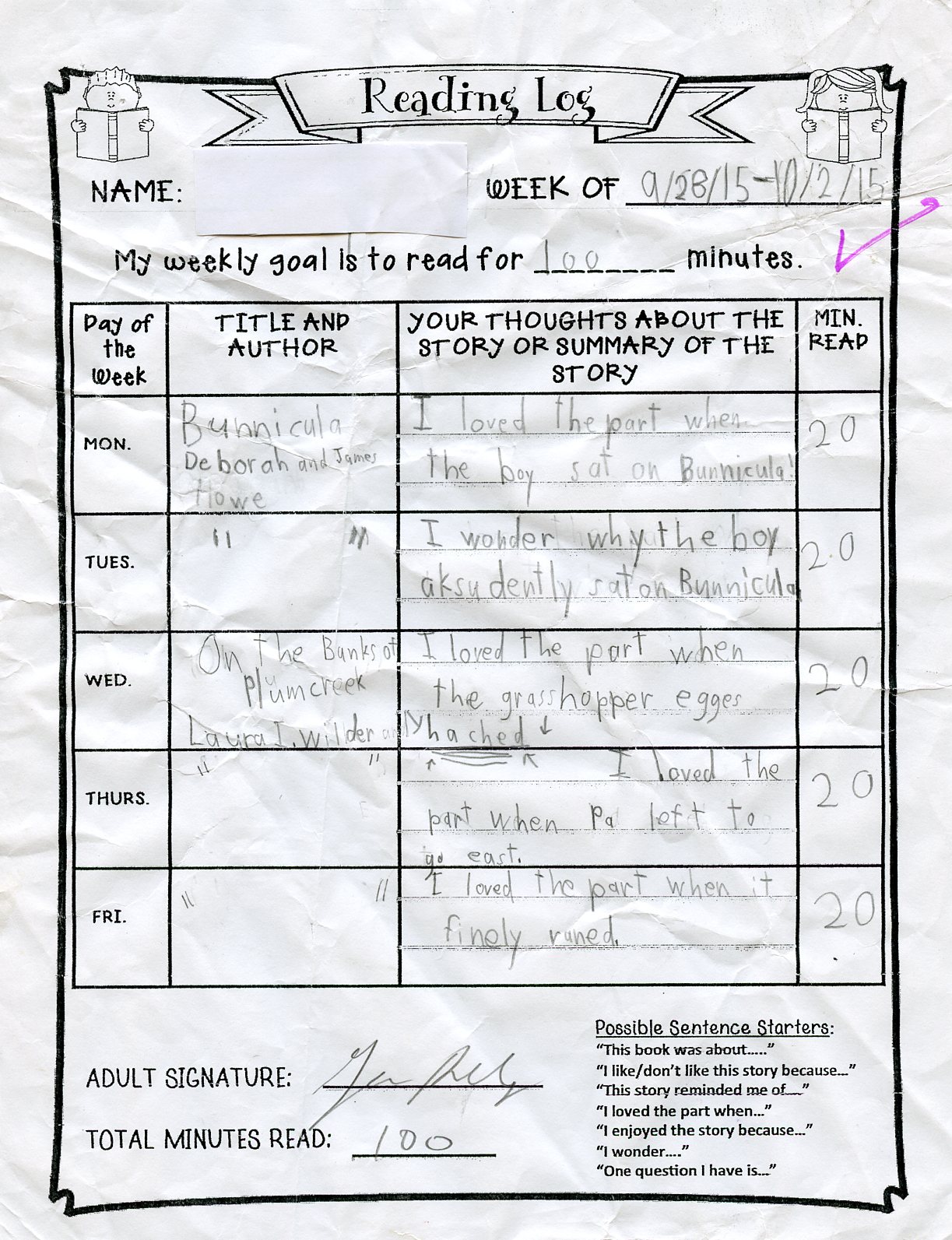
img116_readingLog

What day did he actually read Bunnicula? Who knows? But he is writing about books, and that’s what matters.

Flexible reading log. I have a hard time with reading logs. Though I understand that they are supposed to promote daily reading, I can’t stand the thought of timing one’s reading and keeping a record, as if reading is a chore to be endured. But the reading logs that my son completes each week are flexible enough that we can adapt them to our read-for-pleasure-with-abandon lifestyle.

  • For each day (Monday through Friday), there is a space for students to fill in the number of minutes that they’ve read, but we don’t keep track. My son just writes “20” for each day, though he usually reads for much longer.
  • He has to write one sentence per day on what he’s read, but the sentence can be anything at all, as long as it says something about the book. This really helps. My son needs practice writing sentences about what he reads, but at this point, he doesn’t need something overly prescriptive.
  • And here’s what really makes the reading log doable for us: We don’t worry about filling in the chart every day. My son does most of his reading before bedtime, and it would be extremely disruptive to have him fill out his reading log just before bed. Besides, reading is pure fun for him, and I don’t want the reading log — a task that he does not enjoy — to intrude on that experience. So he sometimes writes a week’s worth of sentences in one day. He still gets practice writing sentences about what he reads, but its not really a daily log anymore after we’re done with it. And that works better for us.

Continue reading

Weekly News Roundup: Construction Delays, Maintenance Concerns, Literacy Coaches, Openings for Bus Drivers and Nurses

Accokeek Academy middle school students thought that they would begin the new school year in a newly renovated building, but due to construction delays, they are still in portable classrooms. The Academy is a K-8 school, and the elementary school portion of the renovation was completed in 2014. However, the new HVAC system has not worked properly since the upgraded building opened. (Sentinel)

In a September 24 meeting, the Board of Education discussed the need for better maintenance of facilities and debated whether there is inequity between schools in the southern and northern regions with respect to the system’s responsiveness to maintenance needs. (Sentinel)

In 2014, only 12% of PGCPS students who took the SAT demonstrated college readiness, compared with a 41% of students in the state of Maryland. PGCPS hopes that literacy coaches in schools will help to change that. (ABC 7)

Arne Duncan’s departure as Education Secretary — happening in December — has been met with a wide range of reactions. The Washington Post publishes a roundup of reactions, from Duncan’s critics and supporters. (Washington Post)

Continue reading

Give Input on Next Year’s Budget at Oct. 13 Forum

by Genevieve Demos Kelley

CEO Kevin Maxwell and his team are already developing the Fiscal Year 2017 operating budget for Prince George’s County Public Schools and will present a proposed budget to the Board of Education some time in December. On Tuesday, October 13 at 7 pm, members of the community will have the opportunity to present testimony in the Sasscer board room regarding budget priorities for FY 2017. This public input will be shared with CEO Maxwell.

Speakers will be given two minutes to speak at the forum and must register by 4:30 p.m. on the day of the forum by calling 301-952-6001. Read more details in the Oct. 7 news release.

Wondering why we’re already talking about the 2017 budget? Here’s a quick review of the budget process:

  • The Fiscal Year 2017 budget actually goes into effect in 2016. It covers the period from July 2016 through June 2017.
  • The CEO and his team begin crafting a budget during the summer, a full year before it will go into effect. The CEO then presents a recommended budget to the Board of Education some time in December.
  • After work sessions and public hearings, the Board of Education adopts a version of the budget, using the CEO’s proposed budget as a starting point. Once the Board votes on the budget (probably in some time in February), it is known as the “requested budget” for the next fiscal year.
  • Why “requested”? Because the Board then sends the budget to the County Executive and County Council for approval. The County Council may or may not decide to fully fund the Board’s requested budget. (In the case of the FY 2016 budget, the Council gave PGCPS less than they asked for.)
  • Once the County Council has approved a spending level, the Board of Education must go through a process of reconciliation — making the budget fit the constraints set by the Council’s funding decision.
  • The Board of Education then votes to pass a final budget in June.

Weekly News Roundup: Health Director Placed on Leave, New U.S. Secretary of Education

Dr. Angela Wakhweya, PGCPS’s director of health services, has been placed on leave for reasons that are not entirely clear. School records indicate that thousands of students have not been properly immunized (NBC 4).

Related stories: Dr. Wahkweya discussed challenges of immunization and blamed PGCPS administration for failing to help her get the job done (NBC 4). Almost 2,000 students were not permitted to attend Prince George’s County schools on October 1, because they did not have up-to-date vaccinations on record (NBC 4).

Forty-one schools are participating in PGCPS’s arts integration program, where students learn academic concepts through visual art, music, and movement. PGCPS hopes to expand the program to all schools in the county within five years. (The video at WUSA 9 is a more complete story than the text below the video viewing window.)

Twenty-nine elementary schools will benefit from a federally funded grant of $911,200 aimed at helping students sample fresh fruits and vegetables that they might not otherwise experience (e.g. asparagus, star fruit). Schools will be given $50-75 to spend per student for a vegetable or fruit snack during the day. (PGCPS News Release)

Secretary of Education Arne Duncan will step down in December. President Obama has chosen deputy secretary John B. King, Jr. as his successor. King previously served as New York state’s commissioner of education, where he came under fire for implementing new teacher evalutions tied to test scores and for pushing the state to adopt new Common Core tests. King also has a background in charter school leadership. (Washington Post)

Continue reading

Sixth Grader Excited about Composting, Gardening, and Recycling at School

Berwyn Heights Elementary has been certified as a green school by the Maryland Association for Environmental and Outdoor Education (MAEOE). One student member of the school’s environmental club wrote about how Berwyn Heights Elementary runs a successful composting and gardening program.

Hi, I’m Zada and I’m in 6th grade at Berwyn Heights Elementary School in Prince George’s County. I’m a member of the school’s environmental club for the second year now. In the environmental club we do many activities. Some things we do are composting, recycling, and trying to be as green as possible!

Composting was the main thing we did. We would compost every week last year. This year we have buckets for compost in the lunchroom and outside classrooms. Every day some sixth graders, including me, collect the buckets from the cafeteria and classrooms and empty the compost. It is later dumped into a larger compost bin that is located outside of our school. In the compost we put in greens and browns. Greens are things like apple cores, banana peels, orange peels, coffee grounds, egg shells, and salad without dressing, cheese or meat. Browns are things like leaves, grass clippings, and hay. Meat, cheese, dressing, and large sticks and twigs cannot be composted. The ratio is every bucket of greens needs three buckets of browns.

When we began composting last year, we only collected food scraps from breakfast. It took us a long time to fill our large compost bin outside. When we finally filled it, we mixed it up really well and then let it “cook.” While it “cooked” (which was really just sitting there breaking down), we took the temperature of it a few times a week. When it was really breaking down the temperatures got as high as 130 degrees! Once during the cooking process, we pulled everything out, mixed it again and then put it back in the bin.

Continue reading